Finding the right resources after that moment matters enormously. The wrong content sends you back to productivity frameworks designed for someone else's brain. The right content feels like someone finally speaking your language.
This guide covers the top podcasts for women navigating ADHD, what to look for when evaluating wellness resources, and holistic approaches that support nervous system health, hormonal awareness, and whole-person wellbeing — not just focus and task management.
Key Takeaways
- ADHD in women more commonly presents as inattentive-type — chronic disorganization, emotional overwhelm, and internal restlessness — not hyperactivity
- Hormonal shifts during PMS, perimenopause, and postpartum can measurably worsen ADHD symptoms
- Women are diagnosed an average of 5 years later than men, often after years of anxiety or depression treatment
- Effective ADHD support for women centers on identity healing and nervous system regulation alongside productivity
- Combining podcasts, peer community, coaching, and holistic practices creates a more resilient support system than any single approach
Why ADHD Often Goes Unrecognized in Women
The Inattentive Presentation Problem
ADHD in women rarely looks like the restless, disruptive child that shaped the diagnostic criteria. More often, it shows up as:
- Chronic disorganization despite genuine effort
- Difficulty initiating tasks, even ones that matter
- Emotional overwhelm that feels disproportionate to circumstances
- Internal restlessness with no outward sign
- Hyperfocus on some things, complete inability to engage with others
These patterns get misread, consistently, as anxiety, depression, or burnout. Research from ADDitude's 2024 analysis found that women with inattentive ADHD had prior anxiety diagnoses at rates of 17–26% and prior depression diagnoses at 13–18% before their ADHD was identified.
Masking: The Hidden Cost of Coping
Many women develop well-practiced coping strategies that hide executive dysfunction from others and from themselves. Common masking behaviors include:
- Over-preparing for meetings to compensate for focus gaps
- People-pleasing to avoid the conflict that disorganization creates
- Using social mirroring to appear put-together when internally chaotic
A 2023 systematic review confirmed that women frequently mask ADHD symptoms by overworking and compensating, which delays recognition because impairments are less externally visible.
The result: a mean ADHD diagnosis age of nearly 29 years for women, compared to 24 years for men, despite no meaningful difference in age of symptom onset.
The Hormone Connection
Estrogen influences dopamine pathways, which means hormonal fluctuations aren't just mood events — they directly affect ADHD symptom intensity. Women often experience noticeable worsening during:
- The luteal and premenstrual phases — when estrogen drops and progesterone rises
- Postpartum : a Monash University survey found 70.4% of respondents perceived ADHD symptom worsening after childbirth
- Perimenopause : a 2025 cohort study found 54.2% of women with ADHD experienced severe perimenopausal symptoms, compared to 30.1% of controls
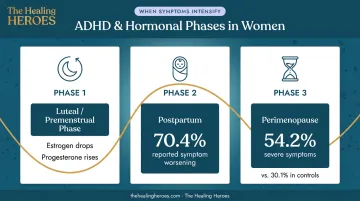
For many women, perimenopause is when previously manageable symptoms become undeniable and prompt a first assessment.
Top ADHD Podcasts for Women's Wellbeing
These podcasts were selected for their relevance to the female experience of ADHD — covering emotional regulation, hormonal health, late diagnosis, identity, and holistic wellbeing. Each one fills a different need.
Quick guide — find your fit:
| Podcast | Host | Best For |
|---|---|---|
| ADHD Women's Wellbeing | Kate Moryoussef | Newly exploring neurodivergent identity |
| Women & ADHD | Katy Weber | Late diagnosis, lived-experience stories |
| I Have ADHD | Kristen Carder | High-masking women, practical tools |
| ADHD for Smart Ass Women | Tracy Otsuka | Strengths-based reframing |
| Taking Control: The ADHD Podcast | Nikki Kinzer & Pete Wright | Daily-life systems and structure |
ADHD Women's Wellbeing Podcast — Kate Moryoussef
This UK-based podcast takes a non-medical, whole-body approach to ADHD. Expect conversations on nervous system regulation, hormonal awareness, breathwork, and nutritional support — all delivered in a tone that's genuinely gentle rather than clinically distant. For women newly exploring their neurodivergent identity, it's a natural starting point.
Women & ADHD — Katy Weber
Centered on in-depth interviews with neurodivergent women about their lived experience, this show goes deep on late diagnosis, rebuilding identity, and self-advocacy. The format is less instructional and more conversational — well suited to women who want to feel seen and understand how ADHD shaped their personal history.
I Have ADHD Podcast — Kristen Carder
Designed for high-functioning women who appear to have it together externally but struggle significantly behind the scenes. Carder's coaching background shows in the practical tools she covers: time blindness, task initiation, emotional regulation, self-compassion. If you've ever heard "but you don't seem like you have ADHD," this show was made for you.
ADHD for Smart Ass Women — Tracy Otsuka
High-energy and strengths-based, this show reframes ADHD traits like hyperfocus and intensity as assets rather than deficits. Otsuka's core argument: ADHD women are often remarkably capable — just not in the ways traditional systems reward. A useful counterweight to deficit-heavy narratives.
Taking Control: The ADHD Podcast — Nikki Kinzer & Pete Wright
A long-running show grounded in therapy and coaching. Practical and structured, covering time blocking, sleep optimization, accountability systems, and the "good enough" mindset. Strong choice for women who want concrete daily-life strategies alongside relatable conversation.
What to Look for in an ADHD Wellness Resource
Not all ADHD content is built equally — and much of it wasn't built for women at all. When evaluating a podcast or resource, look for these markers:
It addresses the female experience specifically:
- Hormonal intersections with symptoms
- Emotional dysregulation, not just focus and task management
- Late diagnosis and identity rebuilding
It moves beyond symptom management:
- Nervous system regulation and somatic awareness
- Shame reduction, not just coping strategies
- Whole-person care across multiple dimensions of wellbeing
The host or guests have credibility:
- Lived experience with ADHD, or clinical expertise in women's neurodivergent health
- Guests who speak with specificity, not generalization
Many women with ADHD carry layers of unprocessed stress, relational trauma, and chronic shame sitting underneath the executive dysfunction. These aren't side issues — they're central to why symptom management alone rarely feels like enough.
Pairing an ADHD-specific podcast with a broader holistic wellness resource — one that covers modalities like EMDR, somatic therapy, breathwork, or energy healing — reaches what symptom-focused content misses.
That's where a resource like the Healing Heroes podcast fits in. Hosted by Chandler Stroud, the show explores complementary healing practices through expert-led conversations designed to meet you at the body level, not just the cognitive one. Episodes have covered EMDR resourcing with licensed clinical social worker Jen Baumgold, myofascial release for trauma stored in the body, and breathwork for nervous system regulation — all areas that connect directly to the chronic stress and emotional dysregulation ADHD women navigate.
Holistic Approaches That Support ADHD Women's Wellbeing
Nervous System Regulation
ADHD is fundamentally a nervous system condition. Research shows emotion dysregulation affects 34–70% of adults with ADHD, with women showing higher rates of emotional reactivity than men in multiple studies.
Practices that address dysregulation directly include:
- Breathwork — slows the stress response and brings the nervous system out of fight-or-flight
- EFT (Emotional Freedom Technique) tapping — combines acupressure points with verbal processing
- Vagus nerve toning — humming, cold exposure, and diaphragmatic breathing stimulate the vagal nerve
- Mindfulness-based practice — a 2025 meta-analysis found mindfulness interventions improved self-reported ADHD symptoms with a standardized mean difference of 0.48
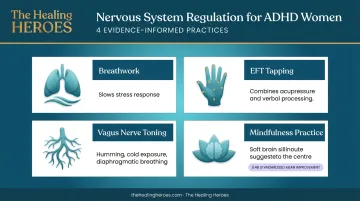
None of these replace medication or clinical support, but they meaningfully reduce the baseline reactivity that makes ADHD harder to manage.
Nutrition and Blood Sugar Stability
Blood sugar fluctuations affect dopamine and cortisol levels — both central to ADHD symptom expression. A 2026 systematic review found that poorer carbohydrate quality (high-glycemic, processed foods) was associated with greater ADHD symptom burden.
The practical application comes down to three anchors:
- Protein, fat, and fiber at each meal — stabilizes glucose and reduces cortisol spikes
- Fewer high-glycemic foods — limits the blood sugar swings that worsen brain fog and irritability
- Consistent meal timing — supports more predictable cognitive function across the day
This isn't a treatment, but removing this variable makes everything else easier to manage.
Hormonal Awareness and Cycle Syncing
Women with ADHD can reduce symptom severity by working with their cycle rather than against it:
- Follicular phase (just before ovulation) — estrogen is rising, cognition tends to peak; schedule complex cognitive work here
- Luteal and premenstrual phases — estrogen drops, focus declines; reduce demands, build in recovery
- Track symptoms across phases — this data is useful to bring to a clinician, especially if medication dosing or timing needs adjustment
A 2025 cognitive study confirmed that memory and attention performance differ measurably by menstrual phase, supporting the rationale for cycle-aware scheduling.
Therapeutic Modalities Worth Exploring
Several evidence-supported approaches are particularly relevant for women with ADHD:
- ADHD-informed CBT — A meta-analysis of 28 randomized controlled trials confirmed CBT-based interventions reduce core ADHD symptoms and internalizing symptoms in adults
- EMDR — While research specifically targeting late-diagnosis ADHD shame is still emerging, EMDR's design for processing stuck trauma patterns makes it a reasonable option to explore with a qualified practitioner
- Somatic therapy — addresses trauma held in the body, which many ADHD women accumulate through years of chronic stress and self-blame
These are conversations to have with a clinician who understands women's neurodivergent health — not DIY protocols.
Building Your ADHD Support System Beyond Podcasts
Podcasts are an excellent starting point: they're ADHD-friendly by nature, accessible during movement or chores, and built for daily doses of validation and education. But passive listening has limits.
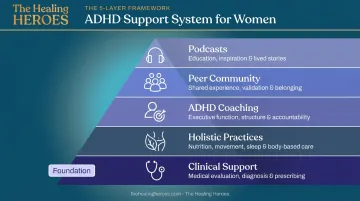
A layered support system typically includes:
- Podcasts: daily education and shame reduction — the shows listed above are strong anchors
- Peer community: belonging and shared experience; ADDA offers virtual support groups specifically for adults with ADHD
- ADHD coaching: skill-building in time management, task initiation, and accountability; the ADHD Coaches Organization maintains a directory of vetted coaches
- Holistic practices: somatic work, breathwork, and movement practices that regulate the nervous system between high-demand periods
- Clinical support: for formal diagnosis, medication evaluation, or therapy referrals
If you're still in the "wondering if this applies to me" stage, ADDitude Magazine offers a Female ADHD symptom self-assessment as a preliminary tool — useful for organizing your observations before meeting with a clinician. Tracking symptoms across hormonal phases adds context to bring to that conversation.
No single resource carries the full weight. The goal is enough overlap that when one layer feels insufficient, you're not starting from zero.
Frequently Asked Questions
What is the ADHD Women's Wellbeing Podcast?
It's a podcast hosted by Kate Moryoussef focused on holistic, non-medical support for women with ADHD. Episodes cover nervous system regulation, hormonal health, lifestyle strategies, and emotional wellbeing — with a tone that's particularly accessible for women who are newly navigating a late diagnosis.
Why are there podcasts specifically for women with ADHD?
ADHD presents differently in women — typically as inattentive-type with significant emotional and hormonal dimensions. Generic ADHD content rarely addresses these nuances. Women-focused podcasts provide validation, targeted tools, and lived experience that standard resources don't offer.
How can listening to ADHD podcasts help with symptoms?
Podcasts are ADHD-friendly — easy to absorb during walks, commutes, or household tasks, no sustained reading required. They reduce shame through shared stories and introduce practical coping tools and mindset shifts that improve day-to-day functioning.
Can ADHD symptoms worsen during perimenopause or PMS?
Yes. Hormonal shifts (particularly drops in estrogen) affect dopamine pathways and can intensify brain fog, emotional dysregulation, and executive dysfunction. Many women receive their first ADHD diagnosis during perimenopause precisely because declining estrogen makes previously manageable symptoms undeniable.
What holistic approaches help women manage ADHD without medication?
Key non-medication strategies include:
- Nervous system regulation: breathwork, EFT tapping, vagal toning
- Blood sugar stability through diet quality
- Cycle-aware scheduling
- Therapeutic modalities like EMDR-informed therapy or somatic work
These can complement medication or, for some women, meaningfully reduce reliance on it.
Why do so many women get diagnosed with ADHD later in life?
Diagnostic criteria were developed primarily from hyperactive male presentations. Women are far more likely to mask symptoms through compensatory behaviors. Their struggles are frequently misattributed to anxiety or depression, delaying recognition by years — sometimes decades.