

If that resonates, you're not broken. You're caught in a pattern that's both extremely common and rarely named directly: performance-driven self-worth — the experience of your value as a person rising and falling with what you produce.
This guide explains why that pattern develops, why women are particularly susceptible to it, what it costs daily, and what a genuine path toward more stable inner worth actually looks like.
Key Takeaways
- Performance-driven self-worth is a learned pattern, not a character flaw — and it can be unlearned
- Girls receive significantly less process praise than boys, creating early achievement-conditional foundations
- Self-compassion predicts more stable self-worth than self-esteem tied to outcomes
- The goal isn't to care less about quality — it's to build an internal foundation that doesn't collapse with outcomes
- Therapy and daily reflective practices — including CBT, ACT, EMDR, and somatic work — both support this shift
What Performance-Driven Self-Worth Actually Means
Researchers Jennifer Crocker and Connie Wolfe define contingencies of self-worth as domains in which self-esteem rises and falls depending on successes, failures, approval, or how well you meet certain standards. In plain terms: you've staked your sense of being a worthwhile person on outcomes you can't fully control.
This is different from healthy ambition. Someone with healthy motivation cares deeply about their work and feels genuine satisfaction when it goes well. Someone with performance-driven self-worth needs the outcome to confirm they're acceptable as a person. Caring about what you do is healthy. Requiring it to prove who you are is something else entirely.
Self-Esteem vs. Self-Worth
These two get conflated often, and the confusion matters:
- Self-esteem fluctuates with circumstances — it responds to how things go
- Self-worth is meant to be stable and unconditional — a foundation that holds regardless of outcomes
Most people operating from contingent self-worth think they have a self-esteem problem, when the real issue is that no stable foundation exists underneath. No amount of success fixes it, because achievements are temporary and the bar keeps moving.
The Pattern Dr. Houltberg Identified
Research published by Benjamin Houltberg and colleagues studied what they called "performance-based narrative identity" — a cluster combining high perfectionism, fear of failure, and contingent self-worth. People fitting this profile showed the highest rates of depression, anxiety, and shame, alongside the lowest life satisfaction. The mechanism makes sense: when love, respect, and belonging feel like they must be earned through performance, you are never truly safe. Only temporarily reprieved.
The cycle reinforces itself. Success delivers a brief dopamine reward, which then raises expectations for the next attempt. Failure confirms the underlying fear of being "not enough."
The bar is never actually reachable — not because you're falling short, but because its function isn't accomplishment. It's managing an internal wound that performance alone cannot close.
Why Women Are Especially Prone to This Pattern
The Praise Gap in Childhood
Research published in Child Development by Gunderson and colleagues found that boys received 24.4% process praise (praise for effort, strategy, and approach) compared to just 10.3% for girls of the same age. Process praise is what builds a growth mindset and an identity rooted in character rather than results. When girls receive less of it, they're more likely to develop fixed-performance frameworks — measuring their worth by outcomes rather than effort or growth.

This sets an early foundation: I am good when I succeed. My value is in the product.
The Multiple-Performance-Axis Problem
Women are evaluated on several dimensions at once. The performance arenas don't stay separate — they stack:
- Career output and professional results
- Physical appearance and how you're perceived
- Emotional labor and relationship maintenance
- Caregiving quality at home
More arenas means more opportunities to "fail," and more surface area for contingent worth to operate.
Productivity culture compounds this by turning output into a moral category: relentless busyness gets reframed as virtue. Rest becomes laziness. Downtime becomes something that needs to be earned.
When Conditional Relationships Install the Pattern
A meta-analysis by Haines and colleagues on parental conditional regard found it promotes contingent self-esteem and is linked to poorer well-being outcomes. When warmth, approval, or belonging in early relationships was tied to performance — to being good enough, helpful enough, successful enough — that pattern takes root early. Worth feels like something that must be constantly re-earned, because at some point, it was.
Why Impostor Syndrome Never Resolves
Those early conditional dynamics have a predictable long-term consequence: impostor syndrome. It's the experience of feeling like a fraud despite external evidence of competence, and it doesn't fade with achievement — it follows it. When there's no stable internal foundation, credentials and promotions feel fragile and undeserved. No amount of achievement resolves it, because the wound isn't evidential. More proof can't repair a belief formed before you had the language to question it.
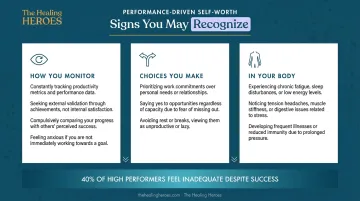
How Performance-Driven Self-Worth Shows Up Daily
Recognition is often the first step. These patterns are so normalized they can feel like personality rather than learned behavior:
In how you monitor and respond:
- Refreshing for replies, responses, or reactions before they arrive
- Over-preparing specifically to preempt criticism
- Interpreting neutral feedback as subtle rejection
- Your emotional state tracking others' approval in real time
In the choices you make:
- Choosing the career path that looks impressive over the one that feels right
- Staying in roles or relationships because leaving would look like failure
- Performing busyness as evidence of worth, even when it's unsustainable
In your body:
- Difficulty resting without justifying it
- Racing thoughts tied to unfinished tasks
- Chronic stress responses that don't fully resolve even when things are going well
Those physical symptoms aren't coincidental — they're where chronic approval-seeking lands in the body. Research by Victoria Blom found performance-based self-esteem was the strongest predictor of burnout over time in working women and men, with women reporting more work stress than men. Burnout isn't a character flaw. It's the predictable outcome of a system that never lets you be enough as you are.
What Untangling Your Worth from Performance Actually Looks Like
The goal isn't to stop caring about quality or to become indifferent to results. The aim is to build an internal foundation stable enough that your sense of yourself doesn't collapse when an outcome disappoints. This is a practice, not a destination — and that distinction matters.
Values vs. Approval-Seeking
A practical starting place: learning to distinguish choices made from your own values from choices made to manage others' perceptions. Decisions rooted in genuine values build something durable. Decisions rooted in approval-seeking erode the connection between who you actually are and how you show up.
Ask yourself about a recent decision: Was I doing this because it aligned with what I actually care about, or because I was afraid of how it would look? No judgment — just increasing awareness.
Self-Compassion as a Foundation
Research by Neff and Vonk found self-compassion predicts more stable feelings of self-worth than global self-esteem — and is less contingent on particular outcomes. This distinction matters practically: self-compassion doesn't require you to evaluate yourself favorably or perform well. It means treating yourself with the same basic kindness you'd extend to a struggling friend, particularly in moments of failure or criticism.
This is a more reliable route to stability than any achievement will ever provide.
Separating Identity from Role
Who you are is not what you do. A reflective practice worth trying: write a list of character traits, values, ways of being, and gifts that exist independent of any title, role, or accomplishment. Not what you've done — who you are while you're doing it:
- Curiosity
- Directness
- Warmth
- The ability to hold someone steady in a hard moment
These things don't disappear when a project fails. They're worth getting acquainted with.
The Grief That Comes with This Work
Many women have organized their entire lives around performance-based worth. Shifting that pattern means recognizing how much energy has gone toward earning something that was never actually conditional on performance in the first place. That recognition can feel disorienting before it feels freeing — and the disorientation is a normal part of the process, not a sign something has gone wrong.

Therapy and Healing Modalities That Can Help
CBT and ACT
Cognitive Behavioral Therapy (CBT) works directly with the core beliefs driving the pattern — thoughts like I am only lovable when I succeed — and helps restructure them. Research supports CBT's effectiveness for perfectionism specifically, including reducing anxiety tied to achievement-linked self-worth.
Where CBT restructures the beliefs themselves, Acceptance and Commitment Therapy (ACT) develops psychological flexibility — the ability to hold difficult thoughts without letting them run the show. ACT's values clarification process helps women distinguish what they genuinely care about from what they've been performing.
EMDR and Somatic Approaches
Because performance-driven self-worth is often stored in the body — not just the mind — approaches that work physiologically can reach what cognitive work alone doesn't.
EMDR (Eye Movement Desensitization and Reprocessing) processes distressing memories and the negative beliefs linked to them. For women whose "I must earn my worth" belief connects to specific early experiences, EMDR can address those target memories directly.
Somatic approaches — including Somatic Experiencing and body psychotherapy — work with the physiological dimension of stored patterns. Where EMDR works through memory, somatic work works through sensation, targeting the places in the body where old beliefs still live.
None of these modalities require a clinical diagnosis to explore. The Healing Heroes podcast has covered EMDR, somatic work, and body-based healing in depth — including conversations with psychotherapist Jen Baumgold on EMDR and licensed therapist Karen Remele on myofascial release — making these approaches more accessible for women exploring where to start.
A few ways these modalities differ at a glance:
- CBT: Restructures the thoughts and beliefs driving the pattern
- ACT: Builds flexibility to hold difficult emotions without acting from them
- EMDR: Processes the specific memories where "I must earn my worth" took root
- Somatic approaches: Releases the pattern where it's held — in the body itself

Daily Practices to Reconnect with Unconditional Self-Worth
These practices don't ask you to overhaul anything. They ask you to pay attention differently — and to start treating your presence as something that matters independent of what you produce.
The Character Inventory
Instead of logging accomplishments, try journaling on this prompt: How did I show up today? Not what you produced — how you were. Your patience. Your honesty. The moment you listened well. This trains attention toward who you are rather than what you generated, and over time it builds familiarity with an identity that isn't outcome-dependent.
Noticing Approval-Seeking in Real Time
When you feel the pull to over-explain, over-prepare, or check for validation, pause and ask: Am I doing this from my values, or to manage someone's perception of me? No self-judgment required. The practice is awareness, not correction. Over time, that pause creates a gap between the impulse and the action — which is where choice lives.
Rest as a Non-Negotiable
For women who have tied worth to productivity, rest without justification is one of the most direct challenges to the belief system. Not rest as recovery for more performance, but rest as an expression of already being enough. Quieting the mind isn't retreat; it's how you come home to yourself. Treating stillness as something you've earned only reinforces the pattern. Treating it as something you're entitled to regardless of output begins to loosen it.
Frequently Asked Questions
What therapy is good for self-worth?
CBT, ACT, somatic therapy, and EMDR are well-supported options. CBT and ACT work primarily at the cognitive and behavioral level, while somatic therapy and EMDR address patterns stored in the body. The best fit usually depends on whether the roots feel primarily cognitive, relational, or physical.
How do I separate performance from my self-worth?
Start by identifying your values and character traits independently of any role or outcome. Then practice self-compassion specifically in moments of failure or criticism, rather than letting those moments confirm your internal narrative. Separation happens gradually through consistent practice, not through a single insight.
How to increase self-worth as a woman?
Shift from external to internal reference points: act from genuine values, practice self-compassion, and trace the conditional patterns absorbed from early relationships and culture. Understanding where the pattern came from makes it possible to consciously choose differently.
Is performance-driven self-worth the same as perfectionism?
Related, but distinct. Perfectionism is a behavioral pattern focused on flawless output. Performance-driven self-worth is the underlying belief that your value as a person depends on that output. Perfectionism is often a symptom of that deeper worth pattern. Addressing the behavior alone rarely resolves it.
Can tying self-worth to performance lead to burnout?
Yes — and predictably so. When the bar continually rises and rest feels like failure, the nervous system rarely gets to register sufficiency. Studies on self-esteem and burnout consistently link performance-based worth to higher exhaustion rates over time, particularly in working women.