

Introduction
Picture this: a friend asks for a favour you genuinely don't have the bandwidth to do. Before you've even thought it through, you hear yourself saying yes — and then spend the next three days quietly resenting it while also feeling guilty for resenting it.
If that hits close to home, you're not alone. You're also not weak or "too nice." For many women, the compulsion to say yes, keep the peace, and put everyone else first isn't a personality quirk — it's a pattern with roots far deeper than most people realize.
What looks like politeness or generosity on the surface is often the nervous system running a very specific protective program — one it built long before you had any say in the matter.
This guide breaks down the trauma mechanism driving people-pleasing (the fawn response), why women are disproportionately affected, the real costs of living this way, and what healing actually requires — because it's not about willpower or just learning to say no.
Key Takeaways
- People-pleasing is a trauma-based survival response (the fawn response), not a character flaw
- Gendered socialization and relational trauma make women disproportionately affected
- Chronic self-suppression has measurable physical health consequences, not just emotional ones
- The pattern lives in the nervous system — willpower-based fixes don't reach it
- Lasting healing requires body-level work, not just behavior change
What People-Pleasing Actually Looks Like
Most people-pleasers don't recognize themselves in the label. The behaviors feel normal — even virtuous — which is exactly what makes them so hard to spot.
The Behavioural Signs
People-pleasing tends to show up as:
- Saying yes before you've decided if you actually want to
- Apologising reflexively, even when nothing is your fault
- Suppressing opinions or preferences to avoid conflict
- Monitoring other people's emotional states and adjusting yourself accordingly
- Struggling to answer "what do you want?" without first asking what others want
- Feeling somehow responsible when someone around you is upset
The Silencing the Self Scale (STSS), a clinically recognized measurement tool in women's mental health research, captures this through four dimensions: externalized self-perception, care as self-sacrifice, silencing the self, and the divided self. That last subscale (the divided self) describes the internal split between how a woman actually feels and how she presents to others.
The Kindness vs. Fear Distinction
Genuine kindness comes from choice. People-pleasing comes from anxiety about what happens if you don't.
When you help a friend move because you want to show up for them, that's kindness. When you agree to help because you're afraid they'll be upset or pull away if you decline, that's something else.
This distinction isn't about self-blame. It's about understanding the source — because you can only change what you can see clearly.
These behaviors are also particularly difficult for women to identify as problems, because they're often met with praise. Being accommodating, selfless, and conflict-averse is frequently treated as a virtue. That social reinforcement is also part of why the pattern tends to run deeper than most women expect — and why it so often connects back to earlier experiences of needing to stay safe.
The Trauma Root: How the Fawn Response Shapes People-Pleasing
What the Fawn Response Is
Most people know the fight-or-flight response. Fewer know about freeze — and fewer still have heard of fawn.
Pete Walker, a psychotherapist specialising in complex trauma, coined the fawn response as the fourth survival strategy: when someone cannot fight or flee from a threat — particularly a relational one — their nervous system may shift toward appeasing, accommodating, and placating the source of danger.
Peer-reviewed research uses the term "appeasement" for this same phenomenon. Bailey et al. (2023) describe appeasement as a natural mind-body survival strategy under conditions of entrapment — a mammalian response that can reduce threat by calming or co-regulating with a perceived aggressor.
How It Gets Wired In
This response develops early. Children who grew up in environments where approval felt conditional, caregiving was inconsistent, or emotional safety was unpredictable learned quickly that keeping others happy was the safest available strategy. When a child cannot leave or fight back, making the adult calm becomes the goal.
That learning doesn't stay in childhood — it gets encoded in the nervous system. Stephen Porges calls this process neuroception: the nervous system's way of detecting safety or threat outside conscious awareness. In adulthood, the body can fire fawn responses in perfectly safe relationships because it's reacting to remembered danger, not current reality.
The Link to Complex PTSD
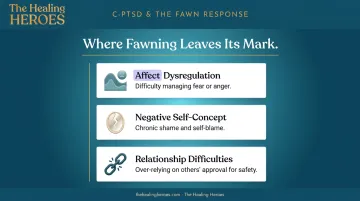
Many women who identify strongly as chronic people-pleasers also relate to Complex PTSD (C-PTSD). Recognised in the ICD-11 (though not separately in the DSM-5), C-PTSD includes PTSD symptoms alongside disturbances in self-organisation. The three areas most affected are exactly where fawning leaves its mark:
- Affect dysregulation — difficulty managing emotional responses, especially fear or anger
- Negative self-concept — chronic shame, self-blame, or a sense of being "too much"
- Relationship difficulties — over-relying on others' approval to feel safe or worthy
People-pleasing is not weakness. It was an intelligent adaptation to an environment that didn't feel safe. Recognising that shifts the work from shame to compassion — and compassion is where healing actually begins.
Why Women Are Especially Vulnerable to People-Pleasing
The Socialization Factor
People-pleasing can affect anyone, but women are disproportionately affected — and research makes this clear.
A meta-analysis by Yang and Girgus (2018) analyzed 108 effect sizes across 90 studies, totalling over 30,000 participants. Women scored higher than men on sociotropy (the tendency to over-prioritise relationships and others' approval) in 90.7% of samples, with an average effect size of d = .30.
Social role theory, described by Eagly (2019), explains that gendered expectations teach women to be communal, agreeable, and nurturing, with these traits reinforced through praise from early childhood onward. Being "difficult" or "selfish" carries real social consequences for women in ways it often doesn't for men.
Compounding Layers
Cultural and family dynamics can multiply this pressure at every level:
- A woman raised in an emotionally unpredictable home often simultaneously absorbs cultural messaging that her role is to nurture and accommodate others — reinforcing fawning at both a personal and structural level
- Women of colour face additional layers: research on Black women, for example, documents how self-silencing can function as a vigilance-based coping strategy under racism-related stress
- Women from collectivist cultures or faith communities shaped by gender-role scripts (such as Marianismo in Latin American contexts) often experience self-silence as both a cultural expectation and a spiritual duty
Where It Shows Up Most Acutely
People-pleasing tends to be especially visible in:
- Romantic relationships — difficulty expressing needs or disagreeing
- Workplace dynamics — over-apologising, avoiding credit, taking on extra labour
- Family systems — particularly with parents, in-laws, or siblings
- Friendships — saying yes when exhausted, never being the one who asks for help
The fear of being perceived as difficult keeps the pattern locked in place across all of these contexts.
Recognizing these pressures — both personal history and structural forces — isn't about assigning blame. It's about knowing exactly where the pattern took root, so the work of unlearning it can be precise.
The Hidden Costs of Chronic People-Pleasing
Physical Toll
Living in a persistent state of fawning means the nervous system is running in low-grade threat mode — almost constantly. The HPA axis stays activated, cortisol stays elevated, and the body pays for it.
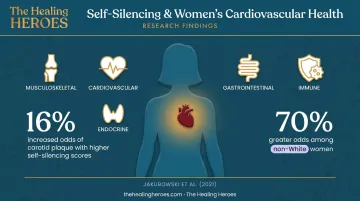
The American Psychological Association identifies chronic stress as affecting the musculoskeletal, cardiovascular, endocrine, gastrointestinal, and immune systems. Research on self-silencing in women adds a sharper data point: Jakubowski et al. (2021) found that in a study of 290 women, higher self-silencing scores were associated with 16% increased odds of measurable carotid plaque — a marker of cardiovascular risk. Among non-White women, that figure rose to 70% greater odds.
That physical burden doesn't stay in the body alone — it shapes the way a woman relates to herself over time.
Identity Erosion
When a woman consistently sidelines her own preferences, opinions, and needs to accommodate others, something quieter but equally damaging happens: she loses track of herself.
This shows up as:
- Difficulty making decisions without checking what others prefer first
- A vague, persistent feeling of emptiness or disconnection
- Resentment that appears out of nowhere and feels confusing
- Not knowing what you actually want, because you stopped listening to yourself long before anyone thought to ask
The STSS "Divided Self" subscale captures this clinically, reflecting the conflict between inner experience and outward compliance.
The Relational Paradox
People-pleasing is usually driven by a fear of losing connection. Yet it produces relationships that feel one-sided, hollow, and eventually exhausting — because the other person never truly knows you, and you never truly feel known.
Why "Just Stop" Doesn't Work — And What Your Nervous System Needs
Every piece of advice that boils down to "just say no" or "set a boundary" misunderstands what people-pleasing actually is.
This isn't a bad habit like nail-biting. It's a threat response — and Porges' work on neuroception explains why: the nervous system evaluates danger outside conscious awareness. When a woman tries to assert herself, her body may interpret the discomfort as a signal of genuine threat, producing guilt, anxiety, or even panic. That's not failure. That's the system doing exactly what it was wired to do.
What actually works isn't forcing the behavior to change. It's creating enough internal and external safety that the nervous system can gradually learn, through repeated experience, that having needs doesn't lead to abandonment or harm.
Felt safety, not willpower, is what makes change possible. SAMHSA's trauma-informed care framework identifies safety as the foundational condition for healing — the prerequisite, not a nice-to-have. That reframe matters: it shifts the work from forcing yourself to act differently to building the conditions where different action becomes possible.
This is why therapeutic support is genuinely helpful here, not optional. The pattern lives in the body. That's where it needs to be met — and the next section covers what that support can actually look like.
Healing Paths: Therapies and Practices That Can Help
Evidence-Based Therapy Approaches
No single therapy is "the" answer — the most effective choice depends on your history and what feels accessible. But several approaches have meaningful evidence for the kinds of patterns described here:
Cognitive Behavioral Therapy (CBT)
CBT targets the automatic thoughts that link self-worth to others' approval — beliefs like "if I say no, they'll leave" or "I'm only valuable when I'm useful." It also builds practical assertiveness skills. CBT works especially well when cognitive patterns are identifiable and close to the surface.
EMDR (Eye Movement Desensitization and Reprocessing)
EMDR works at the nervous system level, processing traumatic memories that are driving automatic fawn responses. The EMDR International Association notes its specific application to complex PTSD in chronically traumatized populations — making it particularly relevant when people-pleasing is rooted in early or relational trauma.
Somatic and Body-Based Therapies
Somatic Experiencing (SE), sensorimotor psychotherapy, and related approaches work through interoceptive sensation to help the body discharge stored threat responses. Because fawning is a body-level pattern, working at the body level — not just the thinking level — is often especially effective. The Healing Heroes podcast has explored this directly across multiple episodes, including conversations about myofascial release, acupuncture, and movement practices like Aikido as pathways to nervous system regulation.
DBT (Dialectical Behavior Therapy)
DBT's interpersonal effectiveness module is directly relevant to women learning to express needs without losing relationships. A randomized clinical trial by Bohus et al. (2020) in 193 women with childhood-abuse-associated complex PTSD found support for DBT-PTSD as an effective treatment approach.
Everyday Practices to Begin the Shift
Therapy is the foundation, but small practices in daily life help the nervous system accumulate new experiences of safety:
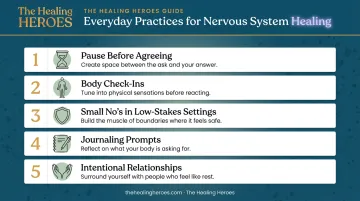
- Pause before agreeing — even 30 seconds creates space for a real response
- Body check-ins — ask "how does this actually feel in my body?" before defaulting to yes
- Small no's in low-stakes settings — decline something minor regularly to build the muscle
- Journaling prompts — "What did I actually want today?" and "What did I hold back?"
- Intentional relationships — spend time with people who respect limits and don't punish honesty
Frequently Asked Questions
What is the root cause of people-pleasing?
People-pleasing most commonly develops as a protective response to early environments where safety or approval felt conditional — including emotional neglect, inconsistent parenting, or relational trauma. Over time, the nervous system encodes this pattern as an automatic fawn response that operates below conscious awareness.
What is the best therapy for people-pleasers?
There's no single best option. Approaches that address both cognitive patterns and the nervous system — such as EMDR, somatic therapy, CBT, and attachment-based work — are commonly recommended. The most effective choice depends on your personal history and what feels accessible and safe to begin with.
Is people-pleasing a trauma response?
Yes, for many people it is. Specifically, it's associated with the fawn response — a nervous system survival strategy that involves appeasing others to avoid conflict or maintain connection when the body perceives relational threat.
How do I stop people-pleasing without feeling guilty?
The guilt is a nervous system signal, not a moral verdict. The path forward involves small, gradual steps toward self-assertion in safe contexts — ideally with therapeutic support — so your body can slowly learn that having needs doesn't make you selfish or unworthy of love.
Is people-pleasing more common in women?
While it can affect anyone, women are disproportionately affected. Research shows women score higher on sociotropy in over 90% of studied samples, driven by gendered socialization that rewards agreeableness — and by the fact that these patterns often go unrecognized or are actively praised rather than identified as trauma responses.
Can people-pleasing affect my physical health?
Yes. Chronic self-suppression keeps the nervous system in a low-grade stress state, which research links to fatigue, physical tension, lowered immunity, and cardiovascular strain. Addressing the body is as essential to healing as addressing the mind.
This article is for educational purposes only and does not constitute clinical advice. If you recognise yourself in these patterns, consider reaching out to a qualified mental health professional.