
Introduction
There's a particular kind of exhaustion that comes from carrying family wounds — not the tiredness you can sleep off, but the kind that shows up in relationships that feel heavier than they should, in a critical inner voice that sounds suspiciously like someone else's, in patterns you keep repeating without quite knowing why.
If any of that resonates, this guide is for you.
Family trauma is not limited to dramatic, obvious events. It includes emotional invalidation, chronic neglect, being the child who kept the peace, and growing up in a home where love felt conditional or unpredictable.
According to CDC data on adverse childhood experiences, female adults report the highest rates of 4+ ACEs at 19.2% — meaning millions of women are navigating the adult aftermath of complex childhood adversity.
Here's what this guide covers:
- How to recognize family trauma, including the quieter, harder-to-name kinds
- How it travels with you into adult relationships and behavior patterns
- The science behind intergenerational cycles
- Healing paths that work — including ones that don't require your family's cooperation
Key Takeaways
- Family trauma includes neglect, emotional invalidation, parentification, and chronic instability — not just overt abuse
- Women are socialized to absorb and minimize family pain, which often delays recognition and healing
- Intergenerational trauma means wounds are frequently inherited, not just experienced firsthand
- Healing is possible even when family members refuse to acknowledge or engage
- Both clinical and holistic modalities exist to support women's recovery
What Family Trauma Really Looks Like for Women
Family trauma spans a wide spectrum. On one end: physical abuse, sexual abuse, witnessing domestic violence, or growing up with a parent navigating addiction or severe mental illness. On the other: subtler but equally damaging experiences like emotional invalidation, enmeshment, and being assigned the caretaker role as a child — what researchers call parentification.
Women are disproportionately affected by this second category. Research shows that girls and women are more likely to internalize distress rather than externalize it, and are socialized to suppress anger, maintain relational harmony, and prioritize others' emotional comfort over their own.
Under stress, women are also more likely to exhibit what researchers describe as "tend-and-befriend" behavior: nurturance and social affiliation that, in a trauma context, can look like people-pleasing or conflict avoidance.
This matters because these patterns often go unrecognized as trauma responses at all.
Signs You May Be Carrying Family Trauma
Many women dismiss these signs for years because the experiences simply felt normal growing up. Recognizing them is where the work — and the relief — begins.
- Difficulty setting boundaries with family members without guilt or fear
- A persistent sense of not being "enough," regardless of what you achieve
- Chronic anxiety or hypervigilance around people you love
- Feeling responsible for managing others' emotions
- Distrust of your own perceptions — second-guessing your memories or reactions
- Physical symptoms like tension, fatigue, or digestive issues without a clear medical explanation
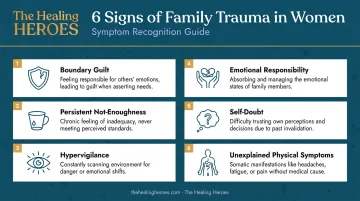
That last point matters more than it might seem. The body stores what the mind hasn't fully processed, and many women spend years seeking physical answers for what is fundamentally an unprocessed emotional load.
How Family Trauma Shows Up in Your Adult Life
The connection between early family experiences and adult relationship patterns is well-documented. Research published in PMC found that childhood physical abuse and neglect predicted higher anxious attachment in adulthood, while neglect specifically predicted avoidant attachment — and that these attachment patterns mediated links to adult depression, anxiety, and low self-esteem.
The way your caregivers responded to you as a child became your nervous system's template for what relationships feel like. That template doesn't disappear just because you grew up.
In Relationships and Friendships
Insecure attachment shows up in how you relate to partners, friends, and even coworkers. You might find yourself:
- Anxiously monitoring people's moods for signs of withdrawal
- Shutting down emotionally when conflict arises
- Choosing relationships that mirror familiar (even painful) dynamics
- Alternating between intense closeness and emotional distance
A 2023 meta-analysis found that a person's own childhood maltreatment created measurable partner effects — including lower relationship satisfaction and higher psychological distress in their partners — even when the trauma happened decades earlier.
Emotional Regulation Challenges
Childhood maltreatment is strongly associated with difficulty identifying, expressing, and managing emotions in adulthood. Women who were taught — explicitly or implicitly — to suppress anger, need less, or hold the family together often arrive at adulthood without the emotional vocabulary or regulation skills no one ever modeled for them.
In daily life, that might show up as:
- Emotional flooding during conflict (reactions that feel disproportionate but aren't)
- Emotional numbness or dissociation when overwhelmed
- Difficulty naming what you're actually feeling beneath the surface
The "Family Emotional Processor" Role
Many women carry an additional burden: they became the emotional center of their family. They mediated conflict, managed relationships on everyone else's behalf, and absorbed the stress their caregivers couldn't hold.
This role originates in childhood and follows women into adult partnerships, friendships, and workplaces — eroding self-worth in ways that are easy to miss and hard to name.
A partner's raised voice triggers a shutdown that belongs to a much older memory. A family gathering pulls you back into roles you thought you'd outgrown. These aren't character flaws. They're the nervous system doing exactly what it learned to do to stay safe.
The Thread of Intergenerational Trauma
Trauma That Travels Through Generations
Intergenerational trauma refers to unprocessed emotional wounds passing from one generation to the next — not just through learned behaviors, but potentially through biological mechanisms. Research on Holocaust survivors and their adult offspring found methylation differences in stress-related genes that correlated between parents and children, suggesting that trauma may leave biological as well as behavioral imprints.
The epigenetic science is still developing, but the behavioral and relational transmission of trauma is far more conclusively documented.
How It Passes Down
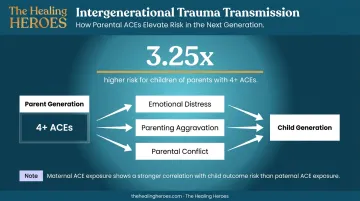
In a study of 2,205 parent-child dyads, children of parents with 4+ ACEs had a 3.25-fold higher risk of reporting 4+ ACEs themselves — with maternal ACEs showing stronger correlation than paternal ACEs. The transmission happened through emotional distress, parenting aggravation, and parental conflict.
Signs of inherited patterns in your own family might include:
- Recurring themes across generations — addiction, emotional unavailability, perfectionism, domestic conflict
- Unspoken family rules that silence emotion ("we don't talk about that")
- Roles women are unconsciously assigned that mirror previous generations' women
- A sense that certain pain is simply "how this family is"
The Empowering Side
Recognizing a generational pattern is the beginning of breaking it. Women who do this healing work don't just change their own lives — they fundamentally alter what they pass forward. When a mother processes her own trauma, she changes the emotional environment her children grow up in.
Research on intergenerational healing confirms this concretely — it's one of the most well-supported findings in the field.
Healing Modalities That Support Women's Recovery
No single path fits every woman. The most effective approach often blends clinical and holistic modalities — which is why exploring diverse options, ideally with a trauma-informed guide, matters more than picking the "right" one.
Clinical Approaches
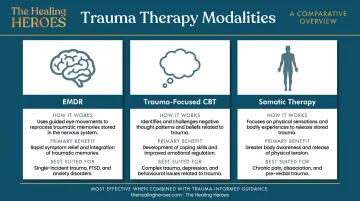
EMDR (Eye Movement Desensitization and Reprocessing) is among the most well-researched trauma therapies available. It helps the brain reprocess traumatic memories through bilateral stimulation — guided eye movements, tapping, or auditory tones — without requiring detailed verbal retelling of events.
Research backs its effectiveness. A systematic review found EMDR associated with reductions in PTSD symptoms, depression, and anxiety in adults with complex childhood trauma histories. A 2024 study of adult women with childhood sexual abuse histories found significant reductions in post-traumatic stress, dissociation, and emotional dysregulation following an 8-week EMDR protocol.
The Healing Heroes podcast featured Jen Baumgold, a licensed clinical social worker and certified EMDR therapist, in an episode titled "Process Your Past for Peace in the Present with EMDR" — a practical starting point for understanding how the therapy works before committing to a practitioner.
Two other well-supported options round out the clinical picture:
- Trauma-focused CBT: Helps identify and shift shame-based beliefs rooted in family experiences. The APA lists it as a strongly recommended treatment for PTSD; NICE guidelines align with that recommendation for adults with significant trauma symptoms.
- Somatic therapy: Works directly with the body's stored responses — tension, freeze states, and chronic physical patterns that often predate words. Episodes on myofascial release (with Karen Remele) and Rolfing on The Healing Heroes are worth a listen for women who sense their healing needs to move through the body, not just the mind.
Holistic and Complementary Modalities
Complementary modalities don't replace clinical therapy, but many women find them genuinely supportive alongside it:
- Mindfulness-Based Stress Reduction (MBSR): A meta-analysis found MBSR reduced PTSD symptoms with a moderate positive effect, making it a solid complement for nervous system regulation
- Acupuncture: Evidence is promising but not yet definitive for PTSD specifically; the Healing Heroes episode "Healing Anxiety, Depression, & Grief Through Acupuncture" explores how acupuncture and Reiki supported one woman through grief, infant loss, and depression
- Energy healing, breathwork, and inner child work: Practitioners like Cait DeMello — featured on The Healing Heroes in a conversation on parts work and embodiment — use tools from inner child work and IFS-adjacent frameworks to address emotional blocks rooted in early experience
These conversations are a low-pressure way to hear directly from practitioners before you commit to anything — so you can make an informed choice rather than a blind one.
Healing When Your Family Won't Join the Journey
This is a painful reality many women face: you want to heal within your family, but other members deny, minimize, or refuse to engage. You may have hoped for acknowledgment that never comes.
Healing does not require their participation.
Individual therapy and personal healing work can shift your internal patterns, your relationship to your own history, and the way you show up — even when nothing changes in the people around you. You are not changing them. You are changing what you carry, what you accept, and how you respond.
Bowen family systems theory — a framework developed by psychiatrist Murray Bowen — describes this as differentiation: the capacity to remain emotionally clear during family conflict rather than being pulled into old roles and reactive patterns. That capacity develops through personal work, not through family consensus.
So what does differentiation look like in practice?
Practical guidance for protecting your healing within family contact:
- Treat boundary setting as an act of self-respect, not punishment or rejection
- Lower your expectations before family events — plan for who they are, not who you wish they'd be
- Identify which relationships can bear the weight of honest conversation and which currently cannot
- Give yourself permission to create distance where contact is actively harmful to your recovery
Building Your Path Forward
Healing from family trauma is not a straight line. Judith Herman's foundational model of trauma recovery describes three stages: establishing safety, revisiting and processing the traumatic experience, and reconnecting with ordinary life. In practice, this means there will be grief, setbacks, sudden clarity, and backward steps that aren't actually backward. All of it counts as part of the process.
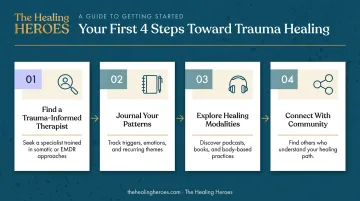
Four concrete starting points for this week:
- Find a trauma-informed therapist — the ISTSS Trauma Specialist Directory and EMDRIA's therapist finder both let you filter for clinicians with specific trauma credentials and experience with women
- Journal about patterns you've noticed — not to analyze them perfectly, but to get them out of your head and onto paper. What roles did you play in your family? What feelings were allowed and which weren't?
- Explore healing modalities through trusted educational resources — podcasts like The Healing Heroes offer conversations with practitioners across disciplines, so you can learn what each approach involves before booking a session
- Connect with women on similar paths — through the podcast's community, social spaces, or local groups; shared experience is its own form of healing
Healing from family trauma doesn't erase where you came from. It changes what you do with it — and that part is yours to shape.
Frequently Asked Questions
Can I heal from family trauma even if my family doesn't acknowledge it?
Yes. Healing is an individual process that doesn't require validation, apology, or participation from anyone who caused harm. Therapy and personal work address your own nervous system and patterns — those can change regardless of whether your family changes.
How do I know if what I experienced qualifies as family trauma?
Trauma is defined by its impact, not its category. If childhood or family experiences left lasting effects on your sense of safety, self-worth, relationships, or emotional regulation, those experiences are worth addressing — regardless of whether they appear "severe enough" by someone else's measure.
What is the difference between family trauma and intergenerational trauma?
Family trauma refers to experiences within your own lifetime and family unit. Intergenerational trauma refers to unprocessed wounds inherited from previous generations. Both can coexist, and both respond to personal work — through approaches like somatic therapy, parts work, or EMDR that address patterns at the root.
How does family trauma affect women differently?
Women are more likely to internalize trauma through people-pleasing, emotional caretaking, and self-blame. They are also more often assigned roles — emotional manager, peacekeeper, caregiver — that carry high trauma burden and are rarely recognized as such.
What healing modality is best for women recovering from family trauma?
There is no single best modality. EMDR, somatic therapy, breathwork, and energy healing each serve different needs and nervous systems. Working with a trauma-informed therapist to find the right combination is consistently more effective than any single fixed method.
Can healing from family trauma affect my own children?
Yes. When a woman does her own healing work, she changes the emotional environment her children grow up in. Research confirms that maternal healing directly reduces children's exposure to adverse experiences — meaning the patterns stop moving forward.