

Introduction
She had food, a roof, parents who showed up. By most measures, her childhood was fine. But something always felt off — a quiet hollowness she couldn't explain, a bone-deep exhaustion with ordinary life, a sense that she was performing rather than actually living.
If that resonates, there's a good chance you've encountered childhood emotional neglect (CEN) — not as a dramatic event, but as an absence. Not what was done to you, but what consistently wasn't.
According to a large-scale meta-analysis by Stoltenborgh et al., emotional neglect affects an estimated 184 per 1,000 children globally — making it far more common than most people realize. Yet it's one of the most frequently unrecognized forms of childhood trauma, precisely because it leaves no single memory to point to.
This guide covers what CEN actually is, why it's especially hard for women to identify, how to recognize it in your own life, and what healing can look like — from evidence-based approaches like EMDR and somatic therapy to integrative modalities that address the mind, body, and spirit together.
Key Takeaways
- CEN is defined by what was missing — emotional attunement and validation — not by a specific harmful event
- Women are socialized to suppress their own needs, which makes CEN feel normal rather than harmful
- Common signs include emotional numbness, perfectionism, chronic self-doubt, and difficulty setting boundaries
- Healing paths include therapy (EMDR, somatic work), inner child practices, and daily self-compassion habits
- You don't need a "bad enough" childhood to deserve support — your experience is valid
What Is Childhood Emotional Neglect?
Dr. Jonice Webb, licensed psychologist and author of Running on Empty, defines CEN as "a parent's failure to respond enough to a child's emotional needs." The key word is enough — and the key distinction is that CEN is an act of omission, not commission.
Parents who emotionally neglect their children aren't necessarily cruel or absent. Many are loving in tangible ways: present, providing, even warm. But they consistently miss the emotional layer — the feelings behind the behavior, the needs beneath the silence.
The Wound That Leaves No Scar
CEN is difficult to name precisely because it has no clear incident. Abuse involves something that happened. CEN involves something that didn't — what Webb calls the "white space in the family picture." There's no moment to point to, no memory with clean edges.
When a child brings distress and it's met with dismissal, distraction, or silence — again and again — she learns something: her feelings are a problem. So she walls them off. The emotional shutdown that protects her then becomes the pattern she carries into adulthood.
That pattern isn't a character flaw. It was a survival strategy — one that made sense then, and one that healing work can gently begin to unravel now.
Why CEN Is Especially Difficult for Women to Recognize
The "I Had It Fine" Trap
Most women who carry CEN don't arrive at therapy with a clear story of neglect. They arrive saying, "Nothing really happened to me" — and they mean it. Without a defining event, there's nothing obvious to grieve or even examine.
This minimization gets compounded by comparison. Women with CEN often look at people with more visible hardship and conclude they have nothing to complain about. But CEN doesn't require dramatic circumstances. Its damage is cumulative and quiet.
How Socialization Hides the Wound
Research from a 166-study meta-analysis by Chaplin and Aldao found that girls are socialized toward internalizing emotions (sadness, anxiety, sympathy) while boys are more often allowed to externalize. Girls learn to read others' feelings carefully and manage relationships smoothly.
The problem: this mirrors the very messages of CEN. Being accommodating, not making a fuss, putting others first are all socially rewarded in women, making the neglect feel like virtue rather than adaptation.
Perfectionism as a Mask
High-achieving women are particularly at risk of missing their own CEN. Society treats perfectionism, self-sufficiency, and emotional control as strengths, praised at work and admired by peers. Research links adverse childhood experiences, including emotional neglect, with multidimensional perfectionism, particularly in women. The external success makes the internal wound nearly invisible.
The Intergenerational Layer
Many mothers who experienced CEN didn't know how to model emotional attunement because no one modeled it for them. Research on intergenerational transmission shows that parents with higher emotional dysregulation tend to invalidate their children's emotions more frequently. This isn't about blame. The pattern simply passes forward, often without anyone noticing.
That invisibility deepens when cultural or religious backgrounds frame emotional expression as weakness or selfishness. For women from communities where stoicism and self-sacrifice are core virtues, the neglect doesn't just feel normal — it feels honorable.
Signs You May Have Experienced Childhood Emotional Neglect
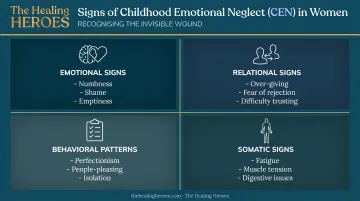
Emotional Signs
- Difficulty identifying or naming what you're feeling (sometimes called alexithymia — research links emotional neglect to this across 24 studies and 14,450 participants)
- Persistent sense of emptiness or numbness
- Low-grade shame that doesn't trace to anything specific
- Feeling fundamentally flawed or "too much" — yet also invisible
Relational Signs
- Over-giving in relationships while consistently neglecting your own needs
- Difficulty asking for help without feeling like a burden
- Extreme sensitivity to perceived rejection or criticism
- Trouble trusting that others genuinely care, even when they show it
Behavioral Patterns
- Perfectionism as a strategy to earn approval or avoid criticism
- People-pleasing as a default mode
- Difficulty setting and holding limits with others
- Retreating into isolation when overwhelmed
Somatic (Body-Based) Signs
Physical symptoms are often where unprocessed emotional experience lives. When neglect happens early — before you had words for what was missing — it tends to settle in the nervous system and show up as:
- Chronic fatigue or low energy without a clear medical cause
- Persistent muscle tension, headaches, or jaw clenching
- Digestive issues that flare with stress or emotional pressure
This is especially common when the neglect predates verbal memory, which means talk-based approaches alone may not be enough to reach it.
A Quick Self-Reflection
Ask yourself honestly:
- Did you feel safe expressing emotions growing up?
- Were you comforted when you were scared or hurt?
- Were you told to "toughen up" or stop being sensitive?
- Did your feelings seem to make the adults around you uncomfortable?
If several of these land with a quiet yes, you're not alone — and that recognition is often where healing begins.
How CEN Shapes Adult Life for Women
Relationships
CEN teaches the nervous system to expect emotional distance, making that distance feel familiar — even safe. Women with CEN may gravitate toward emotionally unavailable partners without consciously choosing that dynamic. Common patterns include:
- Oscillating between over-connection and emotional shutdown
- Struggling to stay present during genuine vulnerability
- Giving endlessly while waiting for reciprocity that never arrives
- Mistaking emotional distance for stability or safety
Studies on adult attachment confirm that childhood neglect shapes anxious and avoidant patterns that affect relationships well into adulthood.
Work and Self-Worth
High performance paired with a persistent internal voice that says it's still not enough. Insecure attachment is associated with perfectionistic self-presentation, and that overlap tracks directly onto burnout and what many women describe as imposter syndrome — the sense that competence is a performance, always at risk of being exposed.
The external results look like success. The internal experience is closer to exhaustion held together by discipline.
Emotional Regulation
CEN women often don't explode — they go flat. Long stretches of emotional numbness, punctuated occasionally by feelings that seem disproportionately large. This isn't drama or instability. It's the natural result of a nervous system that learned early to minimize emotion as a protection strategy.
Numbness is not a character flaw. It's a coping mechanism that outlived its usefulness.
Physical and Mental Health
Long-term emotional suppression is linked to anxiety, depression, and chronic stress-related symptoms. Early life stress from neglect is associated with altered HPA-axis functioning (the body's core stress-response system), which can affect everything from sleep and immunity to mood and pain tolerance.
The body doesn't forget what the mind was never allowed to process.
Healing from Childhood Emotional Neglect
Where It Starts
Healing begins with naming what happened — without minimizing it, and without needing it to be "bad enough." Simply recognizing this is a real wound, and it shaped me creates the first opening. That recognition alone can be disorienting and relieving all at once.
Evidence-Based Therapy Options
Several approaches have meaningful evidence for healing developmental and attachment-based wounds:
- Cognitive Behavioral Therapy (CBT) / Schema Therapy — Targets deeply ingrained negative self-beliefs formed in childhood. Schema therapy in particular is designed for maladaptive patterns rooted in unmet emotional needs, and integrates limited reparenting as a named clinical method.
- EMDR — A systematic review of six randomized controlled trials found EMDR reduced PTSD, depression, and anxiety in complex childhood trauma presentations. For CEN, it's most useful when attachment wounds have produced distressing beliefs or somatic responses that live below conscious awareness.
- Somatic Therapy — Body-based approaches are particularly valuable when the wound predates verbal memory. When there's no narrative to process, the body still holds the experience. Somatic Experiencing and sensorimotor psychotherapy both address how the nervous system stores and releases unresolved stress.

Inner Child Work and Reparenting
At the center of most CEN recovery frameworks is learning to meet your own emotional needs — with the consistency and validation your caregivers couldn't provide. This is what reparenting means in practice: not reliving childhood, but building a new internal relationship with yourself.
Within schema therapy, limited reparenting is a defined clinical method with a clearer evidence base than popular inner child work frameworks. The underlying practice, though, is the same: learning to notice, validate, and respond to your own feelings.
Holistic Modalities
Mindfulness-based practices, breathwork, somatic bodywork, and energy healing can support emotional reconnection alongside formal therapy. They're not replacements for professional care, but each serves a distinct role:
- Regulate the nervous system between therapy sessions
- Rebuild body awareness when emotions have long been suppressed
- Create space for feelings that therapy begins to surface
- Deepen reconnection with the self outside structured clinical work
The Healing Heroes podcast explores many of these modalities through conversations with practitioners across disciplines — a practical starting point for women still figuring out which path fits. Episodes are available on Apple Podcasts and Spotify.
The Therapeutic Relationship
For women with CEN, finding a skilled, attuned therapist isn't just practical — it's part of the treatment. Consistent attunement from a trauma-informed practitioner provides a corrective emotional experience: proof, felt in real time, that being seen and responded to is actually possible. That experience begins to rewire what childhood could not.
Practical Daily Habits to Support Your Healing
These aren't replacements for therapy. They're the practice between sessions — the daily work of building a new relationship with yourself.
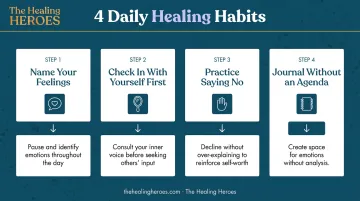
1. Name what you're feeling. Several times throughout the day, pause and ask: What am I actually feeling right now? You don't need to fix it. Naming emotions activates neural regulation and reduces their intensity — research describes this as affect labeling. Treat your feelings as information, not problems.
2. Check in with yourself before defaulting to others. Women with CEN often outsource their decisions — to partners, to social expectations, to whatever seems easiest. Start small: before asking someone else what they think, ask yourself first. Building this habit is less about making better decisions and more about practicing that your inner voice matters.
3. Practice saying no without over-explaining. Every time you decline something that doesn't serve you — without a lengthy justification — you reinforce that your needs and time are real and valid. It will feel uncomfortable. That discomfort is part of the process, not evidence that you're doing it wrong.
4. Journal without an agenda. Use writing to create space for emotions that were never given room. Not to analyze or fix — just to let them exist on the page. This is one of the simplest ways to begin treating your inner world as worth returning to.
Frequently Asked Questions
What type of therapy is best for childhood emotional neglect?
Several approaches can help, including schema therapy, EMDR, somatic therapy, and inner child work within CBT frameworks. The best fit depends on your history and symptoms — but whatever approach you choose, trauma-informed training in your practitioner matters most.
What happens to adults who were emotionally neglected as a child?
Common patterns include emotional numbness, persistent low self-worth, difficulty identifying feelings, relationship struggles, anxiety or depression, and perfectionism. These are adaptations to a childhood where emotional needs went unmet, not fixed personality traits.
What are the 5 inner child wounds?
The five wounds — abandonment, rejection, humiliation, betrayal, and injustice — come from Lise Bourbeau's self-help framework, not a clinical diagnostic system. CEN can activate one or more of these wounds through chronic emotional absence rather than any single event.
How do I know if I experienced childhood emotional neglect?
CEN rarely announces itself with a clear memory. It tends to show up as a vague sense that something was always missing — that your feelings weren't quite welcome. Reflecting on whether your emotions were acknowledged and validated growing up is a good starting point.
Can you heal from childhood emotional neglect without therapy?
Self-directed practices — journaling, emotion naming, inner child work, mindfulness — can meaningfully support awareness and daily regulation. Therapy is recommended when symptoms are severe, patterns are entrenched, or self-directed work keeps hitting the same walls.
How does childhood emotional neglect affect relationships in women?
CEN creates patterns rooted in unmet attachment needs: difficulty being vulnerable, chronic over-giving, fear of rejection, and an unconscious pull toward emotionally unavailable partners. These patterns make sense as adaptations — and they can change with awareness and support.