

Introduction
She lands the promotion, delivers the presentation flawlessly, and gets home to replay every word she said wrong. Sound familiar?
For many driven women, this is Tuesday. Not a bad day — just the baseline hum of a mind trained early to believe that good enough is never quite safe enough. That's a nervous system running the survival script it picked up long before the boardroom.
This guide explores the science-backed connection between trauma and perfectionism: why it develops, who carries it, how it shows up in work and relationships, and what healing actually looks like. You'll walk away with a clearer picture of whether your perfectionism is rooted in genuine values — or in fear of what happens when you fall short.
Perfectionism rooted in trauma isn't the same as having high standards. The gap between those two things is exactly what this guide is here to help you see.
Key Takeaways:
- Trauma-driven perfectionism is a nervous system survival strategy, not a personality trait
- Women face unique social pressures that reinforce perfectionistic patterns primed by early experiences
- Healthy striving is motivated by desire; trauma-based perfectionism is motivated by dread
- Evidence-based therapies like CBT, ACT, EMDR, and IFS address perfectionism at its root
- Healing doesn't lower your standards — it relocates them from fear to genuine values
What Does It Mean When Perfectionism Is a Trauma Response?
The Nervous System Behind the Drive
Perfectionism rooted in trauma isn't about wanting excellence. It's about wanting safety.
When a child grows up in an environment where love was conditional, conflict was unpredictable, or mistakes had real consequences, being flawless became a strategy. The nervous system learned: perform perfectly and stay protected.
The problem is that this pattern doesn't switch off when the danger passes. It follows women into board rooms, bedrooms, and every space in between.
Research on adverse childhood experiences found that ACEs were associated with higher socially prescribed perfectionism in young adults — particularly the compulsion to hide imperfection from others. A separate study of 1,176 workers found that childhood emotional abuse predicted adult perfectionism, which in turn predicted workaholism in adulthood.
Neurologically, chronic trauma keeps the brain's threat-detection system on high alert. The amygdala registers "making a mistake" the same way it registers actual danger.
This triggers hypervigilance, constant self-monitoring, and a relentless need to control outcomes. It's not weakness or overthinking. It's a nervous system doing exactly what it was built to do.
Conditional Regard: When Love Has to Be Earned
That nervous system patterning doesn't develop in isolation. It gets reinforced by the relational environment around it.
Carl Rogers described conditions of worth: the belief that you are only acceptable when you meet certain standards. For many women, this belief was installed early, not through one dramatic event but through a thousand small messages — praise when you performed, withdrawal when you didn't.
Research confirms this pathway. Parental conditional regard predicted self-critical perfectionism in adolescents, and a meta-analysis of 31 samples linked conditional regard to contingent self-esteem and depressive symptoms. When a child learns that love is earned through performance, that child becomes an adult who cannot separate her worth from her output.
This pattern is also intergenerational. Parents who learned the same strategy in their own unsafe environments pass it down, not through intention but through the way they respond to imperfection. The label doesn't matter. The effect on the nervous system is the same.
Adaptive vs. Maladaptive Perfectionism: What's the Difference?
Not all perfectionism is created equal. The distinction matters because conflating the two keeps women stuck in the wrong conversation.
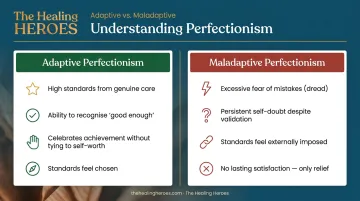
Adaptive perfectionism looks like:
- High personal standards driven by genuine care about quality
- The ability to recognize "good enough" and move forward
- Celebrating achievement without tying it entirely to self-worth
- Standards that feel chosen, not imposed
Maladaptive perfectionism looks like:
- Excessive fear of mistakes — not just concern, but dread
- Persistent self-doubt even after external validation
- Standards that feel like external demands you can never quite satisfy
- No lasting satisfaction after achievement — just relief, then the next threat
A large-scale meta-analysis across 416 studies and over 113,000 participants found that perfectionistic concerns — the maladaptive form — correlated with anxiety and depression at roughly r = .38–.43. That's the form most closely tied to childhood trauma and conditional love.
Why Women Are Especially Vulnerable to Trauma-Driven Perfectionism
The Narrow Band of Acceptable Performance
Women don't just navigate internal perfectionism. They navigate a social environment that actively reinforces it.
Cultural messaging expects women to excel across every domain simultaneously: career performance, caregiving, appearance, emotional availability, and relatability — while penalizing them for being too much or too little in any direction. Research documents what many women already feel: there is a narrower margin for error professionally.
Women who are too assertive face backlash; women who are too accommodating are overlooked. The double-bind facing women in leadership mirrors the conditional approval dynamics of traumatic childhood environments almost exactly.
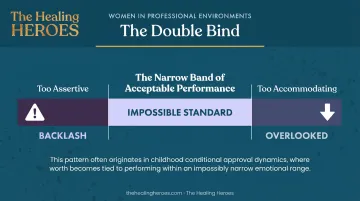
For women already primed by early experiences of conditional love, this external pressure doesn't feel like workplace politics — it feels like confirmation that they have to be perfect to be safe.
An Additional Layer for Women of Color and First-Generation Professionals
For women of color and first-generation professionals, perfectionism isn't just psychological — it's often rational.
Qualitative research on Black college women at predominantly White institutions found that perfectionist tendencies were directly tied to stereotype management: the pressure to disprove assumptions about incompetence, to never confirm a negative stereotype, to be excellent in ways that leave no room for interpretation. Perfectionism becomes a buffer against bias.
These pressures often compound each other. For first-generation professionals specifically, perfectionism and imposter syndrome tend to operate in tandem:
- The fear that one misstep will expose them as not truly belonging
- The awareness of having worked twice as hard to enter the same rooms
- The ongoing pressure to perform flawlessly as a form of self-protection
Any meaningful healing work must acknowledge these systemic realities. The perfectionism isn't only in the individual's history — it's also a rational response to real institutional pressures, and that distinction matters for how healing actually unfolds.
How Trauma-Driven Perfectionism Shows Up in Daily Life
Trauma-driven perfectionism doesn't stay internal. It shapes behavior in concrete, daily ways — often looking like discipline or dedication from the outside.
At Work
Procrastination as protection. Unfinished work cannot be judged. Leaving something incomplete means it can never be declared insufficient — so for the trauma-driven perfectionist, procrastination isn't laziness. Research consistently shows that perfectionistic concerns, not high standards alone, drive task avoidance.
The achievement hangover. Hitting a goal delivers a brief moment of relief before the inner critic pivots to the next potential failure. A meta-analysis found that women showed clinical-level imposter syndrome rates between 41% and 52% in some samples — and perfectionism was a consistent predictor. Achievement never becomes evidence of competence. It becomes temporary protection from exposure.
In Relationships
Perfectionism doesn't stop at the office door. In relationships, it shows up as:
- Over-apologizing for ordinary imperfections
- Rehearsing and replaying conversations looking for what went wrong
- Difficulty receiving care — because being cared for means being seen as needing something
- Performing capability even in intimate spaces, because the original lesson was that being seen as imperfect meant losing love
This is perfectionism as armor. It keeps others at a safe distance, but it also keeps genuine intimacy out. Vulnerability requires imperfection. When imperfection was the original source of danger, closeness becomes its own threat.
In the Body
Chronic hypervigilance — the constant monitoring, adjusting, preparing for judgment — is a sustained stress response. A meta-analysis of 15 studies involving over 10,000 participants found that perfectionistic concerns correlated with insomnia severity and poor sleep quality. Sleep disruption, chronic fatigue, and elevated cortisol are well-documented physical consequences.
Perfectionism can also surface in body-related behaviors, especially for women whose early environments included commentary on appearance or where physical control became another way to seek safety:
- Rigid food rules or restriction
- Compulsive exercise routines tied to self-worth
- Relentless body scrutiny and self-monitoring
These patterns are the nervous system's attempt to regain control — the same impulse that drove perfectionism in the first place, just expressed through the body.
Recognizing the Signs: Is Your Perfectionism Trauma-Based?
The following patterns distinguish trauma-rooted perfectionism from healthy high standards. Each one is a signal from a nervous system that learned to cope — not a character flaw:
- All-or-nothing thinking — if it's not perfect, it's a failure
- Intense fear of mistakes, disproportionate to the actual stakes
- Difficulty accepting compliments — deflecting or immediately pointing to what could be improved
- The procrastination paradox — caring deeply, but being unable to finish
- Chronic self-criticism that continues long after the moment has passed
- People-pleasing — prioritizing others' comfort to prevent conflict or rejection
- Physical stress symptoms — tension, sleep disruption, fatigue, digestive issues
- Fear of vulnerability in relationships — keeping people at a managed distance
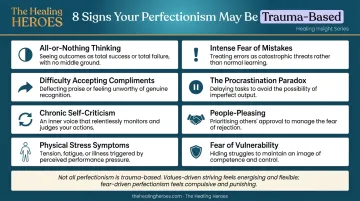
One question cuts through the noise: Does striving feel like it comes from desire and genuine care about your work — or from fear of what will happen if you fall short?
If the answer is fear — if mistakes trigger shame rather than problem-solving, if rest feels dangerous rather than restorative — that fear has a origin point worth finding.
And if several of these signs resonate, that doesn't mean something is broken. It means your nervous system adapted to survive difficult experiences. Those adaptations can shift — and that's exactly what trauma-informed consulting is designed to help with.
How Women Heal from Trauma and Perfectionism
The fear most driven women carry into this work is that healing will make them less. Less motivated. Less sharp. Less successful.
The evidence points the other way. When perfectionism is driven by fear, enormous energy goes toward shame management, paralysis, and avoidance. Healing doesn't lower standards — it relocates them from childhood fear to authentic values. The drive stays. What falls away is the dread underneath it.
Trauma-Informed Therapy Approaches
Several modalities address perfectionism at its root rather than just managing its surface symptoms:
- EMDR processes the specific memories where perfectionistic beliefs were encoded — the moments a child learned that imperfection meant danger. It's supported by evidence across 26 randomized controlled trials for trauma and PTSD treatment.
- IFS (Internal Family Systems / parts work) approaches the inner critic not as an enemy to defeat, but as a protector to understand. The question becomes: what is this critical part afraid of? That reorientation moves women from self-attack toward curiosity — and curiosity is where real change begins.
- Somatic work builds nervous system capacity to tolerate imperfection — to feel the discomfort of an unmade choice or an imperfect outcome without the body escalating into a threat response.
- ACT (Acceptance and Commitment Therapy) builds psychological flexibility with difficult emotions rather than trying to eliminate them. Research supports its effectiveness: one RCT found ACT superior to a waitlist control for clinical perfectionism, with a separate 110-participant study showing improvements in perfectionism, inflexibility, and wellbeing.
- CBT has the strongest direct evidence base. A meta-analysis of 15 randomized controlled trials involving 912 participants found CBT for perfectionism reduced perfectionism and symptoms of anxiety and depression.
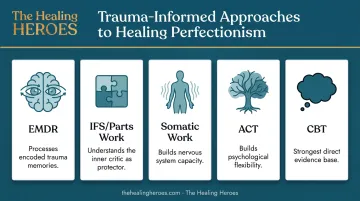
No single modality is right for every woman. What matters most is finding a therapist who understands the trauma-perfectionism connection — not just the behavior, but the nervous system underneath it.
The Role of Self-Compassion
Self-compassion is not a soft alternative to high standards. Research shows it's more effective for motivation and growth than self-criticism — and the studies make this concrete.
Breines and Chen (2012) found across four experiments that self-compassion increased self-improvement motivation following failure — more so than self-esteem-boosting approaches. A separate study of over 1,000 adolescents and adults found that self-compassion moderated the link between maladaptive perfectionism and depression. Treating yourself with the warmth you'd offer a good friend isn't indulgence — it directly counters the shame that fuels the perfectionist loop.
Practical Starting Points
You don't need to be in therapy to begin shifting the pattern:
- Notice the inner critic — journal what it says and when it shows up. Naming the pattern creates distance from it.
- Challenge all-or-nothing thinking — ask whether the situation is genuinely binary, or whether you've collapsed the middle ground.
- Practice intentional "good enough" in low-stakes situations — send the email before it's perfect, leave the dish in the drying rack. Build tolerance for imperfection in small doses.
- Use mindfulness to interrupt spirals — not to stop the thoughts, but to notice them without fusing with them.
The Role of Shame
Underneath most trauma-driven perfectionism isn't guilt — it's shame. Guilt says I did something wrong. Shame says I am something wrong. Research links perfectionistic concerns more strongly to shame than to adaptive guilt.
Healing eventually means touching this shame directly — not managing it through perfect performance, but bringing it into relationship. With a therapist. With a trusted community. With your own inner experience, over time. Performance can keep shame contained for a long time. But it's connection — with another person, with your own felt experience — that actually moves it.
A Resource for Exploring the Landscape
For women who want to understand different healing paths before choosing a direction, The Healing Heroes podcast — hosted by Chandler Stroud — features in-depth expert conversations spanning EMDR, somatic practices, parts work, breathwork, and more. It's an accessible way to hear practitioners describe their modalities directly, so you can orient toward what resonates before committing to a specific path. It's not a replacement for professional support, but it's a genuinely useful place to start orienting. You can explore the podcast at thehealingheroes.com.
Frequently Asked Questions
What type of therapy is best for perfectionism?
There's no single best approach, but trauma-informed therapies tend to be most effective when perfectionism is rooted in early experiences. EMDR, IFS, CBT, and ACT are all commonly used — CBT has the strongest direct research base for perfectionism specifically. A therapist who understands both trauma and perfectionism together will serve you better than one who specializes in only one side of that equation.
What is maladaptive perfectionism?
Maladaptive perfectionism is driven by excessive concern over mistakes, fear of failure, and the equation of imperfection with unworthiness. Unlike healthy striving, it creates more distress than it resolves — and is associated with anxiety, depression, and burnout. The key signal is that achievement brings relief, not satisfaction.
What is the 70/30 rule for perfectionism?
The 70/30 rule is a practitioner heuristic: completing something to 70% quality gets it done and functional, while the remaining 30% represents diminishing returns relative to the energy spent. Therapists use it as a behavioral experiment to help perfectionists practice releasing the need for flawless outcomes.
How do I know if my perfectionism is a trauma response and not just high standards?
The clearest signal is what drives it. If striving feels fueled by fear of what will happen if you fall short — and if mistakes trigger shame or disproportionate anxiety rather than problem-solving — it's likely rooted in earlier experiences rather than genuine care about quality. A therapist can help explore this distinction in depth.
Can healing from perfectionism make me less motivated or successful?
Most women find the opposite. Trauma-driven perfectionism consumes enormous energy in shame management, avoidance, and paralysis. Healing frees that energy. Motivation grounded in genuine values tends to be more sustainable and more creative than motivation built on fear — and it doesn't need constant dread to keep moving forward.