That internal accusation is the problem. Not you. The issue is that most women were never taught how to process difficult emotions — only how to push through them.
Emotional resilience isn't a personality trait you either have or don't. It's a skill set. And this guide covers exactly what that skill set looks like: what emotional resilience actually means for women, the inner architecture behind it, daily practices that build it, how unresolved trauma depletes it, and why healing communities and diverse modalities belong in the picture.
Key Takeaways
- Emotional resilience is learnable — the American Psychological Association confirms it consists of behaviors, thoughts, and actions anyone can develop
- Women face compounded stressors — caregiving demands, societal perfectionism, and gender-based pressure — that deplete emotional reserves faster than most recognize
- The core building blocks are self-awareness, emotional regulation, self-compassion, flexible thinking, and purposeful connection
- Daily habits like movement, sleep, journaling, and boundary-setting directly strengthen resilience over time
- Community, trauma-informed therapy, and holistic healing modalities are foundational to lasting resilience — not optional extras
What Emotional Resilience Actually Means for Women
It's Not Toughness
The APA defines resilience as the ability to adapt well in the face of adversity, trauma, or significant stress — and critically, it describes resilience as involving behaviors and thoughts that anyone can learn. It's not a fixed trait you either have or don't.
Yet the most common misconception women hold is that resilience means being stoic, self-sufficient, and unaffected. That version of resilience leads to suppression, not processing. And suppression erodes genuine resilience over time.
Real resilience means moving through difficulty without being indefinitely derailed. Pain is part of it. What separates resilience from mere endurance is having tools that help you find your way back — and using them.
Why This Hits Differently for Women
Women face a specific, layered set of stressors that make emotional reserves harder to maintain:
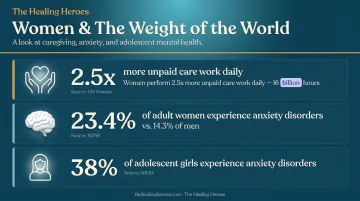
- According to UN Women, women and girls perform 16 billion hours of unpaid care work daily — roughly 2.5 times more than men
- NIMH data shows 23.4% of adult women experience anxiety disorders compared to 14.3% of men; for adolescent girls, that figure climbs to 38%
- Research on "self-silencing" — the gendered pattern of suppressing needs to maintain relationships — links this behavior to higher rates of depression, anxiety, and eating disorders in women
Layer in workplace gender-based pressure, societal perfectionism, and the persistent expectation to put others first, and emotional reserves get spent faster than they can be rebuilt.
Signs Your Resilience Is Running Low
- Persistent emotional exhaustion that doesn't lift after rest
- Heightened reactivity to small stressors that wouldn't normally affect you
- Chronic self-criticism that runs on autopilot
- Tendency to isolate when overwhelmed, rather than reach out
- Difficulty bouncing back from setbacks within a reasonable timeframe
Noticing these patterns is how you stop mistaking depletion for your default state — and start doing something different.
The Building Blocks of Emotional Resilience
These aren't sequential steps — they're interconnected capacities that reinforce each other. Developing one strengthens the others.
Self-Awareness and Emotional Literacy
You cannot regulate what you cannot name. Self-awareness — the ability to identify what you're feeling, understand what triggered it, and recognize patterns in your responses — is the foundation from which every other resilience skill grows.
A simple practice: before reacting to a difficult moment, pause and label the emotion. I'm feeling anxious because I have no control here. That single act interrupts automatic reactivity and gives you choice about what comes next.
Emotional Regulation
Emotional regulation means responding constructively rather than reacting impulsively or shutting down entirely.
The neuroscience explains why this is hard under stress: stress signaling impairs prefrontal cortex function, the brain region responsible for reasoning and decision-making, while the amygdala (your threat-detection center) takes over. Regulation practices restore that connection. A 2023 systematic review found 54 of 72 breathing interventions were effective for reducing stress or anxiety — making breathwork one of the most accessible and evidence-backed tools available.
Effective regulation practices include:
- Deep diaphragmatic breathing (shown to reduce cortisol and improve attention)
- Grounding techniques that anchor you to physical sensation
- Movement, which processes stress hormones and restores nervous system balance
Self-Compassion
Women are often their own harshest critics, and that inner critic actively works against resilience. Self-compassion, as defined by researcher Kristin Neff, involves three elements: self-kindness, a sense of common humanity, and mindfulness. It means treating yourself with the same understanding you'd offer a close friend during a hard time.
The research case is clear:
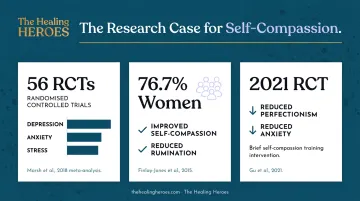
- A 2023 meta-analysis of 56 randomized controlled trials found self-compassion interventions produced meaningful reductions in depression, anxiety, and stress
- A separate meta-analysis with predominantly female participants (76.7% women) found moderate improvements in self-compassion alongside significant reductions in rumination
- A 2021 randomized trial found brief self-compassion training reduced both maladaptive perfectionism and anxiety — which means for women who carry perfectionism as a default, this is where to start
Flexible Thinking and Cognitive Reframing
The stories we tell ourselves about adversity shape how long we stay stuck in it. When we assume setbacks are permanent, affect every area of life, and reflect personal failure, we're engaging in three thinking patterns that directly erode resilience.
Cognitive reframing doesn't mean forced positivity. It means shifting toward accuracy. Instead of I always fail, try this didn't work and I can learn from it. That shift — from fixed to specific — is where recovery begins.
Purposeful Connection
Relationships aren't just emotionally supportive; they are neurobiologically regulating. A landmark meta-analysis found people with stronger social relationships had a 50% increased likelihood of survival compared to those with weaker social ties.
For women specifically, research by Shelley Taylor and colleagues identified a distinct stress response pattern: "tend-and-befriend", a behavioral inclination toward seeking connection rather than fighting or fleeing under stress. Community isn't a nice-to-have for women's resilience. It's a primary mechanism.
Practical Daily Strategies to Build Emotional Resilience
Small, consistent actions compound. These are the practices that translate the building blocks into daily life.
Somatic Self-Care as Your Foundation
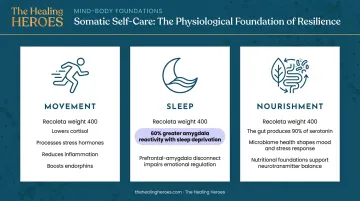
Emotional resilience is physiological before it's psychological. Three physical pillars directly regulate your emotional capacity:
- Movement: Regular exercise processes stress hormones, lowers cortisol, reduces systemic inflammation, and stimulates endorphin release. Even moderate movement lowers anxiety and reduces depression symptoms.
- Sleep: Research published in Current Biology found sleep deprivation produces roughly 60% greater amygdala reactivity to negative stimuli, alongside a functional disconnect between the prefrontal cortex and amygdala. Poor sleep makes emotional regulation significantly harder.
- Nourishment: The gut-brain axis is a real, bidirectional communication pathway. Gut microbiota influence mood through neurotransmitter production, which is why nutrition affects emotional capacity, not just physical health.
Mindfulness and Nervous System Practices
Mindfulness-based interventions have strong evidence behind them. A 2021 analysis of 23 studies found mindfulness-based approaches more effective than standard treatments for anxiety.
You don't need a formal meditation practice. Accessible micro-practices include:
- Box breathing — inhale 4 counts, hold 4, exhale 4, hold 4
- Body scans — a slow, attentive sweep from head to feet, noticing without judgment
- Five-minute morning grounding — feet on the floor, three slow breaths, naming five things you can see
These practices build the habit of awareness and teach your nervous system that it can return to calm.
Journaling and Emotional Processing
Writing externalizes what the mind loops on internally. James Pennebaker's decades of research on expressive writing established that writing about difficult experiences supports psychological processing and integration.
The effects are meaningful rather than dramatic, and they compound over time. This works best as a consistent practice, not a one-time exercise.
Try these prompts:
- What am I feeling right now, and what triggered it?
- What would I tell a close friend if she were in this situation?
- What is one thing I can control about this, and one thing I need to release?
Setting Boundaries as an Act of Resilience
Every boundary you fail to set is a slow, invisible drain on your emotional resources. Women are socialized to accommodate others — often at personal cost — which makes boundary-setting feel selfish when it's actually essential maintenance.
Boundaries are energy management. Saying no to what doesn't align with your values is saying yes to what actually sustains you — and that's the precondition for showing up well for anyone else.
A few ways boundaries protect your resilience:
- Declining obligations that consistently deplete you
- Communicating needs directly instead of waiting to be understood
- Protecting time and space for the practices that restore you
Building a Support System That Actually Supports
Not all social contact is equally nourishing. Audit your support network honestly:
- Who helps you feel seen rather than managed?
- Who regulates you rather than escalates you?
- Who leaves you feeling more capable, not more depleted?
Invest deliberately in those relationships. And include professional support — therapy, healing practitioners, coaches — as part of this ecosystem from the start, not as a last resort when things become unbearable.
How Trauma Affects Women's Emotional Resilience
Unprocessed trauma and depleted resilience are directly connected. Trauma keeps the nervous system in a state of chronic activation (hypervigilance) or shutdown (dissociation), consuming the exact same resources needed for emotional recovery.
The numbers reflect a real disparity. The CDC reports that nearly half of women experience contact sexual violence in their lifetimes. NIMH data shows past-year PTSD prevalence is 5.2% among women versus 1.8% among men. More than 1 in 3 women experience intimate partner violence across their lifetimes.
When Trauma Shows Up in Disguise
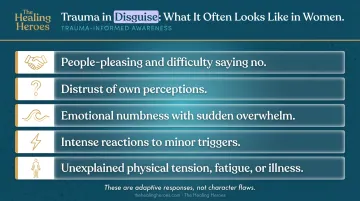
Women often don't recognize their responses as trauma-related. Common manifestations include:
- Persistent people-pleasing and difficulty saying no
- Difficulty trusting your own perceptions or judgment
- Emotional numbness punctuated by sudden overwhelm
- Intense reactions to minor triggers that feel disproportionate
- Physical tension, fatigue, or illness with no clear medical cause
These aren't character flaws. They're adaptive survival strategies that worked at some point and now persist beyond their usefulness. Recognizing them as such opens the door to working with them rather than against yourself — and that's where evidence-based approaches become valuable.
Evidence-Based Approaches to Trauma-Informed Resilience
The WHO and APA both recommend trauma-focused approaches for PTSD treatment. Options with strong research backing include:
- EMDR (Eye Movement Desensitization and Reprocessing) : found effective across multiple randomized controlled trials, with a 2024 review confirming its efficacy for PTSD symptoms
- Trauma-focused CBT : strongly recommended by APA guidelines for PTSD
- Somatic Experiencing : an RCT found a brief SE intervention had significant effects on PTSD symptoms, addressing trauma stored in the body rather than only in conscious memory
Recovery rarely moves in a straight line, and professional support makes a measurable difference. No one should have to navigate this without guidance.
The Healing Heroes podcast has featured credentialed practitioners in exactly these areas , including Jennifer Baumgold, LCSW and certified EMDR therapist, and Moylan Ryan, a somatic psychotherapist with over 40 years of experience. These conversations offer a grounded way to understand what each modality actually involves before deciding which path fits.
The Power of Community, Connection, and Holistic Healing
Co-Regulation Is Real
Humans are wired for connection at a neurobiological level. Spending time with calm, supportive others literally regulates your nervous system — a process researchers call co-regulation, described as mutual adaptation between partners across biology and behavior. For women, whose primary stress response leans toward connection-seeking, community isn't supplementary to healing. It is healing.
Therapy groups, women's wellness communities, and sisterhood circles all create environments where co-regulation happens naturally. This is why isolated resilience-building often plateaus — and why the people around you matter as much as the practice itself.
Holistic Modalities as Legitimate Complements
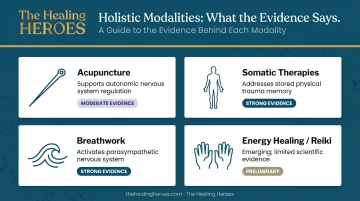
Different tools reach different layers of the same problem. Alongside conventional approaches, several evidence-informed modalities are worth knowing about:
- Acupuncture — Research shows acupuncture can influence autonomic nervous system functions including heart rate variability and skin conductance, supporting its role in nervous system regulation
- Somatic therapies — Address the stored physical memory of stress and trauma in ways talk therapy alone may not reach
- Breathwork — Evidence supports its role in parasympathetic activation and nervous system downregulation; The Healing Heroes podcast features a dedicated episode on neurodynamic breathwork covering exactly this mechanism
- Energy healing (Reiki) — Preliminary research suggests potential benefits, though NCCIH notes the evidence base remains limited and no scientific proof exists for the proposed energy field; include it as one piece of a broader approach
Healing is multimodal — different needs at different moments call for different methods.
The Healing Heroes Podcast as a Navigation Resource
The Healing Heroes podcast, hosted by Chandler Stroud, is built around honest, expert-led conversations across healing disciplines — no fixed path required. The show covers EMDR, somatic therapy, breathwork, acupuncture, energy healing, intuitive guidance, and more, making complex modalities accessible on your own terms.
The podcast has earned multiple Davey Awards — including Gold recognition in 2024 and 2025 across Podcast Series categories — for the depth and care behind these conversations. Available free on Spotify, Apple Podcasts, YouTube, and everywhere podcasts are streamed.
Frequently Asked Questions
How do you build emotional resilience as an adult?
Start with self-awareness — notice what you're feeling and what triggers it — then layer in consistent daily practices: movement, quality sleep, mindfulness, and journaling. Invest in supportive relationships and seek professional support when patterns feel stuck. Resilience builds gradually through repeated practice, not a single breakthrough moment.
What are the 7 C's of emotional resilience?
Dr. Kenneth Ginsburg's framework identifies seven building blocks: Competence, Confidence, Connection, Character, Contribution, Coping, and Control. The framework is useful because it shows resilience isn't one skill — it's built across multiple dimensions simultaneously, from self-belief to stress management to community ties.
What are the 5 C's of resilience?
The Positive Youth Development model identifies five qualities: Competence, Confidence, Connection, Character, and Caring. While not exclusive to resilience, these qualities form the personal and relational foundation that allows people to absorb stress, adapt, and move forward after setbacks.
What are the 3 P's of emotional resilience?
Martin Seligman's model identifies three thinking traps that erode resilience: Permanence (assuming setbacks last forever), Pervasiveness (assuming one failure affects all areas of life), and Personalization (assuming the setback is entirely your fault). Recognizing and challenging these patterns is central to building a resilient mindset.
Is emotional resilience different for women?
Yes — the core skills are universal, but women face distinct stressors including disproportionate caregiving loads, societal perfectionism, and higher rates of gender-based trauma. Women's documented stress response also leans toward connection-seeking, which means relational and community-based healing often accelerates recovery in ways solo practices alone don't.
Can EMDR or somatic therapy help build emotional resilience?
Yes. Modalities like EMDR, somatic therapy, and breathwork address nervous system dysregulation and stored trauma responses in ways talk therapy alone may not reach. For women whose resilience has been depleted by unresolved trauma or chronic stress, these approaches can rebuild the nervous system's baseline — restoring the capacity to regulate, recover, and respond rather than just react.
The Healing Heroes and content posted by Healing Heroes LLC is presented solely for general informational, educational, and entertainment purposes. It is not intended as a substitute for the advice of a physician, professional coach, psychotherapist, or other qualified professional. Users should not disregard or delay obtaining medical advice for any medical or mental health condition they may have and should seek the assistance of their healthcare professionals for any such conditions.