
This isn't a personal failing. It's one of the most human responses to trauma there is.
Trauma — whether a single overwhelming event or years of relational wounds accumulated slowly — doesn't just leave emotional pain in its wake. It can reshape how a woman understands herself at the most fundamental level. As Chandler Stroud, founder of The Healing Heroes, puts it: "The woman you're trying to become isn't in front of you. She's behind you, untouched by everything that came after."
This guide explores how trauma disrupts identity, what that disruption looks like in daily life, the survival roles women often adopt without realizing it, and practical ways to begin finding your way back.
Key Takeaways
- Trauma doesn't erase identity — it buries it beneath survival strategies that once kept you safe
- Identity loss often happens gradually, through quiet adaptation to unsafe or emotionally demanding environments
- The body holds this disruption just as much as the mind does — healing requires both
- Rebuilding identity means recovering who was always there, not becoming someone new
- No single path fits everyone; what resonates for you is worth trusting
How Trauma Fragments a Woman's Sense of Self
What Happens in the Brain
When trauma occurs — especially repeated or relational trauma — the brain reorganizes itself around one priority: survival. Research shows that PTSD is associated with decreased function in the medial prefrontal cortex and increased amygdala activation, disrupting the circuits responsible for emotional regulation and self-reflection. The parts of the brain most involved in thinking clearly about who you are go quiet under threat.
The sense of self relies on the brain's default mode network — a system that in PTSD shows reduced resting-state connectivity. Women with interpersonal or developmental trauma-related PTSD show specific disturbances in self-referential processing (how the brain makes sense of personal experiences): they're more likely to associate negative words with themselves and less likely to associate positive ones.
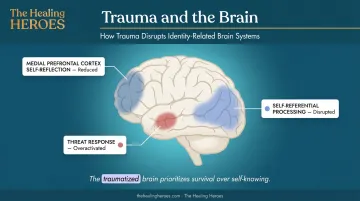
The brain isn't broken. It's adapted. But those adaptations come at a real cost to self-knowing.
When the Story Breaks
Identity isn't only how we feel — it's the story we tell about ourselves. Psychologists Dan McAdams and Kate McLean define narrative identity as an internalized, evolving life story that integrates the reconstructed past and imagined future to give life coherence and purpose.
Trauma interrupts that story. Traumatic memories resist integration into a coherent narrative: they fragment, intrude, and refuse to sequence. Research confirms that constructing coherent autobiographical narratives is directly linked to psychological well-being. When trauma makes that coherence impossible, the sense of self becomes harder to hold.
The Weight of Shame
Shame compounds this disruption in a particular way. The distinction between guilt and shame matters here:
- Guilt says: I did something bad
- Shame says: I am bad
Shame convinces women that trauma happened because of who they are, not what was done to them. Neurologically, this isn't just a metaphor — research shows shame activates regions associated with social pain, including the dorsal anterior cingulate cortex and anterior insula, the same circuits involved in physical pain. Shame doesn't just feel bad — it registers in the nervous system as a genuine threat, making self-reconnection feel dangerous.
Fragmentation was a response, not a failure. The brain adapted to protect you. Healing means creating enough safety for what was always there to resurface — not rebuilding from scratch.
Signs Your Identity Has Been Disrupted by Trauma
Most women don't experience identity disruption as a dramatic crisis. It builds slowly — a quiet, creeping disconnection that eventually starts to feel like just who you are.
Internal Signs
- Feeling like an observer of your own life rather than someone living it
- Not knowing what you want, feel, or believe when no one is watching
- A persistent sense of emptiness even when life looks fine from the outside
- Difficulty naming your emotions or preferences with any confidence
That last experience has clinical grounding. Alexithymia — difficulty identifying and describing emotions — is associated with PTSD symptoms and represents one way trauma can sever a woman from her own inner life. This isn't a character flaw or emotional immaturity. It's a learned response the nervous system adopted to survive.
The dissociative subtype of PTSD, characterized primarily by depersonalization (feeling detached from oneself) and derealization (feeling the world is unreal), affects an estimated 15–30% of people with PTSD. The "observer of your own life" feeling isn't metaphor — for many women, it has a neurological basis.
Behavioral and Relational Signs
- Chronic people-pleasing or difficulty asserting a preference without anxiety
- Taking on whatever identity feels "safe" in a given relationship
- Struggling to make decisions without intense second-guessing
- Feeling unfamiliar with your own history or choices — as if someone else made them
Recognizing these signs matters more than it might seem. Many women spend years assuming this disconnection is simply who they are — never realizing it's a response to what happened to them. Naming it accurately is the first step toward separating your trauma response from your actual self.
The Survival Roles Women Adopt After Trauma
When an environment is unsafe, unpredictable, or emotionally demanding, the psyche learns to shapeshift. These adaptations aren't personality flaws. They were intelligent responses to circumstances that offered no better options.
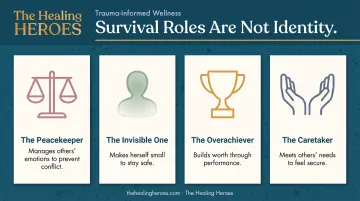
Four Common Roles
The Peacekeeper: She monitors everyone's emotional temperature and manages conflict before it ignites. She's attuned, responsive, and often exhausted. Her needs learned to wait.
The Invisible One: She makes herself small, quiet, and easy to overlook. Taking up less space felt safer than the alternative.
The Overachiever: She built her worth out of performance and productivity. Achievement became the language she used to ask for love and stability.
The Caretaker: She meets everyone else's needs preemptively, having learned that being needed was a kind of insurance against abandonment or rejection.
Every one of these roles worked. The problem is that over time, they can come to feel like identity itself, making it genuinely hard to separate who I am from what I learned to do to survive. That distinction is where healing gets interesting — and where the nervous system tends to push back.
Why Letting Go Feels Threatening
The nervous system doesn't distinguish between a survival pattern that's no longer needed and one that's still essential. According to Porges' polyvagal framework, the autonomic nervous system constantly scans for safety cues outside conscious awareness. Familiar patterns (even painful ones) register as known, and known registers as safe.
This is why unlearning these roles often triggers grief or anxiety rather than relief. That discomfort isn't evidence that healing is going wrong. It's the nervous system processing a deep shift, one that, over time, creates room for something more authentic.
Finding Your Way Back: Practical Steps to Reconnect with Yourself
Start with the Body
Before a woman can know who she is, she needs to be able to safely inhabit her body. Interoception — the internal sense of physical sensations — is where this work begins.
Somatic Experiencing, developed by Peter Levine, guides attention toward interoceptive and proprioceptive experience as a way of reconnecting with internal signals after trauma. The concept of the felt sense, from Eugene Gendlin's focusing-oriented work, describes an embodied inner knowing — something the body holds before language arrives.
Starting points that don't require formal therapy:
- Notice how your body feels against the chair you're sitting in right now
- Track your breath for ten seconds without trying to change it
- Name one physical sensation without judgment — tight, warm, heavy, open
These small acts of attention begin rebuilding the bridge between body and self.
Mindfulness as Active Noticing
Mindfulness has solid evidence for supporting trauma recovery — particularly around attention, emotion regulation, and interoceptive awareness. The goal isn't a perfect meditation practice. It's cultivating the habit of noticing.
Simple starting points:
- One mindful breath before a meal
- Noticing one specific sensory detail in your environment each morning
- Pausing before you agree to something and checking in with your body's response
One important note: for women prone to dissociation, mindfulness practices occasionally need trauma-sensitive adaptation. If turning inward consistently feels overwhelming rather than grounding, working with a trauma-informed practitioner matters.
Exploration Through Low-Stakes Curiosity
Preferences, opinions, and values don't announce themselves — they reveal themselves through experience. The pressure to have everything figured out is part of what keeps identity stuck.
Journaling prompts that open this exploration:
- What parts of me were hidden to survive?
- Who am I choosing to become now?
- What would I do, think, or feel if I wasn't afraid of the response?
Creative expression — writing, art, movement — works in a similar way. These aren't self-improvement projects. They're experiments in noticing what feels true.
Working with the Inner Critic
For trauma survivors, the inner critic often speaks loudest when identity work begins. It shows up as catastrophizing, harsh comparisons, and perfectionism — patterns that discourage any move toward authenticity.
The approach that helps is recognition, not suppression. The inner critic is a frightened, protective voice that developed in response to real experiences. It doesn't need to be destroyed. It needs to learn it's no longer making decisions alone.

Signs the inner critic is running the show:
- Dismissing your own needs before anyone else can
- Comparing your healing pace to others'
- Feeling that authenticity is dangerous or selfish
Connection as Part of Recovery
Healing identity doesn't happen in isolation. Social support functions as a genuine protective factor in posttraumatic recovery — not just emotional comfort, but a biological buffer against continued harm. Safe relationships provide the mirror through which a woman begins to see herself more clearly.
This includes therapeutic relationships, peer communities, and trusted friendships where authenticity isn't punished.
Healing Modalities That Support Identity Reconstruction
No single modality works for everyone. What matters is finding what helps you feel more present, more yourself.
Evidence-Based Therapeutic Approaches
| Modality | What It Addresses |
|---|---|
| EMDR | Processes stored traumatic memories that distort self-perception; targets unprocessed memories containing negative beliefs about the self |
| Somatic Therapy | Heals the body's held trauma responses through interoceptive and movement-based work |
| Cognitive Processing Therapy (CPT) | Directly challenges distorted trauma-related beliefs — about safety, trust, self-worth, and intimacy — through structured cognitive restructuring |
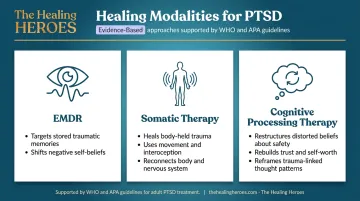
Both EMDR and trauma-focused CBT variants carry strong guideline support from the WHO and APA for adult PTSD treatment. Somatic Experiencing shows promising results, with a growing body of research.
Complementary and Holistic Approaches
Alongside formal therapy, many women find meaningful support through:
- Breathwork, where emerging evidence points to real benefits for stress and nervous system regulation, though research is still developing
- Acupuncture, which many women find helpful for calming trauma responses even as the PTSD evidence base continues to grow
- Energy healing practices, which can serve as a gentler entry point for women not yet in therapy or looking for exploratory support between sessions
If you're not sure where to start, The Healing Heroes podcast features in-depth conversations with practitioners across all of these disciplines. It's a low-pressure way to hear directly from the people doing this work and get a feel for what might resonate before you commit to anything.
Healing isn't linear, and neither is choosing how to heal. Treating modality exploration as part of the process — not a detour from it — is itself a form of self-trust.
Frequently Asked Questions
Why does trauma make it so hard to know who I am?
Trauma activates the brain's survival systems, which prioritize immediate safety over self-reflection. Over time, this trains the brain away from the identity-forming processes — self-awareness, narrative coherence, emotional recognition — that a stable sense of self depends on. The disruption isn't permanent, but it does require intentional support to reverse.
What does identity loss after trauma actually feel like for women?
Common experiences include feeling like an observer of your own life, not knowing what you want or feel unless someone else tells you, chronic people-pleasing, and a persistent sense of hollowness even when external circumstances appear stable. Many women assume this is simply their personality, not recognizing it as a response to what they lived through.
Is it possible to fully rebuild your identity after trauma?
Yes. The goal isn't returning to who you were before — it's discovering who you authentically are now. Research indicates that trauma-focused psychotherapy can be associated with meaningful changes in the brain structures involved in self-perception, and the brain retains the capacity for that change at any age.
How long does it take to reconnect with yourself after trauma?
There's no fixed timeline. The APA notes that recovery pace depends on trauma type, available support, and individual history. What research consistently supports is that small, consistent practices create meaningful change over time — direction matters more than speed.
Can I start healing my sense of identity without formal therapy?
Yes. Mindfulness, journaling, somatic awareness practices, community connection, and education about trauma and healing modalities are all meaningful starting points. Trauma-informed therapy can significantly deepen and accelerate the work, but it doesn't have to be the first step.