Introduction
There's a particular kind of exhaustion that doesn't show up in bloodwork. Many women know it well — carrying grief, anxiety, and unresolved trauma while maintaining the appearance of holding everything together. The message from the outside world is consistent: push through, stay productive, keep going.
Spiritual healing offers a different path. Not a rejection of clinical care, but something that works alongside it — addressing the emotional, energetic, and meaning-making dimensions of a woman's life that symptoms alone don't capture.
According to CDC data, 24.5% of women reported depression symptoms in 2022 compared to 18.0% of men — and those numbers don't account for what's happening beneath the surface. The anxiety, the exhaustion, the sense that something is missing: these are worth paying attention to.
This guide covers what spiritual healing actually is, the types available, why it matters specifically for women, and how to begin building a practice that's yours.
Key Takeaways
- Spiritual healing addresses mind, body, and spirit together — it's a complement to clinical care, not a replacement
- Dozens of modalities exist, from Reiki and EFT to somatic therapy and journaling, and no single path fits every woman
- Women face distinct pressures — caregiving demands, emotional labor, and higher trauma rates — that make holistic approaches especially relevant
- Consistency with even one practice matters more than dramatic commitment
- Starting small — one prompt, one walk, one session — is enough
What Is Spiritual Healing for Women?
Spiritual healing is the process of restoring inner balance by addressing not just physical or mental symptoms, but the deeper emotional, energetic, and meaning-making dimensions of a person's life.
Spirituality here isn't about religion — it refers to a woman's relationship with her inner self: her sense of purpose, capacity for presence, and connection to something larger than daily routine. No specific doctrine required.
What the Process Actually Involves
Spiritual healing is active, not passive. It's not about wishing pain away. It involves:
- Moving through emotional wounds rather than suppressing or bypassing them
- Releasing stored stress held in the body after prolonged anxiety, trauma, or burnout
- Cultivating self-compassion as a daily practice rather than an occasional gesture
- Rebuilding identity and purpose after experiences that have depleted a woman's sense of self
Why It Matters Specifically for Women
The numbers make the case clearly. Research points to several compounding pressures women face that clinical treatment alone rarely resolves:
- Women are roughly twice as likely as men to develop PTSD, with lifetime prevalence rates of 10–12% versus 5–6% for men
- Women make up the majority of unpaid caregivers — and the Office on Women's Health notes they report stress-related health problems from caregiving more often than men
- Emotional labor is a confirmed job stressor tied to burnout, exhaustion, anxiety, and depression — and women disproportionately carry it across both work and home
Clinical approaches can ease symptoms. Spiritual healing works on the layer below them — restoring the internal resources that quietly erode when self-care comes last, year after year.
What Types of Spiritual Healing Are There?
Spiritual healing modalities span a wide spectrum — from ancient traditional practices to contemporary integrative methods. The right starting point depends on where you are, what you believe, and what your body and mind need right now.
Energy-Based Healing
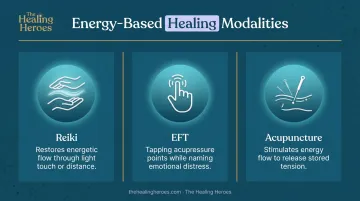
Energy-based modalities work from the premise that emotional and physical imbalances are connected to disruptions in the body's energetic field:
- Reiki — A practitioner channels healing energy through light touch or distance, with the goal of restoring flow and calm
- EFT (Emotional Freedom Technique) — Tapping specific acupressure points with the fingertips while naming emotional distress; a 2022 systematic review across 56 RCTs found evidence for reductions in anxiety, depression, and PTSD
- Acupuncture — Fine needles stimulate energy flow through the body's meridian system, working to release stored tension and support recovery on both physical and emotional levels
Mind-Body Practices
These practices connect mental and physical experience — and they're among the most researched modalities for reducing anxiety and stress:
- Meditation — A JAMA Internal Medicine meta-analysis found mindfulness meditation produced measurable improvements in anxiety and depression compared to active controls; as little as 13 minutes of daily practice for 8 weeks has shown benefits for mood and attention
- Breathwork — A 2023 meta-analysis of randomized controlled trials found breathwork reduced self-reported stress, anxiety, and depression; a separate review found 54 of 72 breathing interventions were effective
- Yoga — Supports emotional regulation and body awareness, though evidence quality varies; most beneficial when practiced consistently rather than sporadically
Reflective and Expressive Practices
These are accessible, low-barrier entry points that don't require a practitioner:
- Journaling — Prompts like "What am I carrying that isn't mine?" or "What does my body need today?" create space for honest self-examination; a study published in Psychiatry Research found expressive writing significantly reduced PTSD severity in women
- Creative arts — Drawing, movement, and music provide non-verbal pathways to process emotion
- Nature immersion — Research confirms forest environments reduce cortisol in the short term and restore attentional capacity, offering a form of healing that requires nothing more than stepping outside
Integrative Therapeutic Modalities
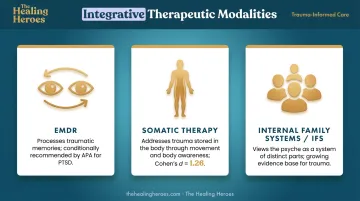
When healing calls for clinical depth, these modalities — offered by licensed practitioners — bring together psychological and body-based frameworks:
- EMDR — Conditionally recommended by the APA for PTSD; licensed clinical social worker Jen Baumgold, featured on The Healing Heroes, describes EMDR as a way to process traumatic memories and remove emotional obstacles that block healing
- Somatic therapy — Addresses trauma stored in the body through movement and body awareness; a 2017 RCT of Somatic Experiencing found significant effects on PTSD severity (Cohen's d = 1.26)
- Internal Family Systems (IFS) — Views the psyche as a system of distinct parts; the evidence base is still developing, though early research and clinical use show meaningful results for trauma and parts-based inner work
Core Spiritual Healing Practices for Women
These are invitations, not prescriptions. Start with what feels accessible.
Meditation and Mindful Stillness
Daily meditation doesn't require clearing the mind — it requires learning to observe thoughts with less reactivity. That distinction matters for women who've tried meditation and given up because thoughts kept arising.
Simple entry formats:
- Breath-focused meditation — Follow the inhale and exhale without controlling it
- Body scan — Move attention slowly through the body, noticing sensation without judgment
- Guided visualization — Audio-led sessions that give the mind a gentle anchor
Research suggests 13 minutes daily for at least 8 weeks produces measurable improvements in mood, memory, and attention. Cortisol reduction has been observed in both short-term and sustained practice.
Journaling as Spiritual Practice
Journaling in this context isn't a diary — it's spiritual inquiry. The goal is to excavate emotional patterns and reconnect with inner wisdom rather than simply log events.
Useful prompts to start:
- What am I carrying that isn't mine?
- What does my body need today?
- Where am I performing versus actually feeling?
Pennebaker and Beall's foundational 1986 study found that writing about the emotional content of trauma was associated with fewer health visits over the following six months. More recent work confirms expressive writing reduces PTSD severity in women specifically.
Connecting with Nature
Time in natural environments — forests, water, open sky — has measurable effects on the body. A systematic review in the International Journal of Biometeorology found that forest bathing significantly reduced cortisol in the short term. Attention Restoration Theory adds that natural environments restore the capacity to concentrate that stress depletes.
In practice, this means a 20-minute walk outside, sitting near water, or tending a garden. The science holds regardless of how simple the setting is.
Community and Sisterhood
Being witnessed by other women — having experiences held with compassion rather than judgment — directly addresses shame and isolation, two of the most persistent barriers to healing.
A 2024 review found that social connection is associated with a 50% improvement in survival odds — making it one of the most powerful health variables researchers have identified. For women specifically, social support reduces perceived stress and lowers anxiety and depression.

This can take the form of:
- Women's circles or group healing sessions
- Faith communities with shared values
- One trusted accountability partner who shows up consistently
Ritual and Intentional Self-Care
Personal ritual is distinct from generic self-care. A bath is self-care. Lighting a candle, setting an intention, and sitting quietly for five minutes before the day begins is ritual — it creates a reliable signal to the nervous system that her inner life is worth returning to, regardless of what the day brings.
Ritual doesn't require elaborate ceremony — just repetition and purpose. A brief morning practice, a seasonal reflection, or an end-of-day releasing exercise each build the same thing: a consistent touchpoint with inner life, no matter what else is happening.
How Spiritual Healing Supports Emotional and Mental Well-Being
The evidence connecting spiritual and mindfulness practices to mental health outcomes is substantial, even where individual studies have limitations.
A 2017 review in Psychiatric Clinics of North America found that mindfulness-based interventions reduced anxiety and depression severity across treatment-seeking populations. For PTSD specifically, a separate 2017 review of mindfulness-based treatments reported medium to large effect sizes and notably low dropout rates.
The Role of Meaning-Making in Trauma Recovery
One of spiritual healing's most distinct contributions is meaning-making — helping women contextualize suffering rather than be defined by it. This isn't toxic positivity. It's the ability to hold what happened honestly — and still move forward as someone whose story isn't finished.
Spiritual healing also offers practical emotional regulation tools and a framework for forgiveness that clinical approaches don't always address:
- Breathwork and somatic awareness to regulate the nervous system during distress
- Meditation practices to build sustained emotional resilience
- Forgiveness and release work to process grief, resentment, and self-blame
Working Alongside Professional Care
Spiritual healing is most effective as a complement to clinical support for serious mental health concerns — not as a replacement. Attempting to use spiritual practice alone to address complex trauma, severe depression, or acute PTSD is neither appropriate nor sufficient.
That limitation is also where integration becomes valuable. More mental health practitioners are now weaving trauma-informed spiritual approaches into clinical work — including:
- Therapists incorporating somatic awareness alongside evidence-based modalities
- Mindfulness-based cognitive therapy (MBCT) combining CBT with meditation practices
- EMDR sessions that include resourcing and meaning-focused reflection
The Healing Heroes podcast offers an accessible way to understand how these integrations work before committing to a practitioner — with episodes featuring licensed clinicians like Jen Baumgold (LCSW, EMDR-certified) and somatic practitioners like Moylan Ryan discussing the clinical and embodied dimensions of trauma healing in plain, accessible language.
Building Your Personal Spiritual Healing Practice
Finding a spiritual healing practice isn't about locating the "correct" system — it's about discovering what genuinely restores and grounds you.
Start with self-inquiry:
- What am I drawn to?
- What feels safe right now?
- What do I need most — stillness, movement, community, or expression?
Choose one or two practices. Not six. Not a complete overhaul. One journaling prompt in the morning, or one 13-minute meditation, or one walk outside without a podcast playing. Consistency matters more than intensity. Research from University College London found it takes anywhere from two to five months for new behaviors to become truly automatic — so give yourself that runway.
Expect nonlinearity. Healing is not a straight line from broken to whole. There are days of genuine peace and days of old patterns returning. Both are part of the process. Neither cancels out the other.
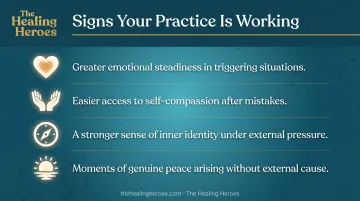
Signs that something is working are often subtle:
- Greater emotional steadiness in situations that used to trigger reactivity
- Easier access to self-compassion after mistakes
- A stronger sense of inner identity that doesn't collapse under external pressure
- Moments of genuine peace that arise without a clear external cause
Noticing even one of those signs is worth paying attention to. If you're still figuring out where to begin, The Healing Heroes podcast is a low-pressure starting point — expert conversations spanning modalities from acupuncture to EMDR to astrology, built to help you understand each approach before committing to it. For more personalized direction, a private consultation is available for women who want a healing roadmap tailored to their specific circumstances.
Frequently Asked Questions
What types of spiritual healing are there?
The main categories are energy-based healing (Reiki, EFT, acupuncture), mind-body practices (meditation, yoga, breathwork), reflective practices (journaling, creative arts, nature), faith-based and ceremonial healing, and integrative therapeutic approaches like EMDR, somatic therapy, and IFS. Most women find their way into more than one category as their healing deepens.
How is spiritual healing different from religion?
Spiritual healing doesn't require religious belief or affiliation. It focuses on inner wholeness, meaning, and connection to self rather than doctrine. It can complement religious faith or exist entirely outside of it, adapting to each person's worldview.
Can spiritual healing work alongside therapy or medical treatment?
Yes, and it's most effective that way. Spiritual healing is a complement to professional mental health care, not a replacement — particularly for trauma, grief, or diagnosed conditions. Many licensed practitioners now integrate mindfulness and somatic approaches alongside clinical approaches.
What are the signs that spiritual healing is working?
Signs are often subtle: increased emotional steadiness, growing self-compassion, reduced reactivity to familiar triggers, a stronger sense of inner identity, and moments of genuine peace that arise without obvious external cause.
Is spiritual healing the same as energy healing?
No. Energy healing (Reiki, EFT, acupuncture) is one category within the broader umbrella of spiritual healing. Not all spiritual healing is energy-based — journaling, meditation, somatic work, and community connection are also forms of spiritual healing with no energy-specific framing required.
How do I start spiritual healing on my own?
Begin with one simple, low-barrier practice: a daily journaling prompt, a short meditation, or time outside in nature. Consistency and self-compassion matter far more than elaborate rituals. Starting small and showing up regularly is the practice.