Work-life balance consulting offers something generic productivity advice can't: a structured, personalized process that actually accounts for the unique pressures women face. This guide covers why balance is harder for women than mainstream wellness content acknowledges, what consulting involves in practice, the key frameworks behind it, practical strategies you can use today, and holistic approaches that address burnout at its roots.
Key Takeaways
- Mental load, caregiving expectations, and emotional labor compound imbalance — scheduling alone won't fix it
- Consulting gives you a structured path to identify imbalances, set boundaries, and build routines around your values
- A 4-pillar framework — physical health, emotional wellbeing, relationships, and career/purpose — pinpoints where attention is most needed
- Boundary-setting and energy management are learnable skills anyone can develop with the right support
- Holistic mind-body approaches reach the nervous system and emotional roots of burnout, not just the to-do list
Why Work-Life Balance Is Uniquely Challenging for Women
The Double Shift Nobody Talks About
According to the 2023 American Time Use Survey released by the Bureau of Labor Statistics, women spend 2.7 hours per day on household activities compared to 2.1 hours for men. That gap compounds across a career. Before a woman opens her laptop in the morning, she's already logged invisible hours of labor that don't appear on any performance review.
This "double shift" — a full-time career layered on top of disproportionate unpaid domestic work — is the structural baseline most women are operating from. It's not a personal productivity failure. And the weight doesn't stop at physical tasks.
The Mental Load: The Real Energy Drain
The mental load is the constant background process of tracking, planning, anticipating, and deciding: who needs a doctor's appointment, what's in the fridge, whether the permission slip went in. It runs continuously, whether or not anyone acknowledges it.
A 2024 peer-reviewed study of 322 mothers of young children found cognitive household labor was directly associated with depression, stress, burnout, and impaired relationship functioning. That's measurable cognitive depletion that starts before the workday begins.
The Superwoman Narrative and Its Cost
Societal conditioning tells women to excel at everything without complaint. Research on the Superwoman Schema — a concept developed by Dr. Cheryl Woods-Giscombé — identifies the pressure women face to suppress vulnerability, show strength at all times, and succeed despite limited resources.
The cost is practical: when rest feels like failure and asking for help triggers guilt, recovery becomes nearly impossible.
This narrative doesn't just exhaust women — it makes recovery harder. When you believe you should be able to handle it all, you stop recognizing legitimate need as a signal worth responding to.
Workplace Pressures Add Another Layer
Inside the office, women absorb additional weight: navigating imposter syndrome (KPMG found 75% of senior executive women have experienced it), managing team emotional dynamics, and proving competence in competitive environments. McKinsey and LeanIn.Org's 2022 Women in the Workplace report found 43% of women leaders were burned out compared to 31% of men at the same level.
None of this reflects individual failure. These are structural pressures with measurable consequences. Recognizing that distinction matters — because you can't work harder to solve a problem that was never yours to solve alone.
What Is Work-Life Balance Consulting for Women?
Defining the Process
Work-life balance consulting is a professional support process in which a consultant brings structured frameworks, assessments, and expertise to help a woman identify her specific imbalances and build a realistic, values-aligned action plan.
Unlike therapy, it doesn't address clinical mental health conditions. And compared to life coaching — which varies widely in rigor — consulting typically has a defined engagement period, defined deliverables, and accountability built in from the start.
What Consultants Actually Do
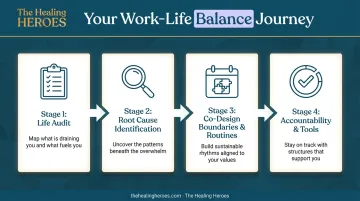
In practice, a work-life balance consultant will:
- Conduct a life audit — assessing where time, energy, and attention currently go versus where they need to go
- Identify root causes — distinguishing symptoms (exhaustion, resentment, irritability) from underlying patterns (chronic boundary violations, perfectionism, unsustainable role expectations)
- Co-design boundaries and routines — building realistic systems the client can actually maintain
- Provide accountability and tools — checking in on progress and adjusting as life shifts
Who Benefits Most
This type of support is particularly well-suited for:
- Working mothers managing career alongside primary caregiving responsibilities
- Women entrepreneurs experiencing founder burnout
- Women in leadership roles absorbing disproportionate emotional labor
- Women navigating major transitions: new role, new child, divorce, empty nest
What to Expect Early On
Most consultants begin with a discovery call or intake session — a non-judgmental conversation exploring current stressors, energy patterns, priorities, and what "better" would actually look like. It's collaborative exploration, not a prescriptive fix handed down from a clipboard.
A 2023 meta-analysis confirmed that workplace coaching reliably produces positive outcomes. For women specifically, those outcomes typically include:
- Greater clarity on personal values and non-negotiables
- Stronger boundary-setting skills
- Reduced day-to-day overwhelm
- A custom plan for sustainable routines
The 4 Pillars of Work-Life Balance
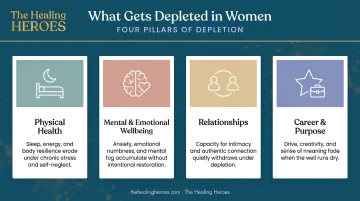
Most work-life balance consulting frameworks organize assessment around four core domains. While these vary slightly by practitioner, the most commonly used pillars are:
| Pillar | What Gets Depleted for Women |
|---|---|
| Physical Health | Sleep sacrificed for productivity, exercise dropped first when time is short |
| Mental/Emotional Wellbeing | Drained by caregiving, emotional labor, and constant cognitive load |
| Relationships | Strained by overwork and the resentment it builds over time |
| Career/Purpose | Sometimes stalled by caregiving gaps or penalized for boundary-setting |
The Wheel of Life: Seeing It Clearly
The Wheel of Life — a coaching tool widely used and recognized by the International Coach Academy — helps clients rate current satisfaction across each pillar on a scale of 1 to 10. The visual result makes invisible patterns obvious: you can immediately see which domains are neglected and which are consuming everything.
Why Imbalance in One Area Always Spreads
Neglected physical health degrades mental clarity, which strains relationships, which quietly erodes career performance. It's a cascade — and each stage compounds the one before it. A meta-analysis drawing on over 1,000 effect sizes confirmed that work-family conflict creates measurable spillover across multiple life domains.
This is exactly where consulting work earns its value: helping you trace the chain back to where it actually breaks, rather than patching each symptom as it surfaces.
Practical Strategies Women Can Start Using Today
Boundary-Setting Is a Skill, Not a Personality Type
If boundary-setting feels hard, it's probably because no one taught you how — not because you're conflict-averse by nature. Three tactics to start with:
- Define your office hours and communicate them explicitly. "I'm available Monday through Friday, 9–6" is a complete sentence.
- Block personal time before scheduling work obligations. If your workout, your dinner, your reading hour isn't in the calendar first, it won't happen.
- Script a confident decline. "I can't take that on right now, but [alternative]" works better than over-explaining or apologizing.
The Healing Heroes podcast episode "Harness the Power of 'No' with Accountability Coaching" goes deeper on this, specifically addressing boundary-setting as a skill for women navigating societal expectations around compliance and helpfulness.
Manage Energy, Not Just Time
Most women aren't failing at time management. They're failing at energy management, which is a different problem entirely.
A Harvard Business Review framework by Schwartz and McCarthy makes the case that sustainable performance depends on managing energy across four dimensions: physical, emotional, mental, and meaning-related. The practical shift: stop asking "Do I have time for this?" Start asking "Do I have energy for this?"
Practically, that means:
- Schedule high-focus work during your peak mental energy windows (morning for most people, afternoon for some)
- Reserve lower-energy periods for administrative tasks, emails, or light coordination
- Treat recovery as productive, not indulgent
The 8-8-8 Rule as a Diagnostic Tool
Once you're tracking energy, the 8-8-8 framework gives you a structural baseline to work from. The concept: 8 hours of work, 8 hours of sleep, 8 hours of personal life — a principle traced back to the labor movement and attributed to 19th-century reformer Robert Owen. It's not a rigid prescription. It's a diagnostic.
Most women who map their actual day against this framework find the personal block has shrunk to 3 or 4 hours. That's the value: not achieving a perfect split, but seeing clearly where the imbalance is.
Holistic and Mind-Body Approaches to Restoring Balance
Why Productivity Strategies Alone Don't Work
Time-blocking and to-do lists are useful tools. But for a woman already operating from a depleted nervous system — running on cortisol, chronic low-grade anxiety, and suppressed exhaustion — reorganizing her calendar won't touch the actual problem. The body needs to be part of the solution.
True restoration requires addressing the emotional and somatic dimensions of burnout, not just the schedule.
Mind-Body Modalities Worth Knowing
Several evidence-informed approaches support nervous system regulation and emotional recovery:
- EMDR: Conditionally recommended by the APA for PTSD treatment in adults, and increasingly explored for broader stress processing. A powerful tool for women whose chronic overwhelm has roots in unresolved experiences.
- Acupuncture: A randomized pilot study found preliminary evidence for stress symptom relief; a separate trial examined its effects on burnout and anxiety in healthcare workers. Best approached as complementary support, not a standalone solution.
- Mindfulness-Based Stress Reduction (MBSR): A systematic review of 24 studies found MBSR may improve psychological functioning in employees. Practical applications include yoga nidra, yin yoga, and breathwork as burnout prevention tools.
- Somatic practices: Movement-based approaches like Rolfing and somatic experiencing show preliminary evidence for stress and trauma-related symptom relief — particularly for women carrying chronic tension or unprocessed emotion in the body.
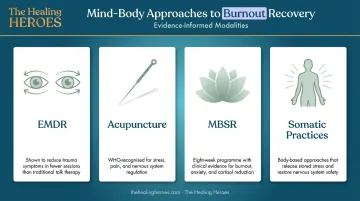
These modalities work alongside structural changes, not instead of them. Nervous system support and schedule redesign are more effective together than either is alone.
The Healing Heroes as a Starting Point
For women curious about integrating holistic support into their healing process, The Healing Heroes podcast offers honest, expert-led conversations across a broad range of modalities — from acupuncture and EMDR to somatic practices and energy healing. Episodes like "Stillness & Somatic Practices for Avoiding Burnout" and "Mindfulness in Motion: Rewiring the Nervous System Through Movement" offer a practical entry point into each discipline before you commit to working with a practitioner.
Host Chandler Stroud built the platform to make mind-body healing feel less overwhelming — offering real conversations with practitioners so you can understand what each modality actually involves before deciding what fits your life.
Frequently Asked Questions
How can women manage work-life balance?
Start by acknowledging that the pressures you face (mental load, caregiving expectations, workplace emotional labor) are real and structural. From there, define your personal non-negotiables, set intentional boundaries, and seek support through consulting, community, or holistic wellness practices. Trying to optimize harder inside an unequal system rarely works.
What is the 8-8-8 rule for work-life balance?
The 8-8-8 rule divides the 24-hour day into three equal blocks: 8 hours of work, 8 hours of sleep, and 8 hours of personal time for relationships, self-care, and rest. It's most useful as a diagnostic benchmark — map your actual day against it to spot exactly where your time is going.
What is the 70/30 rule in work-life balance coaching?
The 70/30 rule suggests dedicating 70% of your energy to professional and high-priority obligations while protecting 30% for personal renewal, rest, and relationships. It's an informal coaching framework, not a research-validated standard, but it's particularly useful for women who treat personal life as whatever's left over after work.
What are the 4 pillars of work-life balance?
The four pillars most commonly used in consulting are physical health, mental and emotional wellbeing, relationships, and career and purpose. Consultants use this as a diagnostic tool to see which areas are depleted and how neglect in one pillar quietly affects the rest.
What does a work-life balance consultant do for women specifically?
A consultant helps identify the root causes of imbalance, including the structural pressures unique to women's lives, then co-creates a realistic, values-aligned plan with practical tools for boundary-setting, priority management, and sustainable routines. The process is collaborative rather than prescriptive.
What are signs a woman needs work-life balance consulting?
Key indicators: chronic exhaustion that sleep doesn't fix, persistent guilt when resting, feeling like every area of life is getting the leftover scraps of your energy, difficulty saying no, and a growing sense of resentment or disconnection from work or relationships you used to care about.