

Many people spend years in talk therapy only to feel like something's still unresolved. That's not a failure of therapy. It's often a sign the healing needs to include the body and spirit, not just the mind.
This guide walks through what holistic emotional healing actually means, the stages it tends to follow, and the practical methods — from breathwork to acupuncture to EMDR — that support a fuller recovery.
Key Takeaways
- Holistic healing treats mind, body, and spirit as one interconnected system, not isolated symptoms
- Recovery typically unfolds in five stages: awareness, understanding, expression, support, and integration
- Breathwork, somatic therapy, and EMDR each unlock different layers of stored emotional pain
- Sticking with one or two methods consistently produces deeper results than sampling everything at once
- A knowledgeable guide helps match the right approach to your specific healing needs
What Is Holistic Emotional Healing?
Holistic emotional healing treats a person as one interconnected system rather than a collection of separate problems to fix. Instead of isolating "anxiety" as a symptom to medicate or reframe cognitively, it asks: where else is this showing up?
The National Center for Complementary and Integrative Health (NCCIH) describes this as whole-person health — an approach that considers biological, behavioral, social, and environmental factors together, rather than treating organs or symptoms in isolation, according to NCCIH's 2021 framework. This framework supports a mind-body-social lens rather than a fixed clinical protocol, offering a way of thinking about health instead of a rigid treatment plan.
The Mind-Body-Spirit Framework
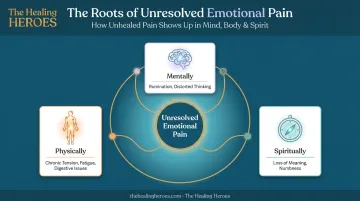
Unresolved emotion rarely stays in one lane. It tends to surface in three interconnected ways:
- Mentally — rumination, distorted thinking, difficulty concentrating
- Physically — chronic tension, fatigue, unexplained illness, digestive issues
- Spiritually — loss of meaning, disconnection from purpose, feeling numb to life
This isn't just anecdotal. A 2018 study on trauma exposure and cortisol response found that greater lifetime trauma exposure in 73 adults correlated with lower basal morning cortisol and increased amygdala and hippocampal activity during acute stress.
Pain that isn't processed doesn't disappear. It gets stored somewhere in the system, often resurfacing as one of the mental, physical, or spiritual symptoms above.
The Stages of Holistic Emotional Healing
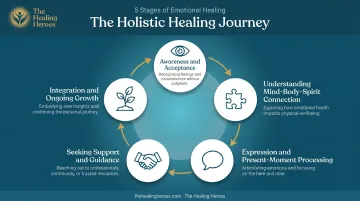
Healing rarely moves in a straight line. Psychiatrist Judith Herman's influential trauma recovery model outlines three broader phases — safety, remembrance/mourning, and reconnection — and notes that setbacks often require revisiting earlier stages, according to Herman's 1998 framework. The five-stage breakdown below is an adaptation built for practical, everyday use.
Stage 1: Awareness and Acceptance
Healing starts with noticing the patterns you've been avoiding. That might mean admitting you numb out with work, scrolling, or busyness instead of feeling what's underneath.
Acceptance isn't resignation. It's simply telling yourself the truth about what happened and how it's affected you — without minimizing it or catastrophizing it.
Stage 2: Understanding the Mind-Body-Spirit Connection
Once you've named the pain, the next step is locating it. Ask:
- Where does this live in my thoughts? (Intrusive worry? Self-criticism?)
- Where does this live in my body? (Tight chest? Clenched jaw?)
- Where does this live in my sense of purpose? (Disconnected? Numb?)
Mapping it this way creates a fuller picture than symptom management alone.
Stage 3: Expression and Present-Moment Processing
Feelings that don't get expressed tend to get stuck. Healthy outlets include journaling, talking with a trusted person, creative work, or body-based release like movement or shaking.
The goal is to feel emotions as they arise rather than suppressing them for later — because "later" often becomes never.
Stage 4: Seeking Support and Guidance
Self-guided processing has limits. Healing happens in connection, not isolation, and trying to work through deep pain entirely alone often stalls progress.
Professional or expert-led support accelerates and deepens the work in ways solo effort usually can't. This might look like:
- A therapist trained in trauma-specific approaches like EMDR
- A bodyworker addressing physical tension tied to emotional pain
- A coach providing accountability and outside perspective
The right guide depends on where you're stuck, not on finding a single "correct" modality.
Stage 5: Integration and Ongoing Growth
Eventually, healing shifts from crisis mode into an ongoing practice. This stage is less about "finishing" and more about building resilience. Setbacks aren't a sign you've failed — they're a normal part of the process, and often a sign of the next layer surfacing.
Holistic Methods That Support Emotional Healing
There's no single right way to heal. Think of this as a toolkit — try what resonates, skip what doesn't.
Mind & Nervous System Practices
Mindfulness, meditation, and breathwork help regulate the nervous system and build tolerance for difficult emotions.
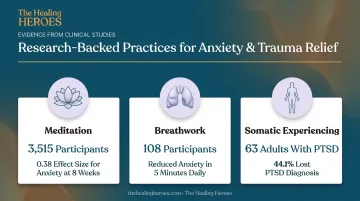
- A 2014 meta-analysis of 47 randomized trials with 3,515 participants found meditation produced moderate improvements in anxiety, with an effect size of 0.38 at eight weeks, according to research published in PubMed
- A 2023 Stanford-led study of 108 participants found that just five minutes of daily breathwork reduced anxiety and negative affect, with exhale-focused "cyclic sighing" outperforming mindfulness meditation for improving mood
Moylan Ryan, a Somatic Therapist and Certified Rolfer® featured on **The Healing Heroes podcast**, teaches NeuroDynamic Breathwork rooted in holotropic breathing traditions. He describes how consistent breath practice can shift the body from a state of somatic retraction into expansion, helping people complete emotional responses that never got fully expressed.
Body-Based & Somatic Practices
Breathwork regulates the nervous system, but the body often holds what the mind can't articulate on its own. Somatic therapy, yoga, and myofascial release work to release that stored tension physically.
- A 2017 randomized study of 63 adults with PTSD found Somatic Experiencing produced large effects on posttraumatic symptoms (d = 0.94–1.26), with 44.1% of participants losing their PTSD diagnosis entirely, per research in PMC
- A 2024 meta-analysis of 954 participants found yoga improved self-reported PTSD and depression symptoms, though benefits weren't always sustained long-term
Moylan Ryan's work centers on the idea that trauma gets "woven into our physical form" — visible in posture, breathing patterns, and chronic tension. Nicole Kim, who blends yoga, Thai bodywork, and sound healing, similarly frames stillness and movement as tools that unlock emotional breakthroughs beyond simple relaxation.
Energy & Spiritual Practices
Beyond body-based work, some people find grief, transitions, and self-understanding easier to process through energy-based or intuitive modalities.
- Acupuncture use among U.S. adults rose from 1.0% in 2002 to 2.2% in 2022, per NCCIH data
- More than 3.7 million U.S. adults have ever seen an energy-healing practitioner
Jacques Depardieu, a board-certified acupuncturist with over 25 years of experience, frames emotional pain as an energetic blockage, using acupuncture to stimulate the flow of qi and release what he calls "body memory." Astrology and human design offer a different angle: Zach Carlsen applies human design to help people understand why they respond to pain the way they do, reducing self-judgment through self-knowledge rather than direct release work.
Evidence-Based Therapeutic Approaches
None of this replaces clinical care. Structured, evidence-based methods remain central for trauma and anxiety, and often work best alongside the holistic practices above.
- CBT is a well-studied therapy commonly used for anxiety disorders, per NIMH
- EMDR carries a conditional recommendation from the APA for adult PTSD treatment, per APA's 2025 PTSD guideline
These are clinician-delivered treatments, not self-guided wellness practices. Pairing one or two complementary methods with a licensed approach tends to produce more sustainable results than juggling everything at once — a focused combination outperforms a scattered one.
Why Expert Guidance Makes a Difference
With dozens of holistic modalities out there, guessing your way through them wastes time and money. Learning directly from practitioners who've spent decades in their field helps you find what actually fits, rather than trial-and-error.
The Healing Heroes podcast, hosted by Chandler Stroud, exists for exactly this reason. Listeners hear real, unscripted conversations with practitioners across disciplines:
- Jacques Depardieu on acupuncture and energetic blockages
- Moylan Ryan on somatic work, Rolfing, and nervous system regulation
- Zach Carlsen on human design and self-understanding
- Jennifer Baumgold, LCSW, on EMDR and trauma treatment
The show has earned multiple Davey Awards, including Gold in Interview & Talk Show for both 2024 and 2025, plus Gold in Health & Wellness for 2025. This third-party recognition reflects the editorial care behind each conversation.
Content like this is educational and complementary. It's not a replacement for licensed therapy or medical care — it's a way to understand your options before choosing a path.
Building a Sustainable Holistic Healing Routine
The biggest mistake people make is trying to overhaul everything at once. A sustainable routine starts smaller, with one or two practices you can actually maintain.
- Pick one or two practices that genuinely resonate: not what worked for someone else, but what you're actually drawn to
- Pair a body-based practice with an expressive one — breathwork plus journaling, or yoga plus therapy
- Revisit your routine seasonally, since what supported you through grief may not be what you need during a career transition
Cait DeMello, a Confidence + Empowerment Coach featured in Healing Heroes' network, describes this pairing well: body-based work like breathwork and somatic movement creates the physiological conditions for release, while an expressive outlet like tarot or journaling helps people access and articulate what surfaces. Neither piece works as well alone, and routines built on just one tend to stall out.
Frequently Asked Questions
What are the stages of holistic emotional healing?
Healing generally moves through awareness, understanding the mind-body-spirit connection, expression, seeking support, and integration. These stages aren't rigid — people often revisit earlier ones as new challenges surface.
What holistic methods help with emotional healing?
Common approaches include mindfulness and breathwork, somatic bodywork, energy healing like acupuncture, and clinical methods like EMDR. The right combination depends on the individual and what they respond to.
How long does holistic emotional healing take?
There's no fixed timeline. Healing isn't linear, and the depth of what you're processing (a single stressful event versus long-term trauma) changes the pace.
Can holistic healing replace therapy or medical treatment?
No. Holistic practices work best as a complement to professional care, not a substitute. The Healing Heroes' content is educational and informational only, and isn't a replacement for a physician, therapist, or other qualified professional.
How do I know which holistic practice is right for me?
Start with whatever feels most accessible right now — that might be a five-minute breathing exercise or a single therapy session. Pay attention to how your body and mind respond, then adjust from there.
What is the difference between holistic healing and traditional talk therapy?
Talk therapy centers primarily on cognitive insight and dialogue. Holistic healing incorporates the body and spirit alongside those cognitive tools, addressing where emotional pain might be physically or energetically stored.