Introduction
Women have been linked to the moon for centuries, and the language proves it. "Menstruation" and "menses" both trace back to Latin words for "month," which itself shares roots with the word "moon." That's etymology, not folklore.
But does the connection go deeper than vocabulary? Many women notice mood shifts, restless sleep, or a period that seems to arrive right on the full moon. Is that a real biological signal, or just a pattern your brain is eager to find?
This article breaks down what research actually shows about full moons and women's cycles, sleep, mood, and physical health. We'll also look at how science and holistic self-care can support each other when the moon is full.
Key Takeaways
- Lunar-menstrual syncing appears in studies but fades with artificial light exposure
- Full moon nights may delay sleep slightly, but no solid evidence links it to worse mood or psychiatric crises
- Confirmation bias explains a lot of what people perceive as a "full moon effect"
- Pairing sleep-protective habits with mindful full-moon rituals helps women feel grounded
Does the Full Moon Affect Women's Menstrual Cycles?
The average menstrual cycle runs about 29.3 to 29.5 days. The moon's synodic cycle, from full moon to full moon, is about 29.5 days too. That numerical overlap alone has fueled centuries of belief that the two are connected.
What the Early Research Found
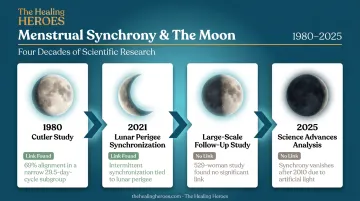
A cluster of studies from the 1980s looked closely at this coincidence. In one widely cited 1980 study by Cutler, researchers tracked 312 women and isolated a subgroup of 68 whose cycles ran close to 29.5 days.
Within that subgroup, 69.1% menstruated during the "light half" of the lunar cycle, the two weeks surrounding the full moon.
That's a real finding. But notice the fine print: it only applied to women whose cycles already matched the lunar rhythm almost exactly. Most women don't fall into that narrow band.
Newer, Larger Studies Tell a Different Story
Fast forward to modern research, and the picture gets murkier. A 2021 study following a small group of women's cycle records over decades found intermittent synchronization, strongest when the moon was closest to Earth (its gravitational pull at perigee). That's interesting, but far from proof of causation.
A much larger study of 529 women tracked over six menstrual cycles found no significant association between lunar phase and period onset at all.
That contrast matters. Small, selected samples can show a pattern that disappears once you study a broad, unselected population. Individual alignment is possible. Population-wide synchronization isn't supported.
Age and Cycle Length Change the Odds
Younger women with cycles closer to 29.5 days are more likely to notice lunar alignment. Women over 35 see less alignment, since their cycles tend to shorten and drift from that lunar-length rhythm.
In long-term tracking data, synchrony with the moon's light cycle dropped from roughly a quarter of the time in women 35 and under to less than 10% in women over 35.
The Post-2010 Light Shift
Here's the twist: a 2025 analysis published in Science Advances found significant lunar-menstrual synchrony in records before 2010, but the signal vanished after 2010. LED lighting and phone screens are the likely culprit, flooding our nights with artificial brightness that drowns out whatever faint lunar cue may have once existed.
Full Moon Effects on Women's Sleep, Mood, and Mental Health
If there's one area where full moon science holds up, it's sleep, though even here, the effect is modest.
The Sleep Connection Is Real, But Small
A well-known 2021 study tracking sleep patterns found that people fell asleep later and slept less in the days leading up to a full moon. The effect was more pronounced in communities with less access to artificial light, where the moon's glow actually stood out against the dark.
Here's the context that puts this in perspective:
| Light source | Approximate brightness |
|---|---|
| Full moon | 0.1–0.3 lux |
| Streetlight | ~15 lux |
| Phone screen | Varies widely, often 40+ lux |
A full moon is dramatically dimmer than a streetlight or a phone screen. That doesn't mean it can't nudge your circadian rhythm slightly. It just means blaming a rough night's sleep entirely on the moon overlooks the brighter light sources probably already disrupting you.
Mood, PMS, and Psychiatric Effects: What the Data Shows
Despite the "lunatic" myth's staying power, research on mental health outcomes doesn't back it up. A review of nearly 18,000 psychiatric inpatient records found no relationship between lunar phase and admissions, discharges, or length of hospital stay. None.
What about PMS and PMDD specifically? Direct research here is limited, and no major study has tested full moon phase against symptom severity head-on.
What we do know: if the full moon disrupts your sleep even slightly, and that disruption happens to overlap with your luteal phase, the sleep loss itself could intensify irritability, fatigue, or mood symptoms. That's an indirect effect through sleep, not evidence of the moon acting directly on hormones.
Why the "Lunatic" Myth Persists
Aristotle theorized the moon disturbed the brain's moisture, similar to ocean tides. Psychiatrist Arnold Lieber revived this idea in the 1970s with his "biological tides" theory. Neither held up under scrutiny, but the story was memorable enough to outlast the data.
What Should Women Do During a Full Moon? Blending Science with Holistic Ritual
You don't need proof of a mystical lunar force to make full moon nights work better for you. Some of the best strategies are practical, and some are simply meaningful.
Start With What's Practical
Protect your sleep. Since moonlight can add a small amount of extra brightness to your bedroom, especially without curtains, try:
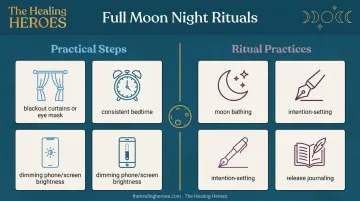
- Using blackout curtains or a comfortable eye mask on full moon nights
- Keeping a consistent bedtime, even if you feel a little more wired than usual
- Dimming phone and screen brightness in the evening, since that light dwarfs anything the moon puts out
Track your own patterns. Population studies show no universal lunar-period link, but that doesn't mean your body lacks its own rhythm. Log your cycle, sleep, and mood across a few lunar months. Personal data beats population averages when you're trying to understand your patterns specifically.
Where Ritual Meets Reflection
Data isn't the only tool worth using. Even without a proven biological mechanism, plenty of women use the full moon as a natural checkpoint, a monthly pause for reflection rather than a biological trigger. Common practices include:
- Moon bathing: sitting or lying outside under moonlight, similar to sun bathing but gentler
- Intention-setting: writing down what you want to release or invite as the lunar cycle turns
- Release journaling: a few minutes of unfiltered writing about what's weighing on you
This is territory The Healing Heroes podcast explores often, through conversations with astrologers, energy workers, and sound healers about how ancient practices support modern emotional balance.
Nicole Kim, a yoga and sound healing practitioner featured on the show, puts it simply:
"Whether it's yoga or sound healing, you're empowered to sit in the discomfort, to trust that I can feel this, I can move through this, and I'm going to arrive on the other side."
That mindset applies just as well to a full moon journaling practice as it does to a sound bath.
Grounding doesn't require ritual, either. Breathwork, a slow walk, or ten quiet minutes without your phone all count as full moon self-care, whether or not the moon is the reason you needed it that night.
Full Moon and Women's Physical Health
Beyond cycles and sleep, a few smaller studies have looked at the moon's reach into other areas of the body.
- Blood sugar and heart rate: A small 2021 study found higher fasting glucose and heart rate near the new and full moon compared to quarter phases in women with type 2 diabetes, with no lunar effect on blood pressure. The tiny sample means this is a lead worth watching, not a settled finding.
- Birth timing: A French analysis of 38.7 million births over 50 years found a slightly higher birth rate at the full moon and the day after, though researchers called the difference "very small" and suspect it reflects expectation rather than biology.
- Athletic performance: Studies looking at physical performance across lunar phases have found no significant effect. Your workout results depend on training, sleep, and nutrition, not moon phase.
None of these findings suggest women's physical health shifts meaningfully with the lunar calendar.
Why Do We Believe the Full Moon Affects Us So Strongly?
If the evidence is this thin, why does the full moon effect feel so real to so many people?
Illusory Correlation Does the Heavy Lifting
Psychologists call this illusory correlation. You notice the one restless night that happened to fall on a full moon. You don't notice the eleven uneventful full moons before it. Memory is selective, and full moons are visually striking enough to stick.
An Ancient Belief With Deep Roots
Greek and Roman writers, including Aristotle, wrote about the moon's supposed pull on the mind long before modern science existed. The word "lunatic" comes directly from luna, the Latin word for moon, and dates back roughly to the 1300s in English. That's 700 years of cultural reinforcement working against a handful of null studies.
Data Doesn't Erase Personal Experience
None of this means your experience isn't real to you. Many holistic traditions treat the full moon less as a biological switch and more as a symbolic timekeeper, a monthly nudge toward reflection.
This idea is one that The Healing Heroes podcast returns to often, sitting with both scientific skepticism and spiritual practice rather than forcing a choice between them. You can trust the data and still find the ritual meaningful.

Frequently Asked Questions
How does a full moon affect women?
Research shows weak links to slightly delayed sleep and occasional menstrual cycle alignment in some women. There's no proven population-level effect on mood, mental health, or behavior.
Do most women have their period on the full moon?
No. Most large studies find no consistent link between period onset and lunar phase. Some women with cycles close to 29.5 days may notice occasional personal alignment, but it's not universal.
What should a woman do during a full moon?
Protect your sleep by limiting light exposure, track your own cycle and mood patterns over time, and consider a reflective ritual like journaling or moon bathing if it feels meaningful to you.
Can the full moon affect PMS or mood swings?
Direct research is limited. However, if full moon-related sleep disruption overlaps with your luteal phase, that lost sleep could indirectly intensify PMS symptoms for some women.
Is there scientific proof that the moon influences menstrual cycles?
Some older, smaller studies found modest synchronization in select groups. Larger, modern studies with better lighting data mostly show no consistent population-wide link.
Why do so many people believe in the full moon effect despite weak evidence?
Confirmation bias plays a big role: we remember the unusual nights and forget the ordinary ones. Centuries of folklore and personal or spiritual experiences also keep the belief alive, even where large-scale data stays inconclusive.