
This isn't rare. It's one of the most common private experiences among accomplished women, and it rarely responds to more achievements or more praise. Understanding where imposter syndrome actually comes from, rather than just managing its symptoms, is what makes lasting change possible.
This guide walks through what causes imposter syndrome in women, how it shows up day to day, and what actually helps: not confidence hacks, but real inner work grounded in psychology and trauma-informed care.
Key Takeaways
- Imposter syndrome is a documented psychological pattern, not a personal failing
- Childhood conditioning, workplace bias, and underrepresentation all fuel the cycle for women
- Left unchecked, imposter syndrome drives burnout, anxiety, and missed opportunities
- Recovery starts with naming the pattern and challenging automatic thoughts, often alongside trauma-informed support
What Is Imposter Syndrome in Women?
Imposter syndrome, or the impostor phenomenon, describes a persistent internal conviction that you're a fraud, despite clear proof otherwise. Psychologists Pauline Clance and Suzanne Imes coined the term in 1978, after studying more than 150 high-achieving women in therapy and academic settings.
These women had PhDs, professional recognition, and glowing evaluations, yet many still believed their success was a fluke waiting to be discovered.
Clance and Imes originally studied women, and later research confirmed the pattern shows up across genders. But it doesn't show up equally.
A 2024 meta-analysis pooling 42,018 participants across 115 studies found women consistently score higher on impostor measures than men, according to a gender-differences meta-analysis published in the New Ideas in Psychology journal. The effect size was moderate (Cohen's d = 0.27) and held across different settings and populations. The gap is real, even if it's not massive.
The 3 C's of Imposter Syndrome in Women
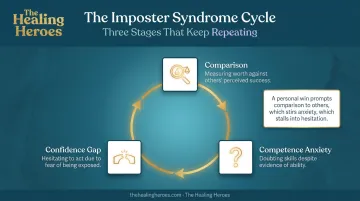
A framework you'll see referenced in coaching and self-help circles breaks the pattern into three reinforcing pieces, often called the 3 C's:
- Comparison – Measuring your progress against others' highlight reels instead of your own timeline
- Competence anxiety – The fear that you don't actually have the skills your title implies
- Confidence gap – The space between what you've proven you can do and what you believe you can do
Here's how it plays out: a woman lands a big client (a win), immediately compares herself to a colleague who landed a bigger one (comparison), spirals into worrying she got lucky (competence anxiety), and hesitates to pitch the next big account (confidence gap). Each piece feeds the next, which is exactly why success alone doesn't break the cycle.
Common Causes of Imposter Syndrome in Women
No single event creates imposter syndrome. It usually builds slowly, layer by layer, from childhood patterns, cultural messaging, and the structure of the workplaces women move through as adults.
Childhood Conditioning and Conditional Achievement
When love or approval as a kid felt tied to grades, performance, or being "the good one," worth gets wired to output early on. Researchers call this contingent self-worth: self-esteem that rises and falls with achievement rather than staying stable. Studies on parental conditional regard found this pattern predicts shame after failure and difficulty internalizing success, even decades later.
Gender Bias and Workplace Culture
Most corporate leadership models were built around traits historically coded male (directness, self-promotion, visible confidence), while women displaying the same traits often get labeled "too aggressive." That double standard doesn't just affect perception. It shapes advancement.
According to McKinsey and LeanIn's 2025 Women in the Workplace report, the promotion gap shows up early and compounds over time:
- For every 100 men promoted to manager, only 93 women and just 74 women of color advance
- Women's representation drops from 49% at entry level to just 29% in the C-suite
When advancement is genuinely harder to earn, self-doubt about "deserving" a seat isn't irrational. It's a reasonable response to an uneven system.
Lack of Representation and Role Models
Being the only woman, or the only woman of color, in a leadership meeting does something specific to belonging. This dynamic has a name: intersectional invisibility, where people holding multiple non-dominant identities get underrecognized in both groups they belong to.
One study found participants were least likely to correctly recall or credit contributions from Black women in group settings, compared with every other demographic tested. Fewer visible examples of "someone like me" succeeding makes it harder to trust your own place in the room.
Perfectionism and Social Comparison
Add curated social media into the mix and the comparison problem intensifies. Research on adolescent girls and young women links upward social comparison online with lower self-esteem and perfectionistic tendencies.
The pattern extends into adulthood: wins get chalked up to luck or timing, while mistakes feel like proof of who you really are. That attribution bias, first documented by Clance and Imes themselves, keeps the imposter cycle running even when the evidence points the other way.
Signs, Symptoms, and Effects of Imposter Syndrome
Recognizing the internal warning signs early matters, because the consequences of ignoring them tend to compound.
Common Symptoms in Women
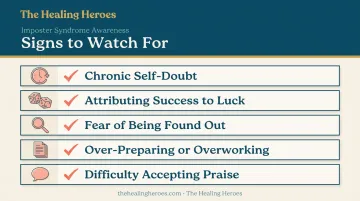
Watch for these recognizable patterns:
- Chronic self-doubt that resurfaces after every achievement, not just the first one
- Attributing success to luck, timing, or other people's generosity
- Persistent fear of being "found out" as less capable than colleagues assume
- Over-preparing or overworking to compensate for a competence gap that isn't actually there
- Difficulty accepting praise, often deflecting or minimizing it in the moment
What Happens When It's Left Unaddressed
Unaddressed imposter syndrome doesn't stay quiet. It tends to show up as chronic stress, burnout, and anxiety that bleeds into decisions about opportunities and relationships.
Women may avoid promotions or leadership roles they're qualified for, simply to sidestep the exposure they fear. Overfunctioning to compensate can also strain relationships, since constant proving leaves little room for rest or vulnerability.
This burnout risk is measurable, not just anecdotal. In a randomized trial of 101 female medical residents, a structured coaching program reduced emotional exhaustion scores by more than four points compared to controls, according to a study published in JAMA Network Open. Imposter scores dropped in tandem. When the internal pattern shifted, the burnout numbers moved with it.
How Women Can Overcome Imposter Syndrome
Collecting more proof of competence rarely fixes imposter syndrome. Most women already have plenty of proof; it just doesn't land. Real change means addressing the identity-level beliefs underneath the doubt.
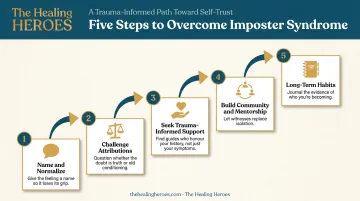
Name and Normalize the Experience
Saying the pattern out loud, to a friend, mentor, or therapist, interrupts the isolation that keeps it alive. Imposter syndrome thrives in silence, where it feels like a uniquely personal flaw rather than a documented, common experience. Even a quick text to a trusted colleague, admitting the doubt creeping in before a big presentation, can loosen its grip within minutes.
Challenge the Attributional Pattern
Notice when you dismiss a win as luck and treat a mistake as identity ("I got the contract because they were desperate" versus "I missed a deadline because I'm incapable"). Write both attributions down side by side. The imbalance usually becomes obvious once it's on paper, and that awareness is the first step toward rebalancing it. Over time, this exercise trains you to catch the double standard in real time, not just in hindsight.
Seek Trauma-Informed Support
Because imposter syndrome is often rooted in early conditioning, surface-level confidence tips rarely hold. Trauma-informed approaches, like EMDR, parts work, or somatic therapy, work at the level where the pattern actually formed.
The Healing Heroes podcast features conversations with practitioners doing exactly this kind of work. Jennifer Baumgold, LCSW, a psychotherapist specializing in EMDR and trauma treatment, is one example. Cait DeMello, a confidence and empowerment coach who works with parts-based approaches, is another. Their episodes offer accessible starting points for anyone curious about what root-cause healing actually looks like.
Build Community and Mentorship
Isolation intensifies imposter feelings. Peer support and visible mentorship reduce it, partly by normalizing struggle and partly by offering real feedback instead of internal guesswork. Even informal peer groups where women speak candidly about doubt tend to loosen its grip faster than solo effort ever does.
Long-Term Habits for Lasting Confidence
A few practices help the shift stick:
- Keep a wins journal – Selective memory tends to erase evidence of competence; writing it down counters that.
- Maintain regular mentorship – Ongoing relationships, not one-off conversations, build sustained perspective.
- Audit your self-talk periodically – Check in every few months on whether worth is still quietly tied to output.
Conclusion
Imposter syndrome traces back to childhood conditioning and systemic bias, often compounded by a lack of visible role models. Talent and effort rarely factor into it. Recognizing that distinction often brings the first real relief.
Healing happens through consistent inner work, honest naming, and ongoing support beyond quick-fix confidence tactics. The Healing Heroes podcast features conversations with practitioners in trauma healing, somatic work, mind-body practices, and confidence coaching, giving you more ways to keep building that support system.
Frequently Asked Questions
What is imposter syndrome in women?
It's a persistent belief that you're a fraud despite clear evidence of competence, first documented by Pauline Clance and Suzanne Imes in their 1978 study of high-achieving women. It's a recognized psychological pattern, not a diagnosis.
What are the symptoms of imposter syndrome in women?
Common signs include fear of being "found out," dismissing achievements as luck, and overworking to compensate for a perceived skills gap. Difficulty accepting praise is another frequent marker.
What are the 3 C's of imposter syndrome in women?
Comparison, competence anxiety, and confidence gap describe how measuring yourself against others, doubting your abilities, and underselling your track record reinforce each other. It's a popular coaching framework rather than a clinical model.
How can women overcome imposter syndrome?
Start by naming the pattern to someone you trust, then challenge the habit of crediting luck for wins and identity for failures. Trauma-informed support and community both speed up the process.
Is imposter syndrome considered a mental health disorder?
No. It's not listed in the DSM as an official diagnosis. It's a recognized psychological pattern that frequently coexists with anxiety and depression, according to the American Psychological Association.
Why do women experience imposter syndrome more than men?
Research points to a mix of childhood conditioning around conditional approval, workplace bias in promotion and leadership expectations, and reduced representation for women, especially women of color, in senior roles.