You're not behind. You're not too much or not enough. You're likely just exhausted from carrying loads that were never sustainable in the first place, and self-help culture hasn't helped, turning growth into another to-do list item stacked on top of everything else.
Gallup found that 51% of working women in the U.S. reported feeling stressed during much of the previous day, compared with 39% of working men, based on data collected through October 2024. That gap isn't random. It reflects the invisible labor many women carry daily.
This guide covers five pillars of holistic growth, practical daily habits that don't require a total life overhaul, why doing less sometimes matters more than doing more, and where to find real support along the way.
Key Takeaways
- Self-development is ongoing and non-linear, not a finish line you cross once
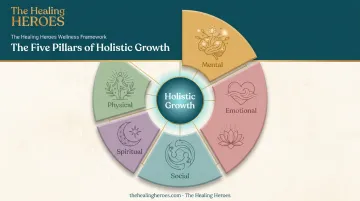
- Growth spans five interconnected areas: mental, emotional, social, spiritual, physical
- Small, consistent habits build more lasting change than dramatic overhauls
- Sometimes releasing obligations matters more than adding new routines
- Support systems, from therapy to community, accelerate and sustain progress
What Is Self-Development for Women?
Self-development is the intentional, ongoing process of building self-awareness, emotional intelligence, confidence, and alignment with your values. It's different from a quick self-help hack that promises results in a weekend.
According to the APA Dictionary of Psychology, personality development is a gradual shift in emotional responses, values, and roles over time, not an overnight transformation. That distinction matters, especially for women, whose growth often happens against a backdrop of specific conditioning.
Why this looks different for women:
- Decades of socialization reward accommodation over assertiveness
- Caregiving responsibilities frequently override personal goals by default
- Career advancement often demands proving competence twice over
- People-pleasing patterns get mistaken for kindness rather than a survival skill
The stress data backs this up. That 51% figure signals something deeper: the systems around many women's daily lives are stretched thin.
Those same overstretched systems help explain why growth rarely moves in a straight line. It's a lifelong process that circles back, stalls, and restarts rather than reaching a fixed finish line. A holistic framework accounts for that unpredictability in ways a single-focus checklist can't.
The Five Pillars of Women's Personal Growth
Wellbeing research consistently points to multiple, interconnected life domains rather than one silver-bullet fix. Gallup's wellbeing framework found that 66% of people were thriving in at least one life area, but only 7% were thriving across all five simultaneously.
That's the case for growth too. Neglect one pillar, and the others eventually strain under the weight. Here's how five commonly grouped areas, mental, emotional, social, spiritual, and physical, work together.
Mental Development: Building a Growth Mindset
Psychologist Carol Dweck's foundational research distinguishes a growth mindset, the belief that abilities can develop through effort and strategy, from a fixed mindset, which treats ability as static. A 2019 nationwide school experiment published in Nature found that a brief growth-mindset intervention improved grades among lower-achieving students.
Important nuance: growth mindset isn't just praising effort blindly. It requires actual strategy shifts and honest feedback.
Reframing example: Instead of "I'm just not good at public speaking," try "I haven't practiced public speaking enough yet to feel comfortable." Same situation, different trajectory.
Emotional Development: Mastering Your Inner World
Emotional development means recognizing triggers, naming feelings accurately, and building resilience without suppressing what you feel. For many women, this involves unlearning the habit of minimizing their own emotional needs to keep others comfortable.
Some emotional patterns run deeper than daily journaling can reach. Trauma-informed modalities like EMDR (Eye Movement Desensitization and Reprocessing) and somatic therapy help process what talk alone doesn't resolve.
Jennifer Baumgold, LCSW, an EMDR-certified psychotherapist featured on The Healing Heroes podcast, works specifically with trauma resolution. Somatic practitioners like Moylan Ryan, by contrast, focus on how the body stores and releases stress.
For women curious about these approaches before committing to one, the podcast offers in-depth conversations with practitioners across these exact modalities.
Social Development: Strengthening Connection & Boundaries
Shifting from people-pleasing to authentic boundary-setting is uncomfortable at first. It should be. You're breaking a pattern that's been reinforced for years.
- Saying "no" without an apology attached
- Choosing depth in a few relationships over breadth in many
- Supporting other women instead of competing for scarce approval
That last point deserves emphasis. Sisterhood, real, unglamorous, showing-up-for-each-other sisterhood, tends to accelerate growth faster than solo effort ever does.
Spiritual Development: Connecting to Purpose
Spiritual development doesn't require religious affiliation. It's about finding meaning and aligning daily choices with personal values, through mindfulness, reflection, or intuitive practices.
Astrologer Ophira Edut and psychic medium Lea Morgan, both featured on The Healing Heroes podcast, approach purpose from different angles, one through archetypal patterns, the other through intuitive guidance. Neither claims to hand you meaning. Both offer frameworks for finding your own.
Physical Development: Honoring the Body
Self-care isn't optional decoration on top of "real" growth. It's foundational. An exhausted nervous system can't sustain mental clarity or emotional regulation, no matter how many affirmations you write.
- Prioritizing sleep as non-negotiable, not aspirational
- Moving the body in ways that feel restorative, not punishing
- Supporting nervous system recovery through practices like breathwork or bodywork
Practitioners like Jacques Depardieu (acupuncture), Karen Remele (myofascial release), and Nicole Kim (yoga and sound healing) each address this pillar from a different entry point into the body.
Practical Habits and Tools for Everyday Growth
Growth doesn't require a two-hour morning routine. It requires consistency in small moves.
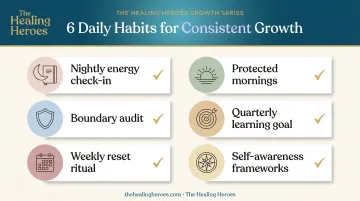
- Nightly energy check-in. Spend two minutes journaling what drained you today versus what energized you. Patterns emerge fast.
- Protected mornings. Five quiet minutes or one written intention before the day starts, before phones, before obligations.
- Boundary audit. Identify one thing you say "yes" to purely out of guilt. Start there.
- Quarterly learning goal. Commit to one new skill every three months. Novelty builds confidence through actual mastery, not just motivation.
- Weekly reset ritual. Review wins, friction points, and one adjustment for the coming week.
- Self-awareness frameworks. Tools like the Wheel of Life or Enneagram can help visualize imbalance, though they're reflection prompts, not diagnostic assessments.
These shifts compound faster than most people expect, but they still take time to feel automatic. Research on habit formation from University College London found the median time to make a behavior feel automatic was 66 days, with individual variation ranging from 18 to 254 days. Missing a day here or there doesn't derail the process. Consistency over perfection wins.
Why Growth Sometimes Means Doing Less
Not every growth plan needs another habit stacked on top. Sometimes the real work is subtraction: releasing limiting beliefs, unfulfilling obligations, or the sheer overcommitment that's kept you spinning.
Here's the part most self-help content skips: an overwhelmed nervous system genuinely can't access clarity or motivation. Neuroscience research shows uncontrollable stress weakens prefrontal cortex functioning, the part of the brain responsible for planning, focus, decision-making, and flexible thinking.
In plain terms: you can't strategize your way out of exhaustion. Safety and space come first.
A starting point before adding anything new:
- Take five slow, extended exhales
- Block 20 minutes of scheduled rest with zero productivity attached
Not as a reward. As a prerequisite.
Once the nervous system settles, clarity tends to follow on its own; forcing it earlier rarely works.
Overcoming Common Obstacles and Misconceptions
A few myths keep women stuck longer than necessary.
"Self-development is selfish." It's the opposite: Depleted women show up worse for the people depending on them. Filling your own cup first isn't indulgent; it's what makes sustained presence for others possible.
"I have to do this perfectly or it doesn't count." Growth is nonlinear by nature, so a missed week of journaling or a boundary you didn't hold doesn't erase the progress you've already made.
"This is just career development." Personal growth touches relationships, spirituality, and physical health just as much as professional ambition, often more.
Where to Find Support on Your Growth Journey
Doing this work alone is harder than it needs to be, and you don't have to.
- Coaching or therapy offers personalized accountability, especially for trauma-related patterns. Jennifer Baumgold provides EMDR-based trauma work, while Bonnie Heim, an accountability coach, guides lifestyle and mindset shifts.
- Community and sisterhood normalize the messy parts of growth. Struggles feel lighter, and wins feel more real, when shared.
- Expert-led education helps you explore healing modalities before investing time or money. The Healing Heroes podcast covers topics from astrology to trauma therapy, offering a low-pressure way to explore.

You can follow along on Instagram or YouTube, or reach out directly through the podcast's support channels if you're looking for a specific type of guidance.
Frequently Asked Questions
What are the stages of womanhood?
Commonly referenced stages include adolescence, young adulthood, career and motherhood years, midlife transition, and elder wisdom years. Each stage carries distinct growth opportunities and challenges.
What are the four things every woman needs?
Core needs include self-worth and confidence, a supportive community, a clear sense of purpose, and physical-emotional wellbeing. These overlap heavily with the five growth pillars covered above.
How can women develop themselves?
Through consistent small habits, self-awareness practices, honest boundary-setting, and support systems like coaching or community. There's no single "right" method, only what's sustainable.
What is the difference between self-development and self-improvement?
Self-improvement often targets a specific skill or achievement. Self-development is broader and more holistic — an ongoing evolution of identity, values, and overall wellbeing.
How long does it take to see results from personal growth work?
Growth is gradual and non-linear. Noticeable shifts often emerge within weeks to a few months of consistent practice, though timelines vary by person.
Can personal development help with confidence and self-esteem?
Yes. Practices like self-awareness, boundary-setting, and tracking small wins build task-specific confidence over time, though it's a gradual process rather than an overnight transformation.