Many women describe feeling stretched thin between roles, wondering where their own sense of meaning went. Others sense a quiet restlessness they can't quite name. This guide walks through what "spiritual" really means for women, the archetypes and traditions that inform the feminine path, the stages most women move through, and the practices and community that help sustain the journey.
Key Takeaways
- Women's spirituality often centers on intuition and cyclical wisdom rather than rigid doctrine
- Archetypes like the maiden, mother, and crone offer frameworks for understanding feminine growth
- The journey unfolds in stages (awakening, exploration, integration), not a straight line
- Practices like breathwork, astrology, and expert-led sessions accelerate connection to your inner wisdom
- Sisterhood and community sustain long-term spiritual growth
What Makes a Woman "Spiritual"?
Spirituality is the search for meaning and connection to something larger than yourself. It's distinct from religious affiliation, though the two can overlap. A woman doesn't need a specific belief system to be spiritual; she needs a genuine orientation toward purpose and inner truth.
Common markers of a spiritual woman include:
- Trusts gut feelings and heightened intuition over logic alone
- Practices mindfulness regularly, through meditation or breathwork
- Makes decisions with purpose rather than on autopilot
- Turns to journaling or reflection to process life's events
This isn't just anecdotal. According to a Pew Research Center study surveying nearly 37,000 U.S. adults, 50% of women reported praying daily compared to 37% of men, a 13-point gap.
That's a measure of religious practice specifically, not proof that women are inherently more spiritual. Still, it points to a real, documented difference in how women engage with meaning-making.
Trusting the Inner Compass
Many spiritually inclined women describe relying on feelings and instinct over pure logic. Practices like journaling and meditation help sharpen that inner compass, turning vague hunches into something women can act on with confidence.
There's often an urgency here too. Once a woman senses an insight, she feels compelled to act on it rather than let it sit. This can look like leaving a job that no longer fits, or having a hard conversation she's been avoiding.
Spiritual growth also tends to produce more authenticity. Boundary-setting gets easier. Honesty becomes non-negotiable. And small talk starts to feel unsatisfying compared to real conversation, which is exactly why finding deeper community becomes so important (more on that later).
The Divine Feminine: Archetypes & Sacred Traditions
Understanding the feminine spiritual path often starts with archetypes and traditions that have shaped how cultures honor women's inner power for centuries.
Understanding the Maiden, Mother, and Crone
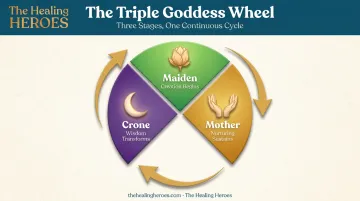
The Triple Goddess framework, maiden, mother, and crone, maps three stages of feminine wisdom onto life's natural cycles: creation, nurturing, and transformation. Scholar Ruth Ray's 2004 analysis in the Journal of Aging Studies frames the maiden and mother as outward-directed phases, while the crone represents authority earned through time and experience.
Modern culture tends to undervalue that crone phase, often reducing older women to stereotypes of invisibility. Reclaiming it looks different for every woman:
- Mentoring younger women instead of competing with them
- Speaking plainly, without softening truth to be palatable
- Leading community work from accumulated wisdom, not just credentials
This three-part scheme is best understood as a symbolic life-cycle framework used in modern feminist and Pagan practice. It's not a universal law every woman's life must follow, and it doesn't require having biological children to be "the mother" phase.
Goddesses & Sacred Feminine Across Cultures
Beyond the Triple Goddess framework, feminine divine figures show up across many spiritual traditions, each carrying a distinct role:
| Figure | Tradition | Symbolic Role |
|---|---|---|
| Guanyin | Chinese Buddhism | Bodhisattva of compassion and mercy |
| Shekhinah | Judaism (Kabbalah) | The felt presence of the divine in the world |
| Kali | Hinduism | Goddess of time, transformation, and destruction of illusion |
| Saraswati | Hinduism | Goddess of knowledge, music, and creative arts |
These figures aren't interchangeable versions of one universal goddess. Each carries specific meaning within its own tradition.
Some point to archaeological evidence, like the female figurines found at Çatalhöyük, as proof of ancient goddess-worshipping societies that predated patriarchal religious structures. The figurines are real. What they meant is genuinely debated among archaeologists, and claims of an organized goddess cult or matriarchal government go beyond what the evidence currently supports.
Addressing "Which Side Is Feminine Spiritually?"
Beyond mythology and archetype, some spiritual traditions locate the feminine within the body itself. In yogic and energy work traditions, the left side is often associated with receptive, intuitive, feminine energy, while the right side represents active, masculine energy.
This split comes from ida (lunar, feminine) and pingala (solar, masculine), the two subtle channels described in classical yoga texts, as outlined by Yoga International's breakdown of these energy currents.
This is a symbolic, traditional framework, not a scientifically verified anatomical rule. Interpretations vary across practices and cultures, so treat it as a lens for reflection rather than a fixed fact.
The Spiritual Journey: Common Stages Women Move Through
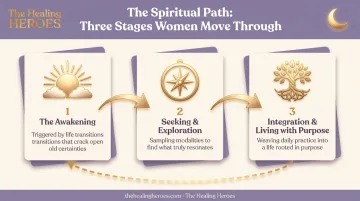
The path rarely moves in a straight line. Most women cycle through recognizable stages, sometimes revisiting earlier ones as life shifts.
Stage 1: The Awakening
Awakenings are often triggered by major transitions: motherhood, divorce, a career change, loss, or simply a growing sense of restlessness that won't quiet down.
Research on spontaneous spiritual awakenings, published in Frontiers in Psychology, describes these experiences as involving sudden shifts in perception, a sense of unity, and lasting changes in meaning and identity.
Early signs vary from woman to woman, but many report an unexplained pull toward practices like yoga, astrology, or energy work, almost before they can explain why.
Stage 2: Seeking & Exploration
This is the experimental phase. Women often try multiple modalities at once, such as energy healing, astrology, therapy, and coaching, to see what resonates. It's less a checklist and more a cyclical process, echoing the natural rhythms women's bodies already know.
The Healing Heroes podcast reflects this exact stage, featuring practitioners across disciplines like human design, acupuncture, and psychic mediumship so listeners can sample different paths before committing to one.
Stage 3: Integration & Living with Purpose
Integration is where the work becomes daily practice. Women learn to trust intuition without second-guessing it, set boundaries without guilt, and align relationships and work with core values.
Mentors accelerate this stage. Human design coach Zach Carlsen, for example, helps women use their design as a practical daily decision-making tool.
Confidence coach Cait DeMello takes a different approach, using tarot and embodiment work to help women reclaim their voice in business and life. Expert-led resources like these turn abstract insight into daily habits women can actually sustain.
Practices That Deepen Spiritual Connection
Building a spiritual practice doesn't require a complete lifestyle overhaul. Small, consistent entry points work best.
Accessible daily practices include:
- Meditation, even five minutes counts
- Breathwork for nervous system regulation
- Journaling to process insight and emotion
- Time in nature, unstructured and quiet
Body-based practices matter just as much as mental ones. Yoga, sound healing, and bodywork reconnect spirit with the physical body.
Practitioners like Nicole Kim (yoga, sound healing, and Thai bodywork) and Moylan Ryan (somatic therapy and Rolfing) focus on this connection directly with clients.
Beyond body-based work, reflection tools like astrology, tarot, and intuitive or mediumship work remain some of the most common entry points.
Ophira Edut, resident astrologer for ELLE and creator of the IAM System, approaches astrology as a practical framework rather than vague prediction. Lea Morgan, a psychic medium, focuses on normalizing intuitive work through down-to-earth, relatable sessions.
Listening to expert-led conversations, such as The Healing Heroes podcast, gives women direct access to practitioners across these disciplines without needing to book a session first. It's a low-pressure way to learn what actually resonates before going deeper.
Sisterhood & Community: What Are Spiritual Women Called?
Historically and today, spiritual women have carried various descriptive titles: mystic, priestess, seer, wise woman, medicine woman, or simply "spiritual sister." These are descriptive roles tied to specific traditions, not formal titles anyone can claim overnight.
- Mystic: someone seeking direct spiritual understanding beyond ordinary perception
- Priestess: a recognized ritual office within a specific tradition
- Seer: one credited with insight or foreknowledge
- Wise woman: a knowledgeable woman, historically linked to folk healing
- Medicine woman: a healer trusted with herbal and ceremonial knowledge
- Spiritual sister: an informal, modern term for women walking a shared path
Community matters because spiritual women have always gathered in circles to share wisdom. Rev. Lizzie McManus-Dail, founder of Jubilee Episcopal Church and a guest on The Healing Heroes podcast, puts it simply:
"Spirituality isn't meant to be practiced in isolation."
Modern equivalents of the old gathering circle include retreats, workshops, and online groups.
Finding "your people," those open to real conversation instead of surface-level talk, is often what separates a fleeting interest in spirituality from a sustained, lifelong practice.
Frequently Asked Questions
What makes a woman spiritual?
A spiritual woman typically relies on intuition, actively seeks purpose, and works toward alignment between her mind, body, and spirit. None of this requires affiliation with a specific religion.
Which side is feminine spiritually?
In yogic and energy work traditions, practitioners view the left side as feminine and receptive, and the right side as masculine and active. This is a symbolic framework, not a scientific rule.
What are spiritual women called?
Common terms include mystic, priestess, seer, wise woman, and medicine woman. These are informal, cultural descriptors that honor women's spiritual gifts across generations.
How do I know if I'm having a spiritual awakening?
Common signs include heightened intuition, shifting priorities, and an unexplained pull toward new practices or beliefs. Awakenings often follow major life transitions or loss.
Is spirituality different from religion for women?
Yes. Spirituality is a personal, experiential connection to meaning, while religion involves structured doctrine and institutions. The two can overlap, though each follows a distinct path.
Where can I learn more about different healing and spiritual practices?
The Healing Heroes podcast features real, expert-led conversations with practitioners across astrology, energy healing, breathwork, and more, making it an accessible starting point for exploration.