
Maybe you've watched a resolution fizzle out by week three. Maybe you've hit every career milestone on paper and still feel restless, like something's missing. Or maybe you're just exhausted from trying to do it all — work, family, health, relationships, and whatever "self-improvement" is supposed to mean this year.
None of that is a personal failing. This article looks at the hidden causes behind stalled goals, including trauma, nervous system patterns, and the invisible rules women are taught to follow, and offers a more holistic way through.
Key Takeaways
- Caretaking loads and unpaid labor leave women less time and energy for personal goals
- Visible ambition often triggers social backlash, so women quietly shrink their goals
- Unresolved stress keeps the nervous system too dysregulated for consistent follow-through
- Self-compassion and values alignment outperform willpower and harsh self-criticism
- Nervous system regulation is the foundation that makes every other strategy work
The Hidden Root Causes: Why Willpower Alone Isn't Enough
The Time and Energy Squeeze and the Perfectionism Trap
Women are taught early that tending to others comes before tending to ambition. The numbers back this up. In the 2025 American Time Use Survey, 87% of women performed household activities on an average day, compared with 75% of men.
Among people who did housework, women spent about 2.8 hours on it, versus 2.1 hours for men. Add childcare, and the gap widens further.
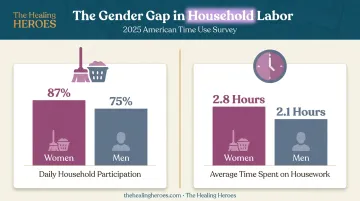
This comes down to math, not motivation. Less discretionary time means less bandwidth to plan, execute, and reflect on personal goals.
Layer comparison on top of that. Goals borrowed from social media, family expectations, or "what successful women are supposed to do" rarely survive contact with a hard week, because there's no personal meaning holding them together.
That gap in meaning often opens the door to perfectionism, tangled with anxiety and a nagging sense of not being competent enough, even when the evidence says otherwise. One missed workout or one skipped deadline can feel like proof of failure rather than a normal bump in a long process.
The goal itself doesn't usually change. The story about what one slip means does.
The "Too Much" Penalty and the Achievement Treadmill
Here's something research actually confirms: a meta-analysis spanning 71 studies found that when women displayed dominant, assertive behavior, their likability and hireability dropped, even though their competence ratings didn't. Direct, verbal assertiveness carried the biggest penalty.
That's a real cost women weigh, often unconsciously, before they even set a goal out loud. Ask for the promotion too directly, and you risk being labeled "aggressive." So the goal gets smaller, quieter, or gets shelved altogether.
Even women who clear that hurdle and reach real achievement don't always find relief. High-achieving women often chase a target that keeps moving: the next title, the next milestone, the next version of "enough."
Survey data on Harvard Business School alumnae found that far more women ended up in traditional, unequal career-and-caregiving arrangements than they'd expected going in. That gap between what was promised and what actually happened breeds a specific kind of restlessness, one where success stops feeling like progress and starts feeling like a treadmill.
The Mind-Body Connection: How Trauma and Nervous System Patterns Block Progress
Why the Body Keeps Score
Chronic stress doesn't stay in your head. It lives in your nervous system, keeping the body cycling through fight, flight, or freeze long after the original stressor is gone. That matters here because a nervous system stuck in survival mode struggles to sustain the steady, forward-moving action that goals require.
Trauma exposure is also more common than most people realize. Data from the NESARC-III study found lifetime PTSD prevalence of 8.0% among U.S. women, compared with 4.1% among men. This widespread pattern shapes how a large share of women relate to stress, risk, and follow-through.

Suppressed Emotions and the "Hold It Together" Habit
Women are frequently praised for staying composed under pressure. The unspoken cost is disconnection from the body's own signals, the exhaustion, tension, or dread that usually shows up before burnout does.
When those signals get suppressed long enough, procrastination and self-sabotage can start looking like a discipline problem. They're actually a nervous system problem.
EMDR, Somatic Work, and Listening to the Body
Trauma-informed approaches address this directly. EMDR (Eye Movement Desensitization and Reprocessing) helps the brain reprocess stored distress so it stops hijacking present-day decisions. Jennifer Baumgold, LCSW, an EMDR-certified psychotherapist featured on The Healing Heroes, works with clients to untangle exactly this kind of stuck trauma response.
Somatic approaches, like the Rolfing and movement work that Moylan Ryan practices, take a body-first route to the same goal: releasing tension patterns that talk therapy alone sometimes can't reach.
Practical starting point: notice tension, shallow breathing, or unexplained fatigue when you sit down to work on a goal. That's often nervous system dysregulation, not laziness, and it's worth addressing before pushing harder on willpower.
Common Goal-Setting Traps Women Fall Into
Even with the best intentions, a few sneaky patterns derail progress:
- Chasing borrowed goals: setting targets based on trends or comparison instead of what you actually want kills intrinsic motivation fast
- The all-or-nothing spiral: one missed day turns into a full abandonment instead of a simple course correction
- Stacking too much at once — three major goals launched simultaneously, with no smaller steps in between, almost guarantees overwhelm
Each of these traps has the same fix: smaller, values-driven steps instead of sweeping, all-or-nothing bets.
External Pressures: Balancing Ambition With Societal Expectations
Caretaking responsibilities are only part of the picture; two more pressures determine whether ambition gets acted on or quietly buried.
Workplace bias. Research on dominance and likability (referenced above) isn't the only signal. Controlled studies show that equally qualified mothers receive lower competence ratings and far fewer hiring recommendations than childless women with identical résumés. Real-world callback audits found similar gaps.
The motherhood trade-off fear. Many women delay big career moves after having children, worried that ambition will now read as "less committed" rather than capable. That fear isn't irrational; it's shaped by exactly the kind of bias the research keeps turning up.
Ambition still matters, but the playing field isn't neutral, and goal-setting advice that ignores these pressures tells only half the story.
Holistic Strategies to Break Through and Finally Reach Your Goals
Turning awareness into lasting change takes more than willpower. These six holistic strategies help close that gap:
Start with values, not trends. Before setting a goal, ask what actually matters to you, separate from comparison or family expectations. Cait DeMello's coaching, including inner child and embodiment work, is built around surfacing that clarity.
Regulate the nervous system first. Breathwork, grounding, and movement come before behavior change, not after. Practitioners like Nicole Kim work with yoga, breathwork, and sound to help clients settle a dysregulated body enough to sustain consistent action.
Practice self-compassion over self-criticism. Research on self-compassion after failure shows it boosts motivation, not complacency. Mindset coach Katie Wee frames setbacks as information rather than proof of failure, keeping momentum alive.
Build in accountability. A coach, mentor, or support circle keeps goals honest. Accountability coach Bonnie Heim's work centers on exactly this kind of "getting out of your own way" support, and The Healing Heroes' 1:1 consultations offer that same personalized structure.
Explore what's underneath the block. Sometimes the real obstacle is an unconscious pattern, not a logistical one. Human Design work, like the sessions Zach Carlsen offers, or somatic therapy, gives another entry point when traditional goal-setting frameworks hit a wall.
Celebrate small wins. Progress markers build self-trust. Self-trust, more than any productivity hack, is what keeps a goal alive long after the initial motivation fades.

Frequently Asked Questions
Why do women struggle to reach their goals?
It's rarely about willpower. Societal conditioning, nervous system and trauma responses, and goals built on comparison rather than personal values all combine to make follow-through harder than it looks from the outside.
Why is goal-setting harder for women than men?
Caretaking responsibilities eat into available time, workplace bias penalizes visible ambition, and assertive women often face social backlash men don't experience for the same behavior.
How does trauma affect a person's ability to achieve goals?
Unresolved trauma keeps the nervous system locked in survival mode. That makes the steady, consistent action goals require physiologically harder to sustain.
What is the "burden of greatness" and how does it affect ambitious women?
High-achieving women often chase constantly shifting external validation. That creates restlessness and identity confusion even after major milestones are met.
How can women overcome self-doubt when pursuing big goals?
Self-compassion, values alignment, and support from a coach or community consistently outperform pure willpower. Reframing setbacks as data rather than failure helps too.
What role does self-care and nervous system regulation play in achieving long-term goals?
A regulated nervous system supports sustained motivation and reduces self-sabotaging patterns like procrastination or avoidance. This foundation is what makes long-term follow-through possible.