Introduction
She shows up to work Monday morning, coffee in hand, like nothing happened.
Nobody knows she spent the weekend crying in her car after a breakup, or that she's quietly rebuilding her confidence after a layoff. This is what inner strength usually looks like: invisible, unglamorous, and easy to miss.
Women are often praised for toughness or achievement, but the quieter work of trusting yourself again after a hard season rarely gets applause.
This guide breaks down what inner strength actually means, how to recognize it in daily life, and practical ways to nurture it using mind, body, and spirit together.
Key Takeaways
- Inner strength grows from resilience, self-trust, and emotional intelligence, not physical toughness
- Setting boundaries or asking for help proves strength, not weakness
- Authenticity and voice stand out as women's most defining source of power
- Resilience builds best through mindset, body, emotion, and spirit combined
- Daily habits and role models can reinforce strength when motivation runs low
What Is Inner Strength (and Why It Looks Different for Women)?
Inner strength is an internal capacity, not a performance. It's the ability to stay grounded, trust your own judgment, and regulate your emotions when life gets messy. That's a different skill set than physical power or outward bravado.
Many women are raised to be nurturing and self-sacrificing first. That conditioning can make quiet strength invisible, even to the woman living it. She might not recognize her own resilience because she's too busy taking care of everyone else.
Lasting strength isn't built through willpower alone. It comes from the intersection of:
- Mental clarity — knowing what you think and feel, separate from what others expect
- Physical regulation — a nervous system that can calm itself after stress
- Spiritual connection — a sense of purpose or meaning that outlasts any single setback
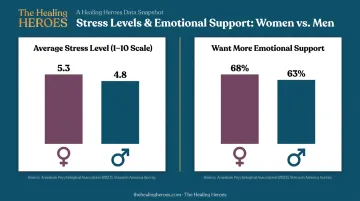
That physical regulation piece shows up in the data. Research confirms women's relationship with stress is real and measurable, not a sign of fragility. The APA's 2023 Stress in America survey found women reported average stress of 5.3 out of 10, compared to 4.8 for men.
Sixty-eight percent of women said they could have used more emotional support, versus 63% of men. That gap reflects an unequal load, not a personal weakness.
Inner Strength vs. Being "Strong" (Society's Version)
The performative version of "strong woman" never struggles, never asks for help, and never cries where anyone can see. It's exhausting to maintain and mostly fake.
Real strength looks quieter:
- Saying "I need a minute" instead of pushing through exhaustion
- Setting a boundary even when it disappoints someone
- Admitting "I don't know" without shame
Sustainable strength trades performance for honesty. That trade is where the actual resilience lives.
Signs & Real-Life Examples of Inner Strength in Women
Inner strength shows up through five recognizable traits, each grounded in something ordinary:
- Resilience: getting back up after a divorce and slowly rebuilding a routine
- Emotional intelligence: noticing you're snapping at your kids because you're overwhelmed, not because they did anything wrong
- Self-confidence: applying for a job you're only 70% qualified for
- Compassion: staying kind to yourself during a health scare instead of spiraling into self-blame
- Adaptability: switching careers at 45 because the old path no longer fits
These traits surface across major life transitions: returning to work after having a baby, leaving a relationship that no longer feels safe, rebuilding after illness or grief, or starting over professionally later in life.
The most overlooked signs are the smallest ones:
- Saying no without over-explaining or apologizing
- Asking for support before burnout forces the issue
- Choosing to love again, or trust again, after being hurt
Resilience research supports this pattern. An APA-reported study of 595 combat veterans (340 women, 252 men) found women showed post-traumatic stress, depression, and mental-health functioning similar to men during the first year after deployment. Strength under pressure comes from circumstance, support, and practice, not gender.
History offers larger-scale examples too. Malala Yousafzai continued her education advocacy after being shot in 2012 and later received the Nobel Peace Prize. Nadia Murad escaped captivity under ISIS, became a UN advocate against sexual violence, and later won the 2018 Nobel Peace Prize. Neither story is a template, but both prove that hardship doesn't have the final word.
The Greatest Strength of a Woman: Beyond Physical Power
There's no single "greatest" strength, because strength depends on context. Emotional intelligence matters in one season, compassion carries the next, and voice takes over in a third. What ties them together is self-awareness: knowing yourself well enough to respond instead of react.
That self-awareness shows up as authenticity—the common thread running through resilience, compassion, and confidence alike. A woman who knows her own values doesn't need to borrow someone else's definition of strength.
Oprah Winfrey captured this at the 2018 Golden Globes, saying, "What I know for sure is that speaking your truth is the most powerful tool we all have". Voice isn't the only strength a woman has, but it's often the one that unlocks the rest—being heard, and believing you deserve to be, changes everything else.
How to Cultivate Your Inner Strength: A Holistic Approach
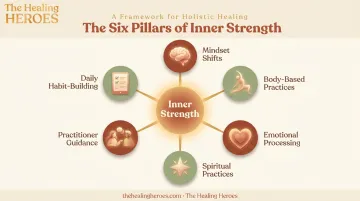
Inner strength isn't a personality trait you either have or don't. It's built, piece by piece, across several connected areas.
Mindset Shifts
Start with self-compassion instead of self-criticism. Journaling helps surface limiting beliefs you didn't know you were carrying, things like "I have to earn rest" or "Needing help means I've failed." Naming the belief is the first step to challenging it.
Body-Based Practices
Stress lives in the body, not just the mind. Somatic work, breathwork, and movement release tension that talk alone can't reach. Somatic therapist Moylan Ryan, featured on The Healing Heroes podcast, points to Aikido as a surprising trauma-informed tool. Its partner-based movement trains the nervous system to stay present and grounded instead of reactive—a skill that transfers well beyond the mat.
Emotional Processing
Endurance isn't the same as healing. Trauma-informed approaches like EMDR and talk therapy help untangle old pain instead of just managing around it. Licensed psychotherapist Jennifer Baumgold, a Healing Heroes guest and EMDR-certified clinician, works specifically with clients trying to move old trauma out of their nervous system rather than white-knuckling through it.
Spiritual and Intuitive Practices
Meditation, energy work, and astrology can reconnect you with your own inner voice. Astrologer Ophira Edut, resident astrologer for ELLE and a Healing Heroes guest, frames these tools as ways to understand patterns in your life rather than predict a fixed outcome.
Learning From Practitioners Across Disciplines
You don't need to pick one modality and hope it works. The Healing Heroes podcast structures conversations with practitioners across more than 50 healing approaches, from acupuncture to EMDR to intuitive coaching. Episodes use timestamped segments, so you can jump straight to the part relevant to your situation instead of listening to an hour of content hoping for one useful insight.
Daily Habit-Building
Small, repeated actions compound faster than big gestures. Accountability coach Bonnie Heim, another Healing Heroes guest, teaches clients to build three daily non-negotiable wins as a structured way to rebuild self-trust one day at a time. She also frames boundary-setting, saying no without guilt included, as a habit that protects the space for everything else to stick.
Empowering Quotes on Women's Inner Strength
Sometimes the right words at the right moment do more than any strategy. Here are a few worth keeping close:
- "I chose the second one. I decided to speak up." — Malala Yousafzai, Nobel Lecture, 2014
- "A time when we have to shed our fear and give hope to each other." — Wangari Maathai, Nobel Lecture, 2004
- "But still, like air, I'll rise." — Maya Angelou, And Still I Rise, 1978
- "Optimism is the faith that leads to achievement; nothing can be done without hope." — Helen Keller, Optimism, 1903
- "What I know for sure is that speaking your truth is the most powerful tool we all have." — Oprah Winfrey, 2018
- "Whatever we can't embrace with love, imprisons us." — Tara Brach, 2017
Pick one that matches whatever you're facing right now. Write it somewhere you'll actually see it: your mirror, your lock screen, the inside of your journal. Let it work as a daily reminder instead of a one-time read.
Frequently Asked Questions
What are examples of inner strength in women?
Everyday examples include setting a boundary without over-explaining, asking for help before burning out, and rebuilding routines after a setback like divorce or job loss. These small, consistent choices matter more than any single grand gesture.
What is the greatest strength of a woman?
There isn't one universal answer. Authenticity and self-awareness are frequently cited as unifying strengths, but which one feels most defining depends on the individual and her circumstances.
What are some quotes on women's inner strength?
Malala Yousafzai's "I decided to speak up" and Maya Angelou's "But still, like air, I'll rise" are two widely referenced examples. See the quotes section above for more options.
How can I build my inner strength as a woman?
Combine mindset work like journaling, body-based practices like breathwork, emotional processing through therapy or EMDR, and small daily habits like boundary-setting. Progress compounds when these areas work together rather than in isolation.
Is inner strength something you're born with, or can it be developed?
Some baseline resilience may be innate, but most inner strength is built over time through consistent practice and support systems. It's a skill, not a fixed trait you either have or lack.