Here's the thing: "holistic" simply means treating the whole person, body, mind, and spirit together. That idea didn't start with modern wellness culture. It's woven through Scripture from Genesis to Revelation.
This article walks through what the Bible actually says about whole-person healing, examines Jesus's own healing ministry, and offers a practical framework for discerning which modern practices fit within a Christian life.
Key Takeaways
- Scripture describes humans as integrated beings: body, soul, and spirit working together
- Jesus's healing ministry addressed illness, spiritual bondage, and social exclusion together
- Not every "holistic" practice is spiritually equal — origin and purpose both matter
- Discernment, prayer, and Scripture (not fear or blanket acceptance) should guide new wellness practices
What Is Holistic Healing, Really?
The word "holistic" comes from the Greek root holos, meaning "whole." Merriam-Webster credits the modern term to Jan Christian Smuts, who coined "holism" in the 1920s. But the concept of whole-person wellness predates the label by thousands of years.
Today's health researchers distinguish between a few related but distinct terms:
- Whole-person health: Addressing biological, behavioral, social, and spiritual factors together, not isolated symptoms
- Complementary approaches: Non-mainstream methods used alongside conventional medicine
- Alternative approaches: Non-mainstream methods used instead of conventional medicine
These get confused often, but they're not interchangeable: a nutrition plan and a Reiki session might both get labeled "holistic," yet they carry vastly different spiritual assumptions.
Why the Confusion Matters
Practices like nutrition counseling, herbal remedies, bodywork, meditation, and energy work all fall under one "holistic" umbrella. Their spiritual roots, though, range from neutral to deeply religious. That variance is exactly why discernment matters more than a blanket yes or no, and we'll build that framework later in this article.
What Does the Bible Say About Holistic Approaches?
Scripture has never treated humans as bodies to be repaired in isolation. From the earliest chapters of the Bible, people are presented as integrated beings, physically, emotionally, and spiritually connected. This idea of "wholeness" traces directly back to Scripture, long before any New Age movement claimed it.
The Whole Person in Scripture
The clearest articulation comes from Paul's closing prayer in 1 Thessalonians 5:23: "May your whole spirit, soul and body be kept blameless at the coming of our Lord Jesus Christ." Theologian David W. Chapman notes this reflects God's complete sanctifying work rather than a body-mind-spirit treatment model, but the language still affirms that all three dimensions matter to God.
Paul makes a related point in 1 Corinthians 6:19-20, describing believers' bodies as "temples of the Holy Spirit." The passage is technically an argument against sexual immorality, not a wellness manual. Still, it gives physical health genuine spiritual weight. Your body isn't incidental to your faith.
Natural & Physical Remedies Referenced in Scripture
Natural treatments show up throughout the biblical text:
- Oil for anointing the sick (James 5:14)
- Wine for Timothy's stomach troubles (1 Timothy 5:23)
- Leaves described as healing in Ezekiel's temple vision (Ezekiel 47:12)
- The balm of Gilead, a known remedy referenced in Jeremiah 8:22
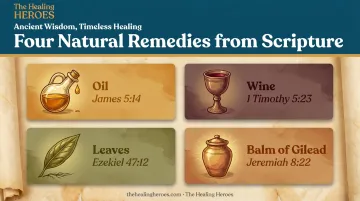
These references show natural, practical remedies were never foreign to biblical faith. God's people used what was available to care for their bodies.
Where Scripture Draws the Line
Not everything labeled holistic gets a biblical stamp of approval. Colossians 2:8 warns against being "taken captive through hollow and deceptive philosophy," meaning teaching that depends on human tradition rather than Christ. Deuteronomy 18:10-12 explicitly prohibits divination, sorcery, and consulting mediums.
Then there's the ongoing filter: 1 John 4:1 instructs believers to "test the spirits to see whether they are from God." This testing is an ongoing discipline meant to accompany every new practice a Christian considers, not a single checklist to complete once.
Was Jesus a Holistic Healer?
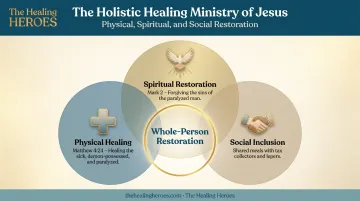
Calling Jesus a "holistic healer" is technically a modern label, since the term didn't exist until the 1920s. But His ministry in the Gospels, especially in Mark, models something close to whole-person care. He never separated physical restoration from spiritual and social renewal.
Healing the Body
Matthew 4:24 describes people bringing Jesus "all who were ill with various diseases, those suffering severe pain, the demon-possessed, those having seizures, and the paralyzed," and He healed them. Withered hands, leprosy, blindness, paralysis. His concern for literal physical suffering wasn't symbolic. It was concrete and immediate.
Healing the Soul and Spirit
Mark 2 pairs a physical healing with something deeper. When Jesus heals the paralyzed man lowered through a roof, He first says, "Son, your sins are forgiven," then tells him to get up and walk. Scholar Rodney Caruthers II notes the visible healing substantiates Jesus's authority to forgive, tying bodily restoration to spiritual reconciliation in a single act.
Jesus also cast out demons throughout the Gospels, addressing spiritual bondage that no physical remedy could touch.
Healing Community and Relationships
Jesus's healing extended beyond individual bodies into social restoration:
- Touching lepers, who were legally excluded from community life
- Dining with tax collectors, socially shunned for their profession
- Restoring dignity to marginalized women others refused to acknowledge
This wasn't incidental kindness. Grant MacAskill points to Jesus's meal with Levi and other social outcasts as fellowship deliberately extended to the shunned. It reflects the kingdom of God breaking into the present: God's original design for human flourishing, made available here and now.
Discerning Which Holistic Practices Align with Scripture
Not every holistic or alternative practice carries equal spiritual weight. Christians aren't called to reject everything wellness-related out of fear, nor to accept everything uncritically. Discernment is the actual assignment.
Ask About the Roots
Research where a practice originated:
- Yoga traces back to Hindu philosophical schools, particularly Samkhya, oriented toward a practical path of self-understanding
- Acupuncture developed within Traditional Chinese Medicine, drawing on qi theory alongside Daoist, Confucian, and other intellectual traditions
- Reiki originated in early 20th-century Japan, rooted in Mikao Usui's practice of channeling universal life energy through touch
Knowing the roots matters, but be careful of the genetic fallacy, dismissing something purely because of where it began. Origin informs the conversation. It doesn't end it on its own.
Ask About the Purpose
The more important question: what does this practice claim to accomplish spiritually? Does it invite reliance on God, or does it aim at emptying the mind, channeling unseen energies, or seeking union with something other than the Holy Spirit?
A stretching routine and a ritual invoking spiritual forces might look similar on the surface. Their purposes are not the same.
Compatible vs. Concerning Practices
| Generally Compatible | Often Flagged as Concerning |
|---|---|
| Massage and bodywork | Mediumship or spirit consultation |
| Stretching-based movement | Transcendental meditation |
| Nutrition counseling | Practices explicitly invoking spirits |
| Acupuncture used strictly as physical therapy | Chakra-based energy channeling |
This isn't an exhaustive or universally agreed-upon list. Romans 12:2 calls believers toward "the renewing of the mind," and that renewal, paired with prayer, should guide each Christian's personal conscience. Scripture doesn't issue a blanket verdict on every modern therapy. That's the work each believer has to do individually.
Is Energy Healing OK for Christians?
Energy healing modalities, Reiki, qi or chi work, chakra balancing, are grounded in Eastern spiritual frameworks rather than purely physical mechanisms. Reiki practitioners direct what NCCIH describes as universal energy through hand placement. Chakras, in Hindu and Tantric Buddhist traditions, are focal points where psychic forces and bodily functions interact.
Christians genuinely disagree here. The U.S. Conference of Catholic Bishops concluded in 2009 that Reiki lacks grounding in Christian revelation, substituting a manipulable universal energy for healing that should come through divine grace. Evangelical apologetics groups like the Christian Research Institute echo that concern.
Other voices take a different view. National Catholic Reporter has documented Christian practitioners, including some in Catholic retreat settings, who reframe Reiki through prayer to Jesus rather than impersonal energy. They describe it as an extension of Christ's healing ministry rather than a competing framework.
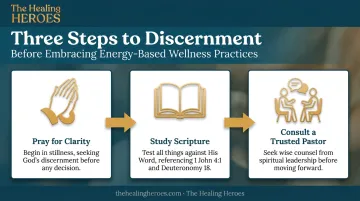
Given how divided this debate is, work through it deliberately:
- Pray for clarity before adopting any energy-based practice
- Study Scripture, particularly 1 John 4:1 and Deuteronomy 18
- Talk to a trusted pastor or spiritual mentor if you're uncertain
This tension isn't confined to personal decision-making, either. Pew Research found that 62% of American Christians hold at least one New Age belief, such as reincarnation, astrology, or spiritual energy in physical objects, showing just how blurred these lines have become in practice. That makes personal discernment more important, not less.
Finding Trustworthy Support for Your Healing Journey
Fear-based avoidance rarely leads to good discernment. Understanding a practice, its history, its claims, its actual mechanics, is usually the first real step toward deciding whether it belongs in your life.
That's the gap The Healing Heroes podcast, hosted by Chandler Stroud, was built to fill. The award-winning show features honest conversations with practitioners across disciplines. Guests have included:
- Jennifer Baumgold, LCSW, an EMDR therapist specializing in trauma treatment
- Jacques Depardieu, a nationally board-certified acupuncturist and herbalist
- Zach Carlsen, a Human Design coach exploring mind-body-spirit systems
Each conversation lets listeners hear a modality's background and reasoning explained directly by someone who practices it.
The format is intentionally exploratory rather than prescriptive. Guests explain what their modality is and why it works the way it does, giving listeners the context to make their own faith-informed decision rather than following a one-size-fits-all script.
Whatever practices you choose to explore, remember where your ultimate hope rests. Revelation 21:4 promises a day when pain and mourning will be no more. Every earthly healing practice, however helpful, is a shadow of that final restoration.
Frequently Asked Questions
What does the Bible say about holistic approaches?
Scripture consistently presents humans as body, soul, and spirit (1 Thessalonians 5:23) and affirms whole-person care. It also warns against practices rooted in deception or empty philosophy (Colossians 2:8).
Was Jesus a holistic healer?
Jesus's ministry addressed physical illness, spiritual bondage, and social exclusion simultaneously. The Gospels model whole-person healing long before the modern wellness movement coined the term.
Is energy healing ok for Christians?
Opinions vary widely due to energy healing's roots in Eastern spiritual frameworks. Praying for discernment, studying Scripture, and talking with a pastor can help guide that decision before participating.
Can Christians practice yoga or meditation?
This remains a debated gray area. Some Christians avoid it entirely because of Hindu origins, while others practice modified versions focused purely on stretching or Christ-centered prayer.
What Bible verses support taking care of the mind, body, and spirit together?
Key passages include 1 Thessalonians 5:23, 1 Corinthians 6:19-20, and 3 John 1:2, each affirming that physical, spiritual, and emotional wellbeing matter to God.
How do I know if a wellness practice conflicts with my Christian faith?
Examine the practice's roots and its stated purpose, then test it against Scripture and prayer. If it invites reliance on anything other than God, treat that as a red flag.