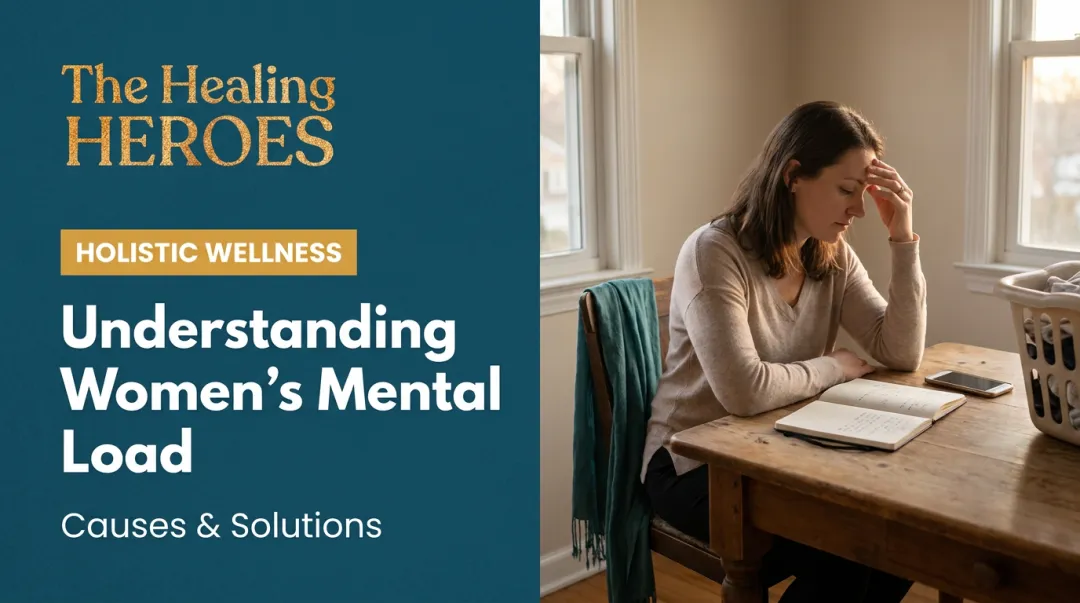

That quiet, constant mental tally has a name: the invisible workload. It's the unpaid, often unnoticed thinking and emotional management that keeps homes, relationships, and even offices running. And it lands on women far more often than on men, whether they're partnered, single, working full-time, or all three at once.
This article breaks down what invisible labor actually is, what it costs women in dollars and mental health, and what real rebalancing looks like. No vague affirmations. Just the research, the patterns, and practical steps toward carrying less alone.
Key Takeaways
- The invisible workload is unpaid mental, emotional, and logistical labor few people notice
- Women carry this load disproportionately, even in dual-income households
- Chronic invisible labor drives burnout, resentment, and physical stress
- Naming, auditing, and reassigning this labor can reduce the burden
What Is the Invisible Workload of Women?
The invisible workload, sometimes called the mental load, is the unpaid cognitive and emotional effort required to keep a household, relationship, or community functioning. It's not the dishes themselves. It's remembering the dishwasher needs a new filter, noticing you're low on detergent, and deciding whether the brand switch is worth the price difference.
The term went viral in 2017 through French cartoonist Emma's comic "You Should've Asked," which illustrated how one partner ends up managing the household and directing the other, rather than both people independently noticing what needs to happen. That comic gave a name to something millions of women already felt but couldn't quite articulate.
The Three Types of Invisible Labor
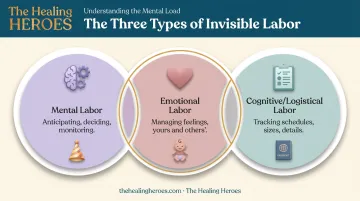
Researchers break invisible labor into three overlapping categories:
- Mental labor: Anticipating needs, weighing options, deciding, and monitoring outcomes, per sociologist Allison Daminger's four-step framework. Planning a birthday party, from guest list to RSVP follow-ups, fits this pattern.
- Emotional labor: Managing your own feelings while soothing everyone else's. Staying patient with an overtired toddler mid-meltdown, or smoothing over tension between siblings before it escalates, both fall here.
- Cognitive/logistical labor: Acting as the family's living database. Knowing everyone's shoe size, the pediatrician's cancellation policy, and which drawer holds the spare passport.
Where It Shows Up Most
At home, it's holiday planning, meal prep logistics, and remembering whose birthday needs a gift this month. At work, it's what Harvard Business Review calls "office housework" — the unglamorous tasks that keep a team functioning but rarely lead to promotion.
That includes:
- Organizing office celebrations and birthdays
- Onboarding or mentoring newer colleagues
- Taking notes in meetings nobody else wants to document
- Smoothing over team conflict before it reaches leadership
Adam Grant's reporting for the World Economic Forum notes that sociologist Rosabeth Moss Kanter observed women shouldering the majority of this administrative work, often without recognition or career benefit.
The Real Cost: How Much Is Women's Unpaid Labor Worth?
Unpaid labor isn't just tiring. It has a measurable dollar value, and that number is staggering.
These numbers turn the invisible into something concrete:
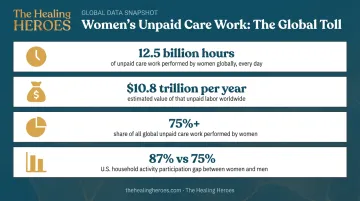
- Women and girls globally perform 12.5 billion hours of unpaid care work every single day, according to Oxfam.
- Valued at minimum wage, that work totals at least $10.8 trillion per year — more than three times the size of the global tech industry.
- Women and girls perform more than three-quarters of all unpaid care work worldwide.
- In the U.S., the American Time Use Survey shows 87% of women handle household activities daily (2.8 hours average) versus 75% of men (2.1 hours).
This gap doesn't disappear when both partners work full-time.
One of the most cited pieces of evidence comes from UCL's analysis of more than 8,500 UK couples, which found that less than 7% of couples shared housework equally. Even among dual-earner households, women still handled more of the domestic load, regardless of what either partner believed about fairness.
Why This Doesn't Show Up in GDP
Unpaid household labor is excluded from core GDP calculations. The OECD explains this is largely a measurement choice: this work happens outside of markets, making it hard to value consistently, and including it could complicate macroeconomic analysis.
Exclusion from GDP is an accounting decision, not proof the labor lacks value. It just means it's invisible in the numbers too.
The Career Connection
This unpaid load has real career consequences. The International Labour Organization found that unpaid care responsibilities kept 708 million women out of the labor force globally in 2024. Care was cited as the barrier for 45% of women outside the workforce, compared to just 5% of men.
Fewer hours available for paid work means less accumulated experience, slower wage growth, and fewer promotions over time. The invisible workload isn't separate from the gender pay gap. It's one of its quiet engines.
The Mental Health Toll of Invisible Labor
Carrying this weight doesn't just cost time. It costs health.
McKinsey and LeanIn.Org's 2022 Women in the Workplace research found that **43% of women leaders reported feeling burned out**, compared to 31% of men at the same level. That gap tracks closely with who's carrying the heavier invisible load at home and at work simultaneously.
Resentment and Relationship Strain
Here's the uncomfortable part: many couples genuinely believe in equal partnership while living something far less balanced. Daminger's interviews with college-educated couples found that partners espousing egalitarian values often described unequal task division as gender-neutral or incidental, rationalizing outcomes that didn't match their stated beliefs.
Separately, a 2025 study of over 2,700 partnered U.S. parents found that equal division of cognitive housework correlated with the highest relationship satisfaction for both mothers and fathers. Unequal invisible labor, in other words, is corrosive even when nobody's fighting about it.
Anxiety, Depression, and Loss of Self
A 2024–2025 study surveying 322 mothers of young children found that cognitive labor was divided more unevenly than physical tasks, and that imbalance was linked to higher depression, stress, burnout, and worse relationship functioning.
Beyond clinical symptoms, invisible labor quietly crowds out everything else:
- Hobbies get shelved indefinitely
- Rest feels impossible even when nothing's "due"
- Personal goals wait for a season that never quite arrives
The Body Keeps Score
Chronic mental overload doesn't stay in the mind. It shows up as tension, headaches, clenched jaws, and fatigue that sleep doesn't fix.
On The Healing Heroes podcast, somatic therapist and Rolfer Moylan Ryan talks about what he calls the "posture of protection" — the way the body physically braces itself in response to ongoing stress, long before someone consciously registers being overwhelmed.
His work with Rolfing and NeuroDynamic Breathwork centers on releasing that stored tension at the level of fascia and nervous system, not just talking it through.
Signs You're Carrying the Invisible Workload
Not sure if this applies to you? A few common signals:
- You're the default parent or partner everyone turns to for schedules, appointments, and "where is the thing"
- You feel guilty resting even when you're not physically busy, because your mind is still tracking everyone else's needs
- You mentally catalog other people's needs even on vacation, weekends, or supposed days off
If even one of these feels familiar, you're likely carrying more than your share, though it may never have been named out loud.
How to Rebalance and Heal from the Invisible Workload
Awareness alone doesn't fix an unequal load. Redistribution has to be deliberate.
Name and Audit the Labor
Write down every mental, emotional, and physical task involved in running your household. Eve Rodsky's Fair Play methodology identifies around 100 recurring responsibilities, from meal planning to holiday cards. Seeing it on paper is often the first time either partner realizes how much has been invisible.
Redistribute Full Ownership, Not Just Tasks
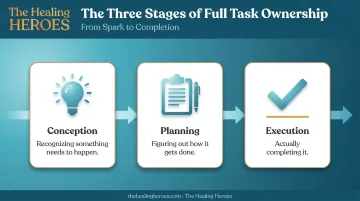
There's a difference between assigning a chore and truly handing it over. Fair Play defines full ownership as covering three stages:
- Conception: recognizing that something needs to happen
- Planning: figuring out how it will get done
- Execution: actually completing it
Handing someone a task without the planning and monitoring that surrounds it just adds a reminder to your own mental list.
Communicate With Direct Scripts and Seek Support
Vague requests breed more invisible labor, not less. Try language like:
- "I need you to own this from start to finish, including remembering when it's due."
- "You've got the dentist appointments now. I won't be tracking or reminding."
- "Let's split the mental list, not just the chore list, starting this week."
Redistributing tasks doesn't automatically dissolve years of built-up resentment, though. That part often benefits from guided conversation.
The Healing Heroes podcast features practitioners like psychotherapist Jennifer Baumgold, who works with trauma and relational patterns, and empowerment coach Cait DeMello, who focuses on boundaries and reclaiming personal energy. Both explore this same terrain: setting limits and letting go of what was never yours to carry alone.
Frequently Asked Questions
How much is women's unpaid labor worth?
Oxfam estimates women's unpaid care work globally is worth at least $10.8 trillion annually, with women performing over three-quarters of it. This labor is typically excluded from GDP because it happens outside formal markets, not because it lacks value.
What is invisible work that women do?
It includes mental labor (anticipating and planning tasks), emotional labor (managing feelings, your own and others'), and cognitive labor (tracking schedules, sizes, and logistics). A birthday party, a calmed-down toddler, and a remembered dentist appointment are everyday examples.
What is the invisible woman syndrome?
This is a related but distinct concept describing women, often in midlife, feeling socially overlooked or unseen in professional or public settings. It's about visibility and recognition, not the unpaid labor discussed here.
Is invisible labor the same thing as the mental load?
"Mental load" is often used interchangeably with cognitive labor specifically. Invisible labor is the broader umbrella term that also includes emotional labor, meaning managing feelings, not just logistics.
Can invisible labor affect relationships?
Yes. Research on couples who believe in equality but don't practice it shows this mismatch breeds quiet resentment and disconnection over time, even without open conflict.
How can couples fix the imbalance of invisible labor?
Start by auditing every task, then assign full ownership—the planning and follow-through, not just the final action. Direct communication about who owns what from start to finish matters more than good intentions alone.