Then it ended. The formal program wrapped up around 2019/2020, and a lot of people have quietly wondered ever since: is "personal progress" even still a thing without the workbook and the bishop interview?
Here's the short answer. The institutional program is gone, but the pursuit it represented, self-worth, integrity, purpose, hasn't disappeared. It's just found new homes in coaching, therapy, and holistic wellness spaces built for how young women actually grow today.
Key Takeaways
- Personal Progress ended in 2019/2020, replaced by the Children and Youth program
- The eight core values still address real needs young women face today
- Personal growth has moved from one standardized program to self-directed paths
- Podcasts, coaching, and expert-led content now fill much of the mentorship gap
- Young women can build a values-based growth journey without formal enrollment
What Was the Young Women Personal Progress Program?
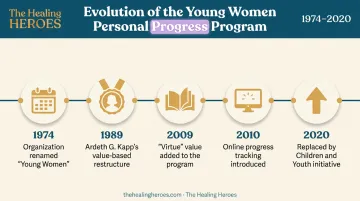
The roots go back further than most people realize. In 1974, the organization was renamed "Young Women" and introduced a development framework that eventually grew into "My Personal Progress."
Ardeth G. Kapp served as Young Women general president from 1984 to 1992. She led the redesign that reorganized the program around a defined set of values, launching the new structure in 1989.
By its final form, the program included eight values:
- Faith
- Divine Nature
- Individual Worth
- Knowledge
- Choice and Accountability
- Good Works
- Integrity
- Virtue (added in 2009)
The structure wasn't one single capstone project. For each of the first seven values, participants completed six value experiences (three required, three elective) plus a project requiring at least ten hours of personal effort. Virtue worked differently, requiring four experiences and a project centered on reading the Book of Mormon.
Completion led to the Young Womanhood Recognition Award: a certificate and medallion, granted after a worthiness interview with a bishop or branch president and often celebrated at Young Women in Excellence gatherings.
Tracking that progress got easier in 2010, when online tools replaced the paper record-keeping young women had used for decades.
The program's end came alongside a much bigger shift. Church leadership replaced Personal Progress with the global Children and Youth initiative on January 1, 2020. The new model is home-centered and simplified, covering spiritual, social, physical, and intellectual growth for both young women and young men. Scouting programs ended the same week.
Why the Program's Core Values Still Resonate Today
Retiring the program didn't retire the problems it was built to address. Adolescence still comes with identity questions, comparison, and pressure, far more intensely now than in 1989.
The numbers back this up. In the CDC's 2023 Youth Risk Behavior Survey, 52.6% of female high school students reported persistent sadness or hopelessness in the past year, compared with 27.7% of male students. That's more than half of teen girls in America.
Confidence takes a hit too. A 2024 Pew Research survey of U.S. teens found 20% of teen girls said social media hurt their confidence, versus 10% of boys. Meanwhile, 25% of girls said it hurt their mental health, versus 14% of boys.
Here's the thing: the old Personal Progress values map surprisingly well onto what these numbers point to.
| Old Value | Modern Equivalent Concern |
|---|---|
| Individual Worth | Self-esteem and identity clarity |
| Choice and Accountability | Boundary-setting, decision-making confidence |
| Integrity | Living aligned with personal values |
| Divine Nature | Sense of inherent worth, purpose |
So yes, personal progress is still a thing. It's just not delivered through one uniform church workbook anymore. Young women now chase the same outcomes, confidence, purpose, connection, through therapy, coaching, self-directed wellness work, or community support instead of a single institutional path.
Modern Tools and Paths for Personal Growth
Growth today doesn't come from a checklist. It comes from a mix of tools young women assemble themselves, often guided by practitioners rather than handbooks.
Mindset Coaching and Confidence Work
Instead of a fixed value project, many young women now work with coaches on mindset, boundaries, and self-advocacy. On The Healing Heroes podcast, accountability coach Bonnie Heim talks openly about the fear of disappointing others and the power of saying no, themes that echo "choice and accountability" almost directly.
Human Design, Astrology, and Identity Frameworks
Where "divine nature" and "individual worth" once got explored through scripture study, plenty of young women now turn to frameworks like Human Design and astrology to understand who they are. Zach Carlsen, a Human Design coach featured on The Healing Heroes, describes the system as "a modern science containing ancient systems for exploring the nature of being." He's used it on the podcast to help people work through imposter syndrome and career uncertainty.
Astrologer Ophira Edut, ELLE's longtime resident astrologer, offers a similar lens through her I*AM System, which breaks a birth chart into three simplified archetypes.
Trauma-Informed and Somatic Practices
Where the old program addressed resilience through good works and accountability, EMDR and somatic therapy now do a lot of that work directly. These modalities help process the anxiety and identity struggles the CDC data points to, not through willpower alone, but through the nervous system.
Podcasts like The Healing Heroes function as a bridge between these worlds, connecting listeners with real practitioners across dozens of disciplines through direct conversation. No enrollment, no ward boundaries, no membership required. Just a podcast episode whenever you need it.
How to Build Your Own Personal Progress Journey Today
You don't need a bishop interview to start. You need structure, and a way to track it.
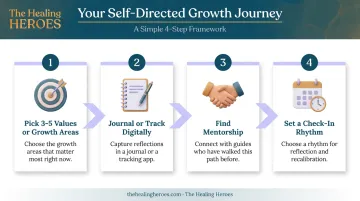
- Pick 3-5 values or growth areas that matter to you right now, such as self-worth, boundaries, purpose, or whatever feels most alive
- Journal or track digitally using an app or a simple notes doc, the modern stand-in for the old handbook
- Find mentorship somewhere, whether that's a coach, a therapist, or curated content like podcast interviews with practitioners in the area you're working on
- Set a check-in rhythm, weekly or monthly, so growth doesn't stall out after week one
For more structured support, options like Mindset & Accountability Consulting (delivered virtually through messaging and video check-ins) or a one-on-one Private Consultation, priced around $250 per hour, offer the kind of individualized guidance that a ward leader once provided. The format has changed. The need for real mentorship hasn't.
Frequently Asked Questions
Is personal progress still a thing?
The formal LDS program ended in 2019/2020, but personal growth and values-based development are very much alive. Today it happens through coaching, journaling, and holistic wellness resources instead of one standardized workbook.
What replaced the Young Women Personal Progress program?
The Church launched its Children and Youth initiative on January 1, 2020, replacing Personal Progress for young women and Scouting for young men with one unified, home-centered program.
What were the core values of the Personal Progress program?
Faith, Divine Nature, Individual Worth, Knowledge, Choice and Accountability, Good Works, Integrity, and Virtue (added in 2009).
How can young women pursue personal growth today outside of a formal program?
Young women can pursue growth through self-directed goal setting, journaling, coaching, and resources like wellness podcasts or workshops that offer mentorship without formal enrollment.
What was the Young Womanhood Recognition Award?
It was a certificate and medallion awarded after completing all eight values and a bishop interview, comparable in spirit to Eagle Scout or Duty to God recognition.
Why did the Church discontinue Personal Progress?
It moved toward a simplified, home-centered, globally consistent youth program better suited to a diverse, worldwide membership than one Young Women-specific track.