
Introduction
Bubble baths and scented candles feel nice. They rarely touch what's actually driving your stress.
Many people lean on fragmented self-care: one yoga class, a spa day, a scroll through a meditation app. It offers temporary relief, then the tension creeps back because the underlying pattern never changed.
In 2022, 18.2% of U.S. adults reported anxiety symptoms and 21.4% reported depression symptoms, according to CDC survey data. Single-dimension coping wasn't built to handle numbers like that.
This article covers seven holistic approaches spanning mind, body, and spirit, the same range of modalities explored in depth on The Healing Heroes podcast. Combining these approaches, rather than relying on just one, is what creates lasting change.
TL;DR
- Self-care links mind, body, and spirit, not isolated checkboxes
- The 7 approaches span movement, breathwork, and spiritual reflection
- Personalization and consistency beat chasing every wellness trend
- These practices complement, not replace, professional mental health care
What Is Holistic Self-Care & Why It Matters
What Is Holistic Self-Care?
Holistic self-care means treating your physical, mental, emotional, and spiritual health as interconnected systems, not isolated problems to fix one at a time.
Conventional self-care usually targets a single symptom in the moment. A candle relaxes your senses. A bath eases sore muscles. Both are pleasant, but the relief rarely outlasts the evening.
Holistic self-care works differently. It assumes the body, mind, and spirit influence each other constantly:
- Regulating your nervous system through movement can sharpen mental clarity
- Processing emotion through journaling can ease physical tension
- Spiritual reflection can reduce the anxious mental chatter that keeps you up at night
Improve one dimension, and the others tend to shift too. That's the underlying logic driving practices like somatic work, Rolfing, and breathwork.
Why It Matters for Mental Health
Stress isn't rare anymore. It's the baseline for a lot of people.
Women in particular report carrying more of this load. The American Psychological Association found women's average stress rated 5.3 out of 10, compared to 4.8 for men, with 27% of women rating their stress between 8 and 10.
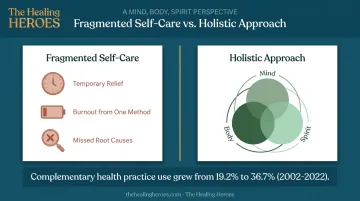
What typically goes wrong with fragmented self-care:
- Temporary relief without resilience. A massage feels good for a day, then old stress patterns return.
- Burnout from over-relying on one method. Meditation alone can't process unresolved trauma; yoga alone can't replace social support.
- Missed root causes. Surface fixes soothe symptoms without touching what's actually driving them.
There's also a growing openness to blending traditional therapy with complementary approaches. According to NIH's National Center for Complementary and Integrative Health, use of at least one complementary health practice among U.S. adults nearly doubled between 2002 and 2022, jumping from 19.2% to 36.7%. People aren't abandoning conventional mental health care. They're building fuller pictures around it.
7 Holistic Approaches to Mental Health & Wellness
Holistic mental wellness isn't one practice. It's a combination of approaches that each support a different dimension of the self, ranging from clinically-backed methods to complementary modalities explored in depth through expert conversations, like those featured on The Healing Heroes podcast.
Mind-Body Movement (Yoga, Tai Chi & Somatic Work)
Mind-body movement combines physical motion, breath, and body awareness to regulate the nervous system and release stored tension. Somatic therapist and certified Rolfer Moylan Ryan describes this as moving beyond talk therapy into the body itself, where a lot of stress actually lives.
The evidence backs this up. A meta-analysis of 12 trials found tai chi produced a large reduction in depressive symptoms among middle-aged and older adults, with an effect size of -1.21 compared to usual care. Results varied a lot between studies, so treat this as a strong signal, not a guaranteed outcome for every person.
Simple entry point: Try a 10-minute yoga flow, or take a short walk while consciously noticing your feet, breath, and posture. No mat required.
Breathwork & Nervous System Regulation
Breathwork uses controlled breathing patterns, like box breathing or alternate-nostril breathing, to shift your body out of a stress response and into calm.
Slow breathing (generally under 10 breaths per minute) is linked to higher heart-rate variability, a marker associated with parasympathetic nervous system activation. This isn't a new idea. Acupuncturist and 30-year Qigong teacher Jacques Depardieu roots his work in this same principle: regulated breath as medicine, drawn from centuries of traditional Chinese practice.
Try it now — box breathing:
- Inhale for 4 counts
- Hold for 4 counts
- Exhale for 4 counts
- Hold for 4 counts
- Repeat for 4-5 rounds
Energy & Sound Healing
Energy and sound healing includes practices like Reiki, sound baths, and vibrational therapy, aimed at releasing energetic blocks and inducing deep relaxation.
Sound healing practitioner Nicole Kim uses crystal bowls, gongs, and tuning forks to create resonant frequencies she describes as moving energy "like waves in a lake." Research here is still emerging. The NIH calls music-based intervention findings preliminary, and reviews of binaural beats show inconsistent results across studies. Treat this modality as complementary, not clinical.
Accessible starting points:
- A guided sound healing session (in-person tends to feel more immersive than an app)
- Binaural beat recordings during a wind-down routine at home
- A short recording of tuning forks or a singing bowl before bed
Nature-Based Therapies (Forest Bathing & Grounding)
Nature-based therapy means intentional time outdoors, from forest bathing to grounding (walking barefoot on natural surfaces), to lower stress hormones and lift mood.
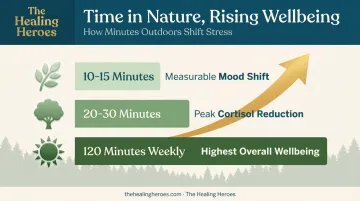
The data is compelling. Adults who spent at least 120 minutes a week in nature reported higher wellbeing than those with no nature contact at all, according to research published in Scientific Reports. You don't need a weekend retreat to benefit, either.
Even 10-15 minutes outdoors can produce a measurable shift. One field study found cortisol dropped most efficiently during 20-30 minute nature breaks. A short walk between meetings counts, and so does eating lunch on a bench instead of at your desk.
Creative Expression & Reflective Journaling
Creative expression uses art, writing, music, or reflective tools to process emotion and access intuition that talk alone doesn't always reach.
Why this matters: verbal processing has limits. Trauma and stuck emotion often live in nonverbal, sensory memory. Creative outlets bypass the analytical brain and let feeling move through a different channel entirely.
Starting habit:
- 5 minutes of free journaling each morning, no editing, no rereading
- 5 minutes of free drawing, doodling counts
- Or a 2-minute voice memo, spoken instead of written, works just as well
Consistency matters more than skill here, not perfection. The point isn't the output; it's the release.
Trauma-Informed Healing (Therapy, EMDR & Somatic Release)
Trauma-informed healing includes structured therapeutic approaches like EMDR (Eye Movement Desensitization and Reprocessing) and trauma-informed talk therapy, both addressing root causes of chronic stress and dysregulation.
This approach is different from the others on this list. It requires trained, licensed guidance rather than self-directed practice.
Licensed clinical social worker Jennifer Baumgold, an EMDR-certified psychotherapist who has supported FDNY first responders through trauma recovery, works within an eight-phase protocol that includes careful preparation and closure at every session. EMDR guidelines explicitly prohibit self-administration.
Signs it's time to seek a licensed therapist:
- Intrusive memories or flashbacks disrupt daily functioning
- Self-care practices provide only brief, shallow relief
- Anxiety or depression symptoms persist or worsen over weeks
Spiritual & Intuitive Practices (Astrology, Human Design & Reflection)
Spiritual and intuitive practices, including astrology, Human Design, tarot, and psychic guidance, offer frameworks for self-understanding and meaning-making.
Human Design coach Zach Carlsen uses BodyGraph readings to help clients move away from pure pro-and-con-list decision-making toward their own internal "authority." Tarot coach Cait DeMello frames her readings as a mirror for the subconscious rather than fortune-telling. Astrologer Ophira Edut brings a similar reflective lens to birth chart work.
Important clarification: these tools are for self-reflection and personal insight, not medical or psychological diagnosis. In-depth conversations with practitioners, like those on The Healing Heroes podcast, can help you figure out which of these modalities actually resonates with you before committing time or money to one.
How to Choose the Right Approaches for You
The "right" combination depends on your personal needs and goals, not what's trending on social media or what worked for your coworker.
Factors to weigh:
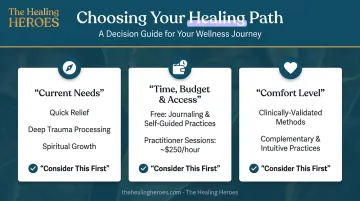
- Current needs: Are you looking for quick stress relief, deeper trauma processing, or spiritual growth? Each points toward different modalities.
- Time, budget, and access: Journaling and grounding are free and immediate. Practitioner-led sessions, like private consultations (often around $250 per hour), require more investment.
- Comfort level: Some people gravitate toward clinically-validated methods like yoga or EMDR, while others prefer complementary work like sound healing or astrology. Both are valid starting points.
Start small. Pick one or two practices rather than overhauling your entire routine overnight. A 10-minute morning walk plus five minutes of journaling will outperform a complicated seven-practice regimen you abandon by week two.
What to Avoid When Building a Holistic Self-Care Routine
A few missteps derail holistic self-care before it has a chance to work.
- Treating alternative practices as replacements. Sound baths and astrology add value, but don't replace treatment for trauma, depression, or suicidal thoughts, which need licensed support.
- Chasing novelty instead of consistency. Trying five modalities in a month, then quitting each after one session, won't reveal what works. Give a practice several weeks first.
- Comparing your routine to someone else's. Self-care is bio-individual. What regulates your friend's nervous system might do nothing for yours, and that's fine.
Conclusion
Holistic self-care treats mind, body, and spirit as connected systems, not isolated fixes you check off a list. Each of these seven approaches offers a different entry point: physical, psychological, emotional, or spiritual.
Combining a few thoughtfully tends to outperform relying on just one. Start with what feels accessible today, then build from there. If a particular modality resonates, exploring expert-led resources like The Healing Heroes podcast can help you go deeper before deciding what belongs in your routine long-term.
Frequently Asked Questions
What is holistic self-care?
Holistic self-care addresses physical, mental, emotional, and spiritual needs as interconnected parts of overall wellbeing, rather than treating each dimension separately. This means addressing sleep, movement, emotions, and sense of purpose together, since each one affects the others.
What are the 7 pillars of self-care?
This article covers movement, breathwork, energy and sound work, nature-based therapies, creative expression, trauma-informed healing, and spiritual reflection. Together, they address the body, nervous system, emotions, and spirit.
How do I take care of myself emotionally?
Start with daily journaling to process feelings, set clear boundaries in relationships, and lean on a therapist or trusted community when things feel heavier than usual. Small, consistent habits matter more than occasional big gestures.
Is holistic self-care backed by scientific research?
Some practices, like movement, nature exposure, and breathwork, have solid research support. Others, like energy work and astrology, remain experiential and complementary rather than clinically validated.
Can holistic self-care replace therapy or medication?
No. Holistic practices complement professional mental health treatment but shouldn't replace therapy or medication when those are clinically necessary. If symptoms are severe or persistent, prioritize professional care first and use holistic practices to support that treatment.
How often should I practice self-care for it to work?
Consistency beats intensity. Five minutes of daily breathwork or journaling will do more for you than one long session every few weeks. Aim for small, repeatable habits.