
That gap between doing all the right things and feeling aligned isn't usually about circumstance. It's about the internal mindset underneath the actions. Two women can have nearly identical resources and end up in completely different places, simply because one has built a different relationship with fear, failure, and her own worth.
This guide breaks down the core mindset shifts, daily habits, and common blocks that separate women who feel stuck from women who feel like they're actually living their lives. No fluff, just the patterns that show up again and again.
Key Takeaways
- A dream-living mindset rests on self-belief, growth, resilience, identity, and boundaries, not luck
- Daily practices like journaling and intention-setting outlast one-time motivation
- Limiting beliefs around gender and self-worth are the most common , most reframable blocks
- Mindset work is an ongoing practice, and community plus expert guidance speeds it up
What Does "Living Your Dream" Actually Mean?
Forget the fixed endpoint. It's not a job title or a relationship status. It's not a number in your bank account, either. Living your dream is an ongoing state of alignment between what you value, how you act, and what you actually want, not a finish line you cross once and check off forever.
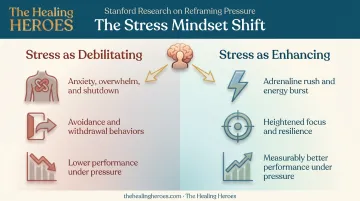
This isn't just feel-good language. Research on mindset backs it up. Stanford psychologist Alia Crum's work on stress beliefs found that what people expect about their own capabilities directly shapes their physiological and behavioral responses to challenge.
In her studies, participants who viewed stress as enhancing rather than debilitating performed measurably better under pressure.
That's not a promise that belief alone rewrites your circumstances. But it does mean your internal framing changes how you show up and how you recover when things go sideways, including the risks you're willing to take.
A few things this rules out:
- Living your dream isn't reserved for the "naturally confident." Confidence is a skill, not a personality trait you were born with or without
- It doesn't require the absence of hardship, just a different relationship to it
- It's not static. Alignment shifts as you grow, so the work never fully stops
The Core Mindsets of Women Living Their Dreams
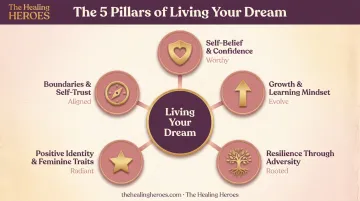
Five interconnected mindset shifts show up consistently among women who describe feeling fulfilled and in control of their direction. None of them work in isolation. Miss one, and the others get harder to sustain.
Self-Belief & Unshakable Confidence
Self-belief is the foundation. Without it, even great opportunities get quietly sabotaged: the pitch never gets sent, the boundary never gets set, the promotion never gets asked for.
Confidence coaches often describe this as "reclaiming your inner authority" rather than chasing outside validation. Business empowerment coach Cait DeMello, who works with entrepreneurial women, frames it as helping clients "stand unshakable in their worth" and "return home to the power that resides within them," rather than teaching new skills. The confidence was already there, buried under conditioning.
A practical marker: you know you're operating from self-belief when decisions come from your own values instead of a need for approval. If you find yourself asking "what will people think?" before "what do I actually want?", that's worth noticing.
Growth & Learning Mindset
A growth mindset treats setbacks as data, not verdicts on your identity. A fixed mindset treats a single failure as proof of who you are.
The research here is well established. In a two-year study of seventh-graders, students who believed intelligence could develop showed rising math grades over time, while those with a fixed mindset plateaued. A separate intervention reversed a declining grade trend simply by teaching students that ability grows with effort.
Applied to real life:
- A rejected pitch isn't proof your idea was bad: it's information about timing, audience, or delivery
- A failed relationship isn't proof you're unlovable: it's data about compatibility and what you need next time
- A missed deadline isn't proof you're incapable: it's a signal to adjust your systems or ask for support
Mindset coach Katie Wee, founder of Happy Camp, puts it plainly on her episode of The Healing Heroes: small challenges "are not a hindrance to your success path, they are the success path." That reframe alone changes what you do next.
Resilience Through Adversity
Resilience isn't the absence of hardship. It's the practiced ability to recover and keep moving after loss, trauma, or a major setback. The word "practiced" matters here, because resilience is trainable.
A 2020 meta-analysis of 268 studies and over 1,500 samples found resilience-focused interventions produced a meaningful average improvement (Hedges' g = 0.48) in participants' capacity to cope with adversity. Results varied widely, so it's not a guarantee. But the direction is clear: structured practice measurably strengthens this capacity.
Trauma therapist Jennifer Baumgold, LCSW, who specializes in EMDR, describes her work with clients as helping them "carry their past without being controlled by it," rather than erasing what happened. That distinction, between transformation and elimination, is the core of what resilience actually looks like in practice.
Positive Identity & Owning Feminine Traits
Many women unconsciously carry a "gender is negative" mindset, treating traits like intuition, empathy, and collaboration as liabilities to overcome in professional or personal settings. The shift is learning to see those same traits as assets.
Not every woman shares identical strengths, and that's fine. The goal is refusing to apologize for the ones you do have. Women who report feeling most aligned tend to stop performing a version of leadership or success that was never built for them, and instead lead from what actually comes naturally.
What this looks like in practice:
- Trusting a gut read on a decision instead of overriding it with pure logic
- Building collaborative relationships instead of treating every interaction as competition
- Naming empathy as a strength on a resume or in a negotiation, not something to downplay
Boundaries, Alignment & Self-Trust
Boundaries protect the time and energy a dream actually requires. Without them, that energy leaks into obligations that were never yours to carry.
Self-trust develops through following through on commitments you make to yourself, even small ones. Human Design coach Zach Carlsen works with clients on recognizing their body's own decision-making signals: expansion and excitement read as a "yes," while contraction reads as a "no." Learning this signal helps separate a fear-based choice from a genuinely desired one.
Cait DeMello uses a similar somatic approach, teaching clients to lean into a feeling in the body rather than suppress it. This speeds up how quickly clarity actually arrives.
A simple filter for any decision: if fear weren't a factor, what would I choose?
Daily Habits That Reinforce a Dream-Living Mindset
Mindset shifts don't stick from a single breakthrough. They stick from repetition. These are the habits that show up most often among women actively living aligned lives.
- Morning intention-setting or visualization — Priming your mind before email, texts, and other people's opinions flood in changes the entire tone of the day
- Journaling or "wins tracking" — Writing down small wins counters the brain's natural negativity bias, and research shows measurable mood improvements from minutes of nightly reflection
- Body-based regulation — Breathwork, movement, or sound healing calm the nervous system so mindset work has somewhere to land; a dysregulated body defaults to fear regardless of effort
- Community and expert guidance — Surrounding yourself with people further along the path accelerates everything. The Healing Heroes podcast's expert interviews on trauma healing and energy work make abstract concepts relatable
- Weekly or monthly reflection — Regular check-ins recalibrate direction and reveal the progress that's easy to miss day-to-day
None of these habits require an hour a day. Five minutes of consistent practice outperforms an occasional two-hour deep dive every time.
Common Mindset Blocks That Keep Women Stuck
Three patterns come up again and again, often disguised as virtues.
Perfectionism and fear of failure. Research distinguishes between perfectionistic strivings (high personal standards) and perfectionistic concerns (fear of mistakes, harsh self-judgment).
Across 43 studies, perfectionistic concerns showed a strong link to burnout, while ambitious standards alone did not. The real problem is the fear driving those standards, not the desire to excel.
People-pleasing and weak boundaries. Saying yes to protect other people's comfort drains the exact energy your own goals need. This pattern often masquerades as being "easy to work with" or "low-maintenance," when really it's a boundary problem wearing a nicer label.
Internalized gender conditioning. The belief that you have to "prove yourself twice as hard" reflects real, documented double standards in how competence gets evaluated.
But internalizing that pressure as a permanent personal requirement, rather than naming it as an external bias to push back against, keeps women stuck in overwork without corresponding reward.
Naming these patterns out loud is usually the first real crack in their grip.
How to Begin Shifting Your Mindset Today
Start smaller than feels productive.
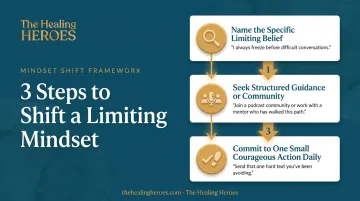
- Name the specific limiting belief running in the background. Not a vague "I'm not confident," but the actual sentence: "I have to be perfect before I show up" or "If I set this boundary, they'll leave."
- Seek structured guidance or community. Listening to expert-led conversations, like Katie Wee's episode on breaking limiting beliefs on The Healing Heroes, gives you language and frameworks other people have already tested.
- Commit to one small, courageous action daily. Don't wait for total clarity. Send the email before you feel ready. Say no once. Clarity tends to show up after the action, not before it.
If you want more personalized support, structured options exist too, from digital mindset and accountability partnerships to one-on-one private consultations for working through exactly where you feel stuck. You don't need to have this figured out alone or do it flawlessly. One small step today is enough.
Frequently Asked Questions
What is a strong woman's mindset?
It's the combination of self-belief, resilience, and clear boundaries that lets a woman act from her own values instead of fear or outside pressure. You develop it through repeated practice, much like any other skill.
How to be respected as a woman?
Respect follows consistent boundary-setting, demonstrated competence, and authentic self-expression. It builds through action over time, the same way trust does.
What's the difference between a growth mindset and a positive mindset?
A growth mindset treats setbacks as information to learn from, while a positive mindset reframes your traits and circumstances as assets rather than liabilities. The two overlap but aren't the same thing.
Can mindset alone help someone achieve their dreams?
Mindset shapes action and resilience, but it works best paired with concrete goals, real skills, and support systems. Belief without a plan rarely gets you very far on its own.
How long does it take to shift a limiting mindset?
Initial awareness can shift almost instantly once you name the belief. Lasting change usually takes weeks or months of consistent practice.
What daily habits build a "living your dream" mindset?
Intention-setting, journaling or wins-tracking, body-based regulation like breathwork, and community support form the core habits. Consistency matters more than intensity.