

That constant, invisible tracking has a name: the mental load. It's the cognitive and emotional labor of noticing what needs to happen, planning how it'll happen, and making sure it actually happens, often while everyone around you assumes things just take care of themselves.
Understanding why this load lands disproportionately on women isn't just an academic exercise. It's the first real step toward lightening it, both for your own well-being and for the health of your relationships. This article breaks down where the mental load comes from, what it does to your body and mind when left unchecked, and practical, holistic ways to start rebalancing it.
Key Takeaways
- The mental load is invisible planning work rooted in social conditioning, not biology
- Left unmanaged, it contributes to burnout, anxiety, sleep problems, and strained relationships
- Making the load visible and redistributing full task ownership, not just "helping," works best
- Lasting change requires ongoing communication, structural support, and self-care, not a one-time conversation
Common Causes of Women's Mental Load
Before fixing something, it helps to know what it actually is. The mental load is the invisible work of anticipating, planning, deciding, and monitoring tasks for a household or family.
It's different from doing the dishes or driving carpool. You can hand someone a chore list, but you can't as easily hand someone the constant mental awareness of what needs to happen next.
This imbalance doesn't come from nowhere. It's built from a mix of social conditioning, policy gaps, and workplace norms that quietly push women into the role of household manager.
Gender Stereotypes and Socialization
Many of us grew up absorbing the idea that women are simply better at caretaking and organizing. Sociologists call this the "myth of women's work," and it's learned, not innate.
- Girls are often given caretaking roles early (watching younger siblings, planning family gatherings)
- Boys are less frequently taught the same anticipatory skills
- These early patterns follow people directly into adult partnerships, where women default into the planner role without anyone explicitly deciding it that way
The Invisible, Boundaryless Nature of the Work
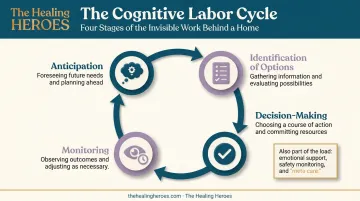
Sociologist Allison Daminger's research breaks cognitive labor into four stages: anticipation, identification of options, decision-making, and monitoring. Her study, based on 70 interviews across 35 couples, found something striking.
Men and women shared decision-making fairly equally. Women, however, carried far more of the anticipation and monitoring, the parts of the work that never really end (Daminger, American Sociological Review, 2019).
Other researchers have expanded the categories further, including life organization, emotional support, safety monitoring, "magic-making" (holidays, traditions), and meta-care, meaning the work of managing everyone else's mental load, too. Unlike laundry, none of this has a clear finish line, which makes it nearly impossible to divide evenly or hand off cleanly.
Unequal Parental Leave and Workplace Policies
This lack of a finish line often starts even earlier, with how parental leave policy sets the tone from day one. When mothers take significantly more leave after a birth than fathers, they become the default household manager almost by accident, and that role tends to stick.
Census data illustrates the gap in practice: about half of first-time mothers used paid parental leave within 12 weeks of giving birth, compared with just one-third of first-time fathers (U.S. Census Bureau, 2025). That gap persists even when leave is technically available to both parents.
That early asymmetry sets up who becomes the go-to parent for school forms, pediatrician calls, and daycare logistics for years afterward.
The Motherhood Penalty vs. Fatherhood Bonus
Here's where things get frustrating. Women often face career setbacks after having children, while men frequently see the opposite.
A peer-reviewed analysis using long-term U.S. labor data found an adjusted motherhood penalty of roughly 5% per child, alongside a fatherhood premium of about 4% to 5% (Demography, 2021). Nearly half of that motherhood penalty was tied to occupational shifts, women moving into lower-paying, more flexible roles to accommodate caregiving demands that, once again, fall disproportionately on them.
What Happens When the Mental Load Goes Unchecked
Carrying an unmanaged mental load isn't just tiring. Over time, it functions like chronic caregiver stress, and the body keeps score.
Common consequences include:
- Depression and anxiety — Studies of mothers with young children link greater cognitive household labor to higher rates of depressive symptoms and perceived stress
- Sleep disruption — Racing thoughts about tomorrow's logistics make it hard to fall asleep or stay asleep
- "Mommy brain" moments — Difficulty concentrating or forgetting things isn't a personal failing; it's what chronic mental overload does to attention and working memory
- Tension headaches — Chronic stress is a common trigger for both headaches and migraines
- Unhealthy coping mechanisms — Increased reliance on alcohol or other substances to manage overwhelm

The ripple effects extend outward, too. Relationships strain under quiet resentment, and career growth stalls when one partner is too mentally overtaxed to pursue new opportunities.
Warning Signs You May Be Nearing Mental Load Burnout
- You feel drained even after a full night's sleep or a weekend "off"
- You feel immediate guilt when spending time or money on yourself, even for small things
- Your mind keeps running task lists during moments meant for rest, like watching a movie or lying in bed
If several of these sound familiar, treat that as real data, not just a rough patch.
How to Prevent and Reduce Mental Load Overload
Solutions here work best as a combination of individual habits and relationship-level shifts. Neither alone fixes the imbalance long-term.
Measure 1: Make the Invisible Work Visible
Sit down together and write out every planning and anticipating task, not just physical chores. Include things like remembering birthdays, tracking school deadlines, and noticing when the pantry is running low. Do this before resentment builds, not after.
Measure 2: Redistribute Responsibility, Not Just Tasks
There's a real difference between "helping with" school communication and fully owning it. Assign complete domains, not partial ones. A short handover conversation, similar to a workplace project handoff, works well during transitions like returning from parental leave.
Measure 3: Advocate for Structural and Workplace Support
Push for flexible scheduling and paid parental leave for both partners at your workplace. Keep raising it as workplace policies and needs shift, not just once.
Measure 4: Prioritize Emotional Support and Self-Care
Guilt-free personal time is maintenance, not an occasional treat. Many women struggle to invest in themselves without justification, which is exactly the pattern worth interrupting.
Holistic, mind-body-spirit resources can help here. The Healing Heroes podcast, for instance, has explored stillness and somatic practices like yoga nidra and yin yoga as tangible tools for women stuck in constant "go mode."
Practitioners like Nicole Kim (yoga and sound healing) and Cait DeMello (embodiment coaching) work directly with clients on reconnecting with themselves after long stretches of overwhelm.
Measure 5: Seek Professional Support When Needed
Persistent anxiety, burnout, or relationship strain tied to mental load imbalance is worth bringing to a professional. Trauma-informed and somatic approaches can be especially useful because chronic overload often lives in the body, not just the mind.
- EMDR with a practitioner like Jennifer Baumgold, LCSW, can help process the deeper stress patterns behind chronic overload
- Myofascial release, offered by Karen Remele, targets physical tension stored in connective tissue
- Aikido and Rolfing, taught by Moylan Ryan, build body awareness and nervous system regulation for those who need more than talk therapy
If you're not sure where to start, a one-on-one consultation ($250/hour) can help map out which combination of approaches fits your specific situation, rather than guessing.

Tips for Long-Term Balance and Shared Responsibility
Fixing mental load imbalance once won't keep it fixed forever. As circumstances shift—new jobs, new kids, new stressors—the division of labor needs to shift too.
- Schedule regular check-ins to reassess who's managing what as circumstances shift
- Teach children, especially boys, care and organizational skills early to interrupt the generational pattern
- Use shared digital calendars and task apps so planning knowledge doesn't live in one person's head
- Normalize talking about mental load openly at work and with friends to reduce the isolation around it
Conclusion
The mental load isn't a personal failing or a sign you're not organized enough. It has clear social and structural roots, from childhood conditioning to workplace policy gaps to how parenthood affects pay differently by gender.
Awareness is the starting point, but it isn't the finish line. Start redistributing full ownership of tasks and pushing for structural support. Then give yourself permission to rest and heal, whether through therapy, somatic work, or an honest conversation. These shifts can lighten what you carry over time.
Frequently Asked Questions
What is the "mental load" in relationships?
It's the invisible cognitive and emotional labor of planning, anticipating, and managing responsibilities for a household. It's distinct from physically completing tasks like cooking or cleaning.
Why do women carry more mental load than men?
A mix of gender socialization, unequal parental leave policies, and workplace norms tends to position women as the default household manager from early in a relationship or after having children.
What are the signs of mental load burnout?
Persistent exhaustion even after rest, guilt around spending time or money on yourself, and constant task-related rumination during moments meant for relaxation are all common warning signs.
Can men experience mental load too?
Yes, men can and do carry mental load. Research consistently shows, however, that women shoulder more of it on average, particularly the anticipation and monitoring stages.
How can couples share the mental load more fairly?
Start by making all the invisible tasks visible, then assign full ownership of specific domains rather than just "helping." Regular check-ins keep the division fair as life changes.
Does mental load affect physical health?
Yes. Unmanaged mental load can trigger sleep disruption, tension headaches, memory and concentration issues, and a higher risk of anxiety and depression.