
That gap between "doing well" and "feeling whole" is exactly what holistic coaching addresses. Instead of isolating one goal, like a promotion or a race time, it looks at the whole person: mind, body, emotions, and spirit, all at once.
This guide breaks down what holistic coaching actually means, how it differs from therapy and traditional coaching, the techniques practitioners use, and how to figure out if it's the right fit for where you are right now.
Key Takeaways
- Holistic coaching treats mind, body, emotions, and spirit as one connected system
- It's client-led and future-focused, not clinical therapy or advice-driven mentoring
- Techniques blend mindfulness, movement, breathwork, and energy-based practices together
- Progress builds gradually, so coach fit matters more than chasing a "perfect" method
What Is Holistic Coaching?
Holistic coaching comes from the Greek word "holos," meaning whole. It's a partnership between coach and client that treats mental, emotional, physical, and spiritual growth as interconnected, not as separate projects to tackle one at a time.
The National Board for Health & Wellness Coaching describes wellness this way too, noting in its scope of practice guidelines that physical, psychological, emotional, social, and spiritual factors all shape a person's overall well-being. That's the foundation holistic coaching builds on.
A holistic coach isn't there to hand you a plan. They act as a facilitator, someone who asks the right questions and helps you access your own insight, rather than directing you toward their answer. The work centers on you.
How Holistic Coaching Differs From Mentoring, Consulting, Therapy & Traditional Coaching
These terms get used interchangeably, but they're not the same:
- Mentoring relies on a more experienced person sharing personal advice and lessons learned
- Consulting is expert-led: a consultant diagnoses your problem and prescribes a fix
- Therapy focuses on healing diagnosed mental health conditions, often rooted in past experiences
- Traditional or niche coaching (career, executive, fitness) zeroes in on one specific outcome
The International Coaching Federation defines coaching as a partnership that treats the client as the source of their own choices and solutions, not someone waiting for expert instruction. Holistic coaching follows that same client-led, future-oriented model. The difference is scope: it widens the lens to include emotional, physical, and spiritual dimensions together, rather than optimizing one lane in isolation.
Core Principles of Holistic Coaching
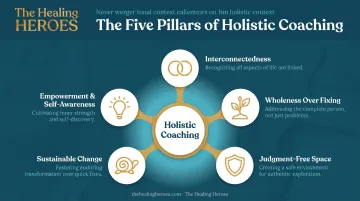
Every approach has an underlying philosophy, and holistic coaching rests on five principles that shape how sessions actually unfold:
- Interconnectedness – Your sleep affects your mood, which affects your relationships. Change one area, and the ripple hits the rest.
- Wholeness over "fixing" – You're not treated as broken; the coach's job is helping you access capacity you already have.
- Judgment-free space – Real change requires psychological safety first; without it, people perform instead of process.
- Sustainable change over quick wins – A crash diet gives you a number; holistic coaching builds habits that actually hold.
- Empowerment and self-awareness – Coaches guide you toward your own answers instead of prescribing theirs, which builds confidence that outlasts the coaching relationship itself.
Notice what's missing from that list: a fixed curriculum. That's intentional: the principles guide the how, not a rigid script.
Techniques & Healing Modalities Used in Holistic Coaching
Holistic coaches rarely rely on one tool. They tend to pull from several disciplines depending on what a client needs in a given season.
Mental and Emotional Techniques
These build self-awareness and help manage day-to-day stress:
- Mindfulness and present-moment awareness practices
- Journaling or expressive writing to process difficult experiences
- Affirmations and reflective dialogue
- Structured trauma-processing approaches like EMDR
Research on these practices is mixed. The NCCIH notes that mindfulness studies vary widely in quality, and some participants report increased anxiety rather than relief. No single technique works the same way for everyone.
Physical Techniques
The body holds tension long after the mind has "moved on." Physical techniques address that directly:
- Movement therapies and somatic practices
- Breathwork for nervous system regulation
- Bodywork, such as myofascial release or Rolfing
- Sound healing, using vibration from tools like singing bowls to shift the body into a more relaxed state
Spiritual and Energetic Techniques
This is where holistic coaching leans into purpose and meaning, not just symptom relief:
- Meditation and ritual practice
- Energy work
- Belief-based frameworks like astrology or Human Design
The common thread across all three categories is blending. A holistic coach might pair breathwork with journaling, or Human Design with mindset coaching, rather than staking everything on one modality.
This multidisciplinary approach is exactly what The Healing Heroes podcast digs into, with long-form conversations featuring practitioners across EMDR, energy healing, acupuncture, and Human Design. Listeners hear how each modality actually works before deciding what resonates with them.
Benefits of Holistic Coaching
Addressing the whole person, instead of one isolated goal, tends to produce effects that spill into areas you weren't even focused on.
Clients often report:
- Greater self-awareness and more balanced emotional responses
- Stronger, more honest relationships
- Improved physical vitality and energy
- Better resilience under stress
These benefits aren't just anecdotal. Clinical research on holistic approaches is still developing, but the closest available data backs it up. A systematic review of 30 studies covering 8,662 participants found health and wellness coaching improved quality of life at three months, with a meaningful effect (standardized mean difference of 0.62). Self-efficacy also improved by the six-week mark.
That review focused on defined wellness coaching, primarily in people managing chronic illness, so it doesn't prove an exact percentage for holistic coaching specifically. Still, it supports something holistic coaches have argued for years: whole-person approaches move the needle in ways single-issue interventions often miss.
Who Is Holistic Coaching For & How to Find the Right Coach
Holistic coaching tends to resonate most with people who feel stuck rather than in crisis:
- You've hit your career or fitness goals but still feel unfulfilled
- You're navigating a major life transition, like a divorce, career pivot, or loss
- You sense your health, relationships, and spirituality are pulling in different directions
- You're burned out despite "doing everything right"
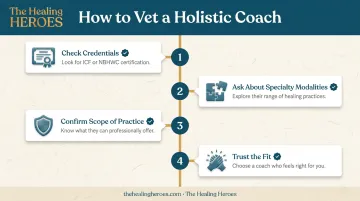
If that sounds familiar, here's how to vet a coach before committing:
- Check credentials. Look for training through recognized bodies like the ICF (ACC, PCC, or MCC levels) or NBHWC certification.
- Ask about their specialty modalities. A coach trained in somatic work and Human Design will run sessions very differently than one focused on mindset and accountability.
- Confirm scope of practice. A coach should refer out for anything requiring diagnosis or clinical treatment, not attempt to cover it themselves.
- Trust the fit, not just the resume. Values alignment matters as much as credentials.
Not ready to commit to a coach yet? Exploring different philosophies first can help. Listening to episodes of The Healing Heroes podcast lets you hear practitioners explain their approach in their own words.
It's a low-pressure way to figure out which modality or coaching style actually feels right before you invest in a private session.
Frequently Asked Questions
What is a holistic approach to coaching?
It means treating mind, body, emotions, and spirit as interconnected, rather than coaching one isolated area like career or fitness. Change in one dimension is expected to affect the others.
What are the four types of coaching?
Common niches include life, health and wellness, career, and executive coaching. Holistic coaching differs by integrating aspects of all four instead of specializing in just one.
How is holistic coaching different from therapy?
Therapy addresses diagnosed mental health conditions and often works through past trauma with a licensed clinician. Holistic coaching is future-focused and centers on personal growth, not clinical treatment.
Do I need a certification to become a holistic coach?
Certification isn't universally required by law, but training through bodies like the ICF or NBHWC adds credibility and hands-on skill. Always check your specific state or country's regulations.
How long does it take to see results from holistic coaching?
Timelines vary by client and goal, but holistic coaching prioritizes sustainable change over quick fixes. Most people notice meaningful shifts over several months, not days.
Is holistic coaching backed by research or evidence?
Coaching as a whole is less clinically studied than therapy, but many underlying practices, including mindfulness, movement, and journaling, have real research support for improving well-being.